We have a brand new updated website! Click here to check it out!

Kansas Prison Health Contractor Piling Up Penalties For Poor Performance

Corizon Health, based in Tennessee, has a $68.8 million contract with Kansas to provide health care for state prisons. The company received reduced payments last year because it did not provide enough staff and did not meet compliance standards.
MICHAEL COGHLAN / CREATIVE COMMONS-FLICKR

The company hired to provide health care in Kansas prisons is getting paid millions less than its contracted amount after failing to meet the agreement’s terms.

State officials reduced payments to Corizon Health because the company failed to hire enough nurses and other health workers. Corizon lost additional money after audits found it fell short of performance standards for a range of medical services.

Now, the Kansas Department of Corrections says the contractor has one more year to look after the health of 10,000 people in its prisons.

The department’s executive finance director, Keith Bradshaw, told lawmakers this month that for now, his agency intends to renew its contract with Corizon for only a year — rather than the two-year option included in the original contract.

“If things continue to improve, we’ll go ahead and pick up that second year,” Bradshaw said. “If we continue to have issues, then we’ll look at doing a rebid.”

The state currently has a $68.8 million contract with Corizon. Kansas penalized the company $534,880 for not meeting performance standards in 2018.

The state also cut $2.82 million from its payments to Corizon because the company didn’t deliver an agreed-upon number of employees and work hours last year. 

Documents provided by the Kansas Department of Corrections show thousands of hours of missing work each month, due to unfilled jobs for nurses, behavioral health professionals and other medical staff.

Corizon currently faces 22 federal lawsuits regarding the care it provides to people in Kansas prisons. Complaints include inmates being refused medication and care for conditions such as hepatitis C. The state first awarded a contract to the company in January 2014.

The University of Kansas Medical Center audits Corizon’s performance for the state corrections department. KU Med tracks medical services such as intake health assessments, sick calls and group therapy and passes the information to the department. The state can deduct money from its payments to Corizon if the company does not meet performance standards.

According to an agreement provided by the Department of Corrections, the state penalizes Corizon $100 per incident when the company falls below 90 percent compliance with any of its 12 performance standards.

That penalty increases if the company doesn’t fix the problem within six months. It goes up again if the company doesn’t meet compliance standards in subsequent months.

Specialty services — X-rays, dermatology, chemotherapy, and obstetric and gynecological services — are penalized at a higher rate.

If the company doesn’t meet 90 percent compliance for those services, the state imposes a penalty of $300 per instance, with higher penalties the longer the problems persist.

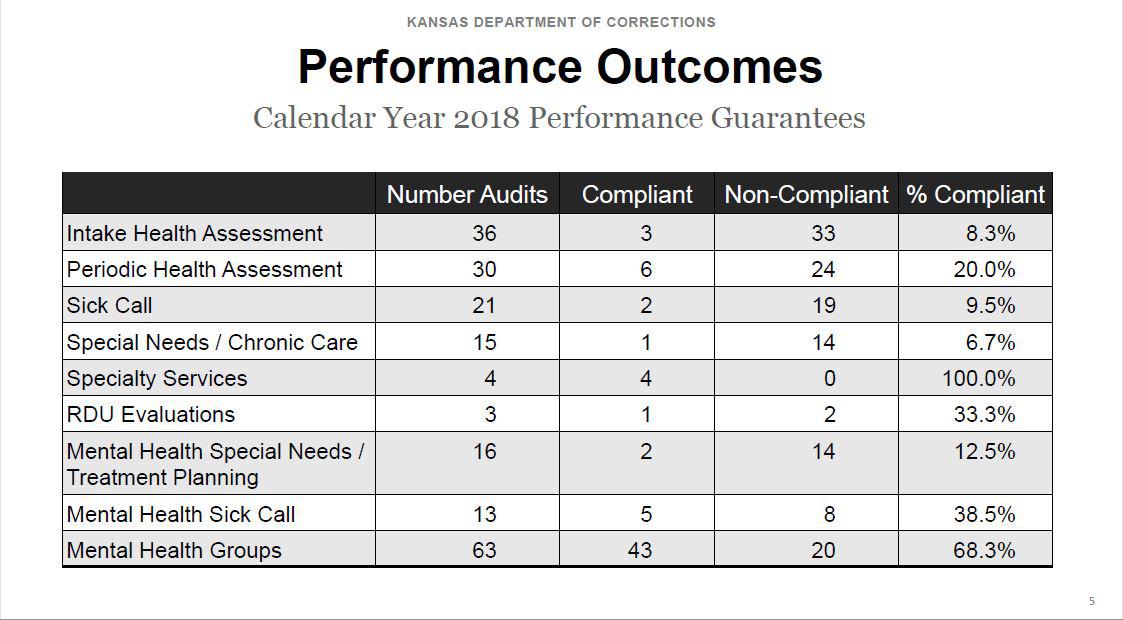
In 2018, KU Med audited nine out of 12 performance standards. Out of those nine standards, Corizon was found to be 100 percent compliant on only one: specialty services. The company’s compliance rates for the other standards were well below the threshold of 90 percent.

Mental health groups, defined as group therapy and workshops on topics such as anger and addiction, were found to be nearly 70 percent compliant. But other services that were audited, including sick calls, intake health assessments and chronic care for conditions like diabetes and HIV, were compliant at rates of less than 10 percent.
 
CREDIT KANSAS DEPARTMENT OF CORRECTIONS

At a presentation at the Kansas Capitol this month, state officials said the audits reviewed a small sample of the total number of medical services and do not accurately represent the overall quality of inmate health care. 

Bradshaw told lawmakers there were too few workers to conduct extensive evaluations for all 12 performance standards.

Much like its shortage of corrections officers, the state’s prisons also face a shortage of health care workers. It relies heavily on overtime and asking administrators to cover shifts.

Bradshaw said the state was having trouble hiring, despite offering signing bonuses of up to $7,000 for registered nurses and $10,000 for psychologists.

“Corizon is also facing the impact of low unemployment rates throughout the state,” he said, “as well as competition in the highly competitive health care industry.”

Documents provided by the Department of Corrections show that wages for nurses, psychologists and other health professionals working in Kansas prisons are similar to average and entry-level wages for those jobs throughout the state.

Registered nurses working for Corizon in Kansas make $25 an hour. On average, registered nurses in Kansas make an hourly wage of $28. Corizon pays dental assistants $15 an hour, while statewide average pay for the same job is $16.86 an hour. Behavioral health professionals working for Kansas prisons make $24 an hour, while average hourly wages for various mental health and counseling jobs in Kansas range between $16 and $24 an hour.

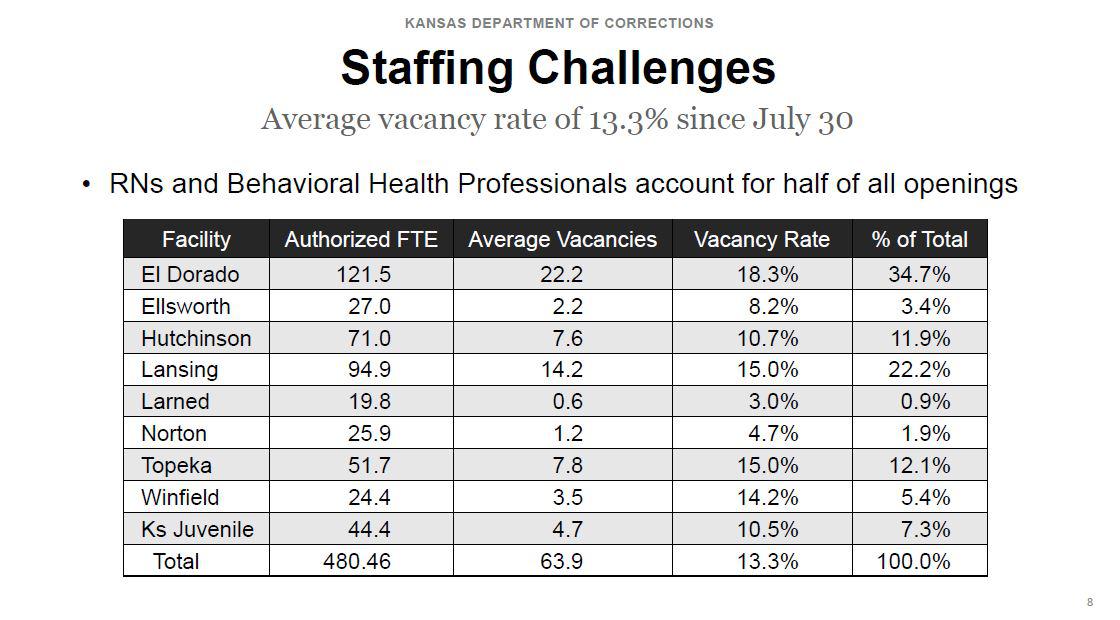
Registered nurses and behavioral health professionals comprise half of all health-related job openings, Bradshaw said.
 
CREDIT KANSAS DEPARTMENT OF CORRECTIONS

Inmates’ health needs can also be time-consuming for corrections officers, who must accompany inmates to expensive off-site medical appointments in pairs. Bradshaw said those appointments often add to officers’ overtime shifts and to vehicle costs.

“With the small staff that we have and the size of this contract and the services being provided,” Bradshaw said, “it’s not realistic to expect every facility and every outcome to be looked at every month.”

Bradshaw said the state didn’t penalize Corizon for noncompliance from June 2017 to December 2017 because the state was moving inmates between facilities and didn’t want to blame the company for any performance issues during that period.

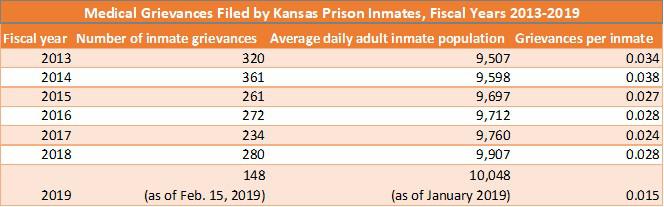
In an interview, he said a better measure of health care quality was the number of medical grievances filed by inmates. 

“We’re actually seeing that trend going down, while at the same time the population’s going up,” he said. “I think we have to look at it more holistically.”

People incarcerated in Kansas prisons can file a written grievance with their prison’s warden if medical issues aren’t addressed within 10 days. If the issue is still not resolved, the next step is an appeal to the secretary of corrections, Roger Werholtz.
 
CREDIT NOMIN UJIYEDIIN / KANSAS NEWS SERVICE

David Tatarsky, director of health services at the Department of Corrections, said KU Med frequently fielded calls from inmates, their family members and prison staff.  He said those complaints and concerns informed where and when KU Med conducts audits of Corizon’s work.

Tatarsky told lawmakers that staff needed to be selective.  “We look for trends. We try to get the most bang for our buck,” he said.  “We try and focus where we think the need is greatest.”

In an emailed statement, Corizon spokeswoman Eve Hutcherson said the company was evaluating information from the state.

“We take all requirements very seriously in our mission to provide exceptional care to the patients we serve as the DOC’s partner,” she said. “Corizon remains committed as a strong partner with Kansas Department of Corrections and the patients we serve.”

Nomin Ujiyediin is a reporter for the Kansas News Service. You can reach her on Twitter @NominUJ.

Missouri investigation: No proof Hawley misused resources

JEFFERSON CITY, Mo. (AP) — Missouri Secretary of State Jay Ashcroft says his office didn’t find evidence to back up allegations that U.S. Sen. Josh Hawley misused public resources while serving as Missouri’s attorney general.

Senator Hawley

Ashcroft announced that he’s closing the investigation Thursday.

Ashcroft launched the investigation against fellow Republican Hawley following a complaint by the liberal group American Democracy Legal Fund.

The group alleged in November that Hawley misused state resources because political consultants directed taxpayer-paid staff in the Attorney General’s Office to emphasize policies that could help his Senate campaign.

Those consultants later worked for Hawley’s successful bid to unseat former Democratic Sen. Claire McCaskill.

But Ashcroft says the consultants were used to further Hawley’s priorities as attorney general. He says no evidence shows they were used to promote him as a candidate.

Sunny skies expected with temps in the 20s

Cold temperatures will again be the concern today with temperatures this morning starting in the teens and only rising into the 20s this afternoon. This will be nearly 25 degrees below normal. Accumulating snow is looking more likely as we get into the Saturday night to Sunday time period. Here’s the 7-day forecast from the National Weather Service:

Today: Mostly cloudy, then gradually becoming sunny, with a high near 25. North northeast wind around 5 mph becoming calm in the morning.

Tonight: Partly cloudy, with a low around 16. Calm wind.

Friday: Partly sunny, with a high near 39. Light and variable wind.

Friday Night: Mostly cloudy, with a low around 18. West northwest wind 5 to 10 mph becoming north after midnight.

Saturday: Mostly cloudy, with a high near 27. North northeast wind 8 to 10 mph.

Saturday Night: Snow, mainly after 7 p.m. The snow could be heavy at times. Low around 11. Chance of precipitation is 90%.

Sunday: Snow, mainly before 1 p.m. The snow could be heavy at times. High near 12. Chance of precipitation is 90%.

Sunday Night: Partly cloudy, with a low around -5.

Monday: Sunny and cold, with a high near 12.

Monday Night: Mostly clear, with a low around 1.

Tuesday: Mostly sunny, with a high near 20.

Tuesday Night: Mostly clear, with a low around 9.

Wednesday: Sunny, with a high near 33.

Southwest Missouri woman charged after baby burned in bath tub

LAKE OZARK, Mo. (AP) — A 25-year-old southwest Missouri woman is jailed after her 6-month-old daughter suffered severe burns in a bathtub.

Austin photo MIller Co. Sheriff

Elizabeth Austin, of Lake Ozark, was charged after the girl was flown Sunday to a Kansas hospital with burns from her waist to her head. The child is on a ventilator at the University of Kansas hospital.

Court records show say Austin told officers she left the baby in baby’s tub while she tried to control her 4-year-old child.

Investigators say Austin claimed her 2-year-old daughter pushed the baby’s tub under running water and turned the hot water on.

Austin is charged with two counts of first-degree child endangerment and felony drug possession. Bond was set at $100,000.

Online court records don’t name an attorney for Austin.

Missouri House passes wide-ranging abortion restrictions

JEFFERSON CITY, Mo. (AP) — The Missouri House on Wednesday took steps to outlaw most abortions in the state should the U.S. Supreme Court overturn Roe v. Wade, an effort that’s part of a broader Republican push amid renewed optimism that the high court might be more open to increased restrictions, and possibly an outright ban, on the procedure.

The wide-ranging legislation includes other measures that would take effect even if the high court doesn’t overturn its 1973 ruling establishing the nationwide right to abortion. Among the restrictions is a ban on most abortions after a fetal heartbeat is detected, possibly as early as six weeks into a pregnancy. Similar bans in Arkansas, Iowa and North Dakota in recent years have been struck down by courts.

Abortion opponents across the U.S. have been emboldened by President Donald Trump’s appointment of conservative Supreme Court Justices Neil Gorsuch and Brett Kavanaugh, while abortion-rights activists are working to protect the procedure in states where Democrats hold power.

“I am proud that Missouri, the Show-Me State, is showing the rest of the country that we will stick up for the unborn, those precious little children that have no one else to speak for them,” Republican Rep. Sonya Anderson told colleagues on the House floor.

But supporters of abortion rights said the bill goes too far.

“There’s been no combination of such draconian laws and measures,” said Democratic Rep. Cora Faith Walker, adding that she’s “terrified” of the bill.

Missouri’s bill, which includes a so-called trigger ban that would take effect if the high court overturns Roe v. Wade, includes exceptions only for medical emergencies and not for rape or incest. Doctors who violate the law would face a felony charge. Arkansas, Louisiana, Mississippi, North Dakota and South Dakota also have abortion bans that would kick in if Roe v. Wade falls.

Efforts to pass bills limiting abortions after a fetal heartbeat is detected are underway in states including Florida, Kentucky, Ohio, South Caroline and Tennessee. The Missouri bill started out with such a ban, and Republicans loaded it up with a number of other restrictions, including a ban on abortions based on race, sex or an indication of Down syndrome, and a requirement that both parents be notified before a minor receives an abortion, with some exceptions.

Farm loan delinquencies highest in 9 years as prices slump

By ROXANA HEGEMAN

WICHITA, Kan. (AP) — The nation’s farmers are struggling to pay back loans after years of low crop prices and export markets hit by President Donald Trump’s tariffs, with a key government program showing the highest default rate in at least nine years.

Many agricultural loans come due around Jan. 1, in part to give producers enough time to sell crops and livestock and to give them more flexibility in timing interest payments for tax filing purposes.

“It is beginning to become a serious situation nationwide at least in the grain crops — those that produce corn, soybeans, wheat,” said Allen Featherstone, head of the Department of Agricultural Economics at Kansas State University.

While the federal government shutdown delayed reporting, January figures show an overall rise in delinquencies for those producers with direct loans from the Agriculture Department’s Farm Service Agency.

Nationwide, 19.4 percent of FSA direct loans were delinquent in January, compared to 16.5 percent for the same month a year ago, said David Schemm, executive director of the Farm Service Agency in Kansas. During the past nine years, the agency’s January delinquency rate hit a high of 18.8 percent in 2011 and fell to a low of 16.1 percent when crop prices were significantly better in 2015.

While those FSA direct loan delinquencies are high, the agency is a lender of last resort for riskier agricultural borrowers who don’t qualify for commercial loans. Its delinquency rates typically drop in subsequent months as more farmers pay off overdue notes and refinance debt.

With today’s low crop prices, it takes high yields to mitigate some of the losses and even a normal harvest or a crop failure could devastate a farm’s bottom line. The high delinquency rates are caused by back-to-back years of low prices, with those producers who are in more financial trouble being ones who also had low yields, Featherstone said.

The situation now is not as bad as the farm credit crisis of the 1980s — a time of high interest rates and falling land prices that was marked by widespread farm foreclosures. At the height of that crisis in 1987, U.S. farmers filed 5,788 Chapter 12 bankruptcies. There were 498 in 2018.

Some fears are also surfacing in reports such as one this month from the Federal Reserve Bank of Minneapolis, which said the outlook is pessimisticfor the start of this year with respondents predicting a further decline in farm income. About 36 percent of farm lenders who responded said they had a lower rate of loan repayment from a year earlier.

Tom Giessel said he borrowed some operating money from his local bank last year and paid it off. Giessel, who raises wheat and corn on some 2,500 acres in western Kansas, said the only thing that kept the farm economy afloat in his area was that people had pretty good fall crop yields. Giessel, 66, said he had once gotten to the point where he didn’t have to borrow his working capital and had a relatively new set of equipment, but he has had to borrow money for the last three years just to put in a crop.

“A lot of people are in denial about what is going on, but reality is going to set in or has set in already,” Giessel said.

The February survey of rural bankers in parts of 10 Plains and Western states showed that nearly two-thirds of banks in the region raised loan collateral requirements on fears of a weakening farm income. The Rural Mainstreet survey showed nearly one-third of banks reported they rejected more farm loan applications for that reason.

Grain prices are down because farmers around the world have had above-average production for several years. But some nations’ economies are not doing as well, decreasing demand for those crops, Featherstone said. Grain prices peaked in 2012 and prices have roughly fallen 36 percent since then for soybeans, 50 percent for corn and 48 percent for wheat.

When Trump imposed tariffs, China retaliated by stopping soybean purchases, closing the biggest U.S. market. While trade negotiations with Chinacontinue, many farmers fear it will take years for markets to recover — as it did when President Jimmy Carter imposed a grain embargo on the then-Soviet Union in 1980.

“The tariffs Trump is messing around with are not helpful at all — I don’t think anybody knows the true effect,” said Steve Morris, who farms near Hugoton in southwest Kansas.

Morris, who has been cutting back acreage in an effort to avoid borrowing money, said drought conditions last year in his area devastated his wheat yields. Trump has offered farmers subsidies to compensate for the tariffs but they are based on harvested bushels. Morris, 73, received a subsidy payment last year for his wheat crop of only $268.

Many farmers are now scrambling to borrow money as spring planting nears.

Matt Ubel, a 36-year-old Kansas farmer who bought out his parents’ farm in December 2016, said they have not been delinquent on their FSA loans, but acknowledged the payment was “a challenge to make last year.”

“We have had trouble for several years getting operating loans,” he said. “This year doesn’t look any better.”

A key factor in whether farmers receive loans is the value of their land.

Farmland values in parts of the Midwest and Plains regionslargely held steady at the end of last year, according to the Federal Reserve Bank of Kansas City. But slightly higher interest rates and an uptick in the pace of farmland sales in states with higher concentrations of crop production could drive those land values down, it said.

“The big key in terms of whether or not we enter a financial crisis would be what would happen to land values,” Featherstone said. “So far land values have gradually declined, so that has kind of prevented us from maybe entering a situation like we did in the 1980s.”

No deal: Trump, Kim high-stakes summit ends early

HANOI, Vietnam (AP) — The nuclear summit between President Donald Trump and North Korea’s Kim Jong Un collapsed Thursday after the two sides failed to reach a deal due to a standoff over U.S. sanctions on the reclusive nation, a dispiriting end to high-stakes meetings meant to disarm a global threat.

Trump, in a news conference after the summit abruptly shut down early, blamed the breakdown on North Korea’s insistence that all punishing sanctions that the U.S. has imposed on Pyongyang be lifted without the country committing to eliminate its nuclear arsenal.

“Sometimes you have to walk,” Trump explained, adding that he had a proposed agreement that was “ready to be signed.”

“I’d much rather do it right than do it fast,” the president said. “We’re in position to do something very special.”

Mere hours after both nations seemed hopeful of a deal, Trump’s and Kim’s motorcades roared away from the downtown Hanoi summit site within minutes of each other, the leaders’ lunch canceled and a signing ceremony scuttled. The president’s closing news conference was hurriedly moved up and he departed for Washington more than two hours ahead of schedule.

The disintegration of talks came after Trump and Kim had appeared to be ready to inch toward normalizing relations between their still technically-warring nations and as the American leader tamped down expectations that their negotiations would yield an agreement by North Korea to take concrete steps toward ending its nuclear program.

In something of a role reversal, Trump had deliberately ratcheted down some of the pressure on Pyongyang, abandoning his fiery rhetoric and declaring he wanted the “right deal” over a rushed agreement. For his part, Kim, when asked whether he was ready to denuclearize, said “If I’m not willing to do that I won’t be here right now.”

The breakdown denied Trump a much-needed victory amid growing domestic turmoil back home, including congressional testimony this week by his former personal lawyer Michael Cohen, who called Trump a “racist” and “conman” and claimed prior knowledge of foreign powers’ efforts to help Trump win in 2016.

Trump insisted his relations with Kim remained warm, but did not commit to having a third summit with the North Korean leader, saying a possible next meeting “may not be for a long time.” Though both he and Secretary of State Mike Pompeo said significant progress had been made in Hanoi, the two sides appeared to be galaxies apart on an agreement that would live up to the U.S.’ stated goals.

“Basically, they wanted the sanctions lifted in their entirety, and we couldn’t do that,” Trump told reporters. Kim, he explained, appeared willing to close his country’s main nuclear facility, the Yongbyon Nuclear Scientific Research Center, if the sanctions were lifted. But that would leave him with missiles, warheads and weapon systems, Pompeo said. There are also suspected hidden nuclear fuel production sites around the country.

“We couldn’t quite get there today,” Pompeo said, minimizing what seemed to be a chasm between the two sides.

Longstanding U.S. policy has insisted that U.S. sanctions on North Korea would not be lifted until that country committed to, if not concluded, complete, verifiable and irreversible denuclearization. Trump declined to restate that goal Thursday, insisting he wanted flexibility in talks with Kim. “I don’t want to put myself in that position from the standpoint of negotiation,” he said.

White House aides stressed that Trump stood strong and some observers evoked the 1987 Reykjavík summit between Ronald Reagan and the Soviet Union’s Mikhail Gorbachev, a meeting over nuclear weapons that ended without a deal but laid the groundwork for a future agreement.

But the failure in Hanoi also laid bare a risk in Trump’s negotiating style: Preferring one-on-one meetings with his foreign counterparts, his administration often eschews the staff-level work done in advance to assure a deal and makes summits more of a victory lap than a hardline negotiation.

The collapse was a dramatic turnaround from the optimism that surrounded the talks after the leaders’ dinner Wednesday and that had prompted the White House to list a signing ceremony on Trump’s official schedule for Thursday.

The two leaders had seemed to find a point of agreement when Kim, who fielded questions from American journalists for the first time, was asked if the U.S. may open a liaison office in North Korea. Trump declared it “not a bad idea” and Kim called it “welcomable.” Such an office would mark the first U.S. presence in North Korea.

But questions persisted throughout the summit, including whether Kim was willing to make valuable concessions, what Trump would demand in the face of rising domestic turmoil and whether the meeting could yield far more concrete results than the leaders’ first summit, a meeting in Singapore less than a year ago that was long on dramatic imagery but short on tangible results.

There had long been skepticism that Kim would be willing to give away the weapons his nation had spent decades developing and Pyongyang felt ensured its survival. But even after the summit ended, Trump praised Kim’s commitment to continue a moratorium on missile testing.

Trump also said he believed the autocrat’s claim that he had nothing to do with the 2017 death of Otto Warmbier, a American college student who died after being held in a North Korean prison.

“I don’t believe that he would have allowed that to happen,” Trump said. “He felt badly about it.”

The declaration immediately called to mind other moments when Trump chose to believe autocrats over his own intelligence agencies, including siding with the Saudi royal family regarding the death of journalist Jamal Khashoggi and supporting Russia’s Vladimir Putin’s denials that he interfered with the 2016 election.

If the first Trump-Kim summit gave the reclusive nation’s leader entree onto the international stage, the second appeared to grant him the legitimacy his family has long desired.

Kim, for the first time, affably parried with the international press without having to account for his government’s long history of oppression. He secured Trump’s support for the opening of a liaison office in Pyongyang, without offering any concessions of his own. Even without an agreement, Trump’s backing for the step toward normalization provided the sort of recognition the international community has long denied Kim’s government.

Experts worried that the darker side of Kim’s leadership was being brushed aside in the rush to address the North’s nuclear weapons program: the charges of massive human rights abuses; the prison camps filled with dissidents; a near complete absence of media, religious and speech freedoms; the famine in the 1990s that killed hundreds of thousands; and the executions of a slew of government and military officials, including his uncle and the alleged assassination order of his half-brother in a Malaysian airport.

Trump also has a history of cutting short foreign trips and walking out of meetings when he feels no progress is being made. That includes a notable episode this year when he walked out of a White House meeting with House Speaker Nancy Pelosi and Senate Democratic Leader Chuck Schumer over a government shutdown, calling the negotiation “a total waste of time.”

___

Associated Press writers Jill Colvin, Zeke Miller and Darlene Superville in Washington contributed to this report.

___

94-year-old Missouri man dies after van crash into ditch

BUTLER COUNTY — One person died in an accident just after 6:30p.m. Wednesday in Butler County.

The Missouri State Highway Patrol reported a 2007 Honda Odyssey driven by Neal I. Holloway, 94, Puxico, was northbound on U.S. 67 just north of Poplar Bluff.

The vehicle traveled off the left side of the road, crossed both soutbound lanes and into the ditch.

EMS transported Holloway to Poplar Bluff Regional Medical Center where he died. He was properly restrained at the time of the accident, according to the KHP.

Suit: UMKC professor stole and sold student’s research

KANSAS CITY (AP) — The University of Missouri system is suing a pharmacy professor at its Kansas City campus over allegations he stole and sold a student’s research, claiming that the school is the rightful owner of the work it believes could be used to make a billion-dollar drug.

Ashim Mitra photo courtesy UMKC

The university filed a federal lawsuit Tuesday alleging that Ashim Mitra improperly made $1.5 million from selling former graduate student Kishore Cholkar’s research, the Kansas City Star reported. Mitra could earn $10 million more in royalties over the next five years, according to the lawsuit.

The university called Cholkar’s work using nanotechnology to deliver drugs to the eye “ground-breaking,” claiming that Mitra defrauded the school out of millions of dollars from the sale. The lawsuit argues that the money belongs to the university because Cholkar developed his research while employed as a graduate research assistant at the Kansas City campus.

Mitra’s wife, Ranjana, is also accused in the lawsuit of being involved in the alleged conspiracy.

Mitra, who announced his resignation from the university last month, denies the accusations.

“All of the alleged wrongdoing on the part of myself and my wife can be proven to be false,” he said.

Cholkar didn’t respond for comment on the lawsuit.

According to the lawsuit, Mitra sold Cholkar’s research to Auven Therapeutics Management, a pharmaceutical development company based in the U.S. Virgin Islands. Auven then resold the work for $40 million, plus ongoing royalties, to Sun Pharmaceutical Industries, a company based in India.

Sun Pharmaceutical received approval from the Food and Drug Administration in August to market the patented formulation in a dry-eye drug called Cequa.

The university accused Auven and Sun Pharmaceutical of avoiding contact in order to dodge having to share profits.

Mitra also faced allegations last year that he had coerced graduate students from India into performing personal favors, such as cleaning his basement, walking his dog and watering his plants. Some of the doctoral students told the newspaper that they feared they could lose their visas should Mitra force them out of the university.

Cholkar was among the students interviewed by the Kansas City Star at the time. He said he witnessed the behavior but he wasn’t involved.

He said he felt abused by Mitra in other ways, including not getting recognition for his work on a research project when it went to market.

“That was my product, I worked day and night and yet my name was not included,” Cholkar said last year. “I was the only student who worked on that product. I put all my efforts into that product. I was cheated.”

Kansas Senate OKs bill for openness on missing foster kids

TOPEKA, Kan. (AP) — Kansas legislators are moving ahead with a bill aimed at making sure they and the governor are notified whenever foster children run away or go missing.

The Senate approved the measureWednesday, 40-0, sending it to the House.

The vote came two days after new Democratic Gov. Laura Kelly promised more opennessabout missing foster children. The state Department for Children and Families launched a new websitewith statistics about missing foster children to be updated daily.

The bill would require contractors providing services for abused and neglected children in foster care to notify DCF within 24 hours when a child goes missing. DCF would then have 48 hours to notify the governor and lawmakers.

DCF initially had concerns about missing children’s names becoming public, but senators revised the bill.

Copyright Eagle Radio | FCC Public Files | EEO Public File