We have a brand new updated website! Click here to check it out!

University of Missouri gets $8.6M grant for research center

COLUMBIA, Mo. (AP) — The University of Missouri’s College of Agriculture Food and Natural Resources has received an $8.6 million federal grant for a new research center.

The university announced Wednesday that it had received the grant from the National Institute of Health. The five-year grant will go toward the Swine Somatic Genome Editing Center, where researchers from across the country will use wild pigs to develop delivery methods for gene-editing compounds.

The Columbia Missourian reports the center is the latest addition to NIH’s Somatic Cell Gene Editing Consortium, which researches tools for genome editing in human patients.

The center will operate out of an existing university research facility after it is renovated to meet federal standards.

Kansas Saves More Than Anyone From Mitigating Disasters

By STEPHEN KORANDA

Build higher, build stronger — it pays off big in Kansas.

A tornado destroyed several dozen houses in Northeast Kansas, on May 29, 2019. photo courtesy Westar Energy

Disaster mitigation investments in Kansas yielded more savings than efforts in any other state, a new study found. The Pew Charitable Trusts listed Missouri as a close second.

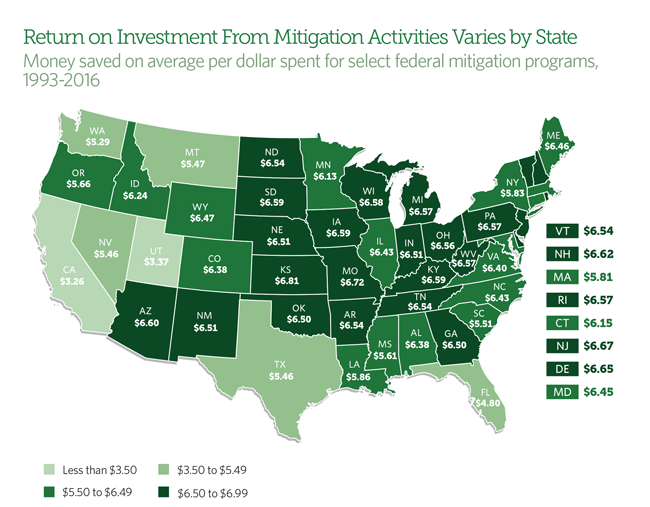
The report shows that every dollar spent in Kansas to protect against flood and tornado damage saved $6.81. In Missouri each dollar saved $6.72.

“The takeaway for policy makers really should be that investing in mitigation saves,” said Colin Foard, one of the authors of the study.

Pew found the payback from disaster mitigation efforts varied widely across the country. Kansas got the biggest return on investment.
CREDIT PEW CHARITABLE TRUSTS

The savings come from avoiding property repairs, casualties, disruptions to businesses and administrative expenses related to insurance.

The findings come at a time when Kansas residents are dealing with floodingaffecting most of the state and cleaning up from recent tornadoes.

The study looked at the continental U.S. and considered mitigation programs aimed at averting costs from earthquakes, fires, floods and wind damage.

The mitigation efforts in Kansas and Missouri addressed only the threats of wind and flooding, but those projects had such a large payback that the two states topped the rankings.

The smallest payback was in earthquake- and fire-prone California, but the study still estimated that every dollar of mitigation in the Golden State saved $3.26.

Mitigation can include adding storm shelters and structural updates to buildings that reduce damage from tornadoes. When it comes to combating floods, officials can remove structures from flood-prone areas or require building structures higher to avoid flood damage.

Over the 23-year period that was examined, the report found the state and federal government spent around $220 million dollars on wind and flood mitigation in Kansas, which netted about $1.5 billion dollars in savings.

Federal programs play a major role in disaster mitigation in Kansas and elsewhere.

“The mitigation projects that the Kansas Division of Emergency Management are able to support or implement are largely reliant on the federal grants,” said Bryan Murdie, director of the Planning and Mitigation Branch at the Kansas Division of Emergency Management.

Looking ahead, state officials are turning their attention to the new National Mitigation Investment Strategy, developed in the aftermath of Hurricane Sandy. That storm hit the East Coast in 2012 causing $65 billion in damage. The program is still in the draft stage, but Murdie expects it will go live soon.

The Federal Emergency Management Agency describes the strategy as a broader shift to preventing damage and loss from disasters.

The strategy will include investments in larger infrastructure improvements such as levees. The range of projects will also include smaller local improvements such as installing warning sirens and demolishing buildings in flood-prone areas.

Murdie said state officials hope to have assistance in the future for Kansans to upgrade their homes.

“Our office has begun the initial steps towards a residential safe room program that will help protect the citizens of Kansas,” Murdie said in an email.

The federal programs typically include a match that must be paid by the state or the local government receiving the grant. Those local matches are often 25 percent, but can be smaller in certain cases where the community is impoverished or the program is targeting an area that’s been repeatedly flooded.

Foard said it’s worth it for governments to find ways to fit mitigation costs into their budgets.

“This analysis shows that it can be a great return on investment for the money spent.”

Stephen Koranda is Statehouse reporter for the Kansas News Service.. Follow him on Twitter @kprkoranda or email skoranda (at) ku (dot) edu.

Authorities identify Kansas pilot who died in Brown Co. crash

BROWN COUNTY —One person died in an accident just before 5:30p.m. Friday in Brown County.

The Kansas Highway Patrol reported a 1975 Beechcraft airplane piloted by Bruce L. Lutz, 67, Andover, was flying south near the Hiawatha Airport when it crashed. Lutz was pronounced dead at the scene and transported to Frontier Forensics.

The accident remains under investigation by the FAA.

Platte County Jail Activity (6/22-6/28/19)

Here’s the latest booking activity from the Platte County Jail. All persons included in this post are innocent of crimes until proven guilty in a court of law.

This information is provided by the Platte County Sheriff’s Office and is not criminal history. The St Joseph Post assumes no legal liability or responsibility for the accuracy, or completeness, of this information.

Man found with dismembered wife in NE Kan. storage unit sentenced

OLATHE, Kan. (AP) — A man who was found at a Kansas storage unit with his dismembered wife’s remains and two of their children has been sentenced to nearly nine years in prison.

Rey -photo Johnson Co.

Thirty-six-year-old Justin Rey was sentenced Friday for child endangerment, contributing to a child’s misconduct and sexual exploitation of a child. The exploitation charges stem from sexually explicit photos of teenagers found on his phone.

Rey hasn’t been charged in the death of his wife, Jessica Monteiro Rey, who died after giving birth in October 2017 at a Kansas City, Missouri, hotel. Rey told authorities both that she killed herself and that she died of childbirth complications. The coroner couldn’t determine her cause of death.

Rey also is charged with abandonment of a corpse in Missouri and with a California homicide.

Missouri driver dies after Kansas semi crash and fire

SHAWNEE COUNTY —One person died in an accident just before 9a.m. Friday in Shawnee County.

Fatal tanker crash photo courtesy WIBW TV

The Kansas Highway Patrol reported a semi tanker truck driven by  Johnnie Robert Odell, 50, Buckner, Mo., was eastbound on Interstate 470 in Topeka.

The semi traveled onto the outside shoulder, collided with the barrier wall. It traveled into the ditch, struck a tree and caught fire.

Odell was pronounced dead at the scene. He was properly restrained at the time of the accident, according to the KHP.

The Latest: Missouri abortions continue, advocates celebrate

ST. LOUIS (AP) — The Latest on a dispute between the Missouri state health department and a St. Louis clinic over the clinic’s license to perform abortions (all times local):

12:20 p.m.

Planned Parenthood and its supporters are celebrating an order by a Missouri commissioner to protect abortion services while a fight over the state’s only clinic plays out.

An administrative hearing commissioner on Friday granted a stay that will allow the St. Louis Planned Parenthood affiliate to continue abortions past Friday. A court order allowing abortions to continue at the clinic was set to expire at that time.

A spokesman for attorneys representing the state says they’re reviewing the order to determine their next steps.

A hearing on whether the clinic should have its abortion license renewed is set for Aug. 1.

___

ST. LOUIS (AP) — A Missouri commissioner on Friday ruled that the state’s only abortion clinic can continue providing the service at least until August as a fight over its license plays out, adding that there’s a “likelihood” that the clinic will succeed in the dispute.

Administrative Hearing Commissioner Sreenivasa Rao Dandamudi granted what’s called a “stay,” which will allow the St. Louis Planned Parenthood clinic to continue providing abortions past Friday.

The state health department last week refused to renew the clinic’s license, but a St. Louis judge issued a court order allowing the procedure to continue through Friday.

St. Louis Circuit Court Judge Michael Stelzer wrote in his ruling that the order would give Planned Parenthood time to take their case to the Administrative Hearing Commission, where Stelzer said the licensing fight must begin.

The Administrative Hearing Commission scheduled a hearing on whether the state was right to not renew the license Aug. 1 in St. Louis.

The state has said concerns about the clinic arose from inspections in March. Among the problems health department investigators have cited were three “failed abortions” requiring additional surgeries and another that led to life-threatening complications for the mother, The Associated Press previously reported , citing a now-sealed court filing.

The Department of Health and Senior Services wants to interview physicians involved in those abortions, including medical residents who no longer work there. Planned Parenthood has said it can’t force them to talk.

The interviews are a major sticking point in the fight over the clinic’s license, and attorneys for the health department wrote in legal filings to the commission that physicians’ refusal to talk “presents the final, critical obstacle.”

But Dandamudi wrote that the physicians’ stonewalling “in itself does not constitute a failure to comply with licensure requirements.”

“Because DHSS relies substantially on the lack of these interviews as grounds for denial, we find there is a likelihood that Petitioner will succeed in its claim,” Dandamudi wrote in his order granting a stay, referring to the clinic and its effort to stay open.

Planned Parenthood has said Missouri is using the licensing process as a weapon aimed at halting abortions.

The fate of the clinic has drawn national attention because Missouri would become the first state since 1974, the year after the Supreme Court’s Roe v. Wade decision, without a functioning abortion clinic if it loses its license. The battle also comes as abortion rights supporters raise concerns that conservative-led states, including Missouri, are attempting to end abortion through tough new laws and tighter regulation.

Republican Gov. Mike Parson signed legislation on May 24 to ban abortions at or beyond eight weeks of pregnancy, with exceptions for medical emergencies but not for rape or incest.

The number of abortions performed in Missouri has declined every year over the past decade, but uncertainty in Missouri is sending women to neighboring states, particularly Illinois and Kansas.

Missouri health department statistics show that abortions in Missouri reached a low of 2,910 last year. Of those, an estimated 1,210 occurred at eight weeks or less of pregnancy.

The Hope Clinic in Granite City, Illinois, 10 miles (16 kilometers) from St. Louis, has seen a big increase in Missouri clients since 2017, said Alison Dreith, the clinic’s deputy director. That year, Missouri adopted a more restrictive abortion law, including giving the attorney general power to prosecute violations.

Dreith said about 55 percent of patients at Hope Clinic are from Missouri, 40 percent from Illinois and 5 percent from elsewhere around the country. The clinic attracts clients from across the U.S. in part because Illinois allows the procedure for up to 24 weeks of pregnancy, longer than most states, she said.

The Granite City clinic saw about 3,000 total patients in 2017. Missouri’s more restrictive law played a big role in the number spiking to 3,800 in 2018, Dreith said.

This year, she expects well over 4,000 patients. So far in 2019, the number of Missourians at the Hope Clinic has spiked 30 percent due to concerns about the St. Louis clinic’s license and other anti-abortion efforts, Dreith said.

“Our patients are calling us with a lot of anxiety because they’re seeing the headlines that abortion is banned,” Dreith said.

Information from the state of Kansas shows that about 3,300 of the 7,000 abortions performed there last year involved Missouri residents, meaning that more Missourians get abortions in Kansas than in their home state. Kansas has an abortion clinic in Overland Park, a Kansas City suburb just 2 miles (3 kilometers) from the state line.

Top Kansas court: Cities can raise age for buying tobacco

By JOHN HANNA

TOPEKA, Kan. (AP) — Kansas’ highest court ruled Friday that cities can raise the age for buying tobacco products even though state law sets it at 18, bolstering a public health movement driven in part by concerns about teenagers’ use of e-cigarettes.

File photo Kansas News Service

The state Supreme Court’s unanimous decision allows the city of Topeka to enforce an ordinance setting the age to buy tobacco products, e-cigarettes or liquid nicotine at 21. A company operating two local businesses, Vapebar Topeka and Puffs ‘n’ Stuff, sued just before the ordinance took effect in January 2018, and a lower-court judge blocked it.

The ruling had broader implications because 19 other Kansas cities have raised the age for buying tobacco to 21, and five counties have done so in areas outside cities.

More than 470 cities and counties in 29 states have raised the age to 21, as have 17 states, according to Tobacco 21, a national group promoting the higher age as a way to reduce smoking and e-cigarette use among young people. Also, the U.S. Senate is considering bipartisan legislation to raise the age nationally to 21.

“What people understand is that their kids are getting addicted and they have to do something,” said Dr. Rob Crane, president of Tobacco 21.

In Kansas, the state constitution gives cities “home rule” power, allowing them to set policies locally on a wide variety of issues, even if the state has laws on them. The exceptions are when a state law bars cities from acting or when a local ordinance conflicts with a state law.

The local businesses argued that by setting the age for buying tobacco products at 18, the state law implied that cities cannot go higher. They also argued that the Topeka ordinance conflicted with the state law.

But, writing for the court, Justice Caleb Stegall said raising the age for buying tobacco products “merely enlarges” on the state law, without creating a conflict. Also, he wrote, nothing in the law expressly forbids cities from acting.

Tuck Duncan, the attorney for the local businesses, said the ruling still allows another challenge on other grounds, such as a claim that the city did not adequately document the public health problems used to justify its ordinance. But he said businesses ultimately could face “a patchwork quilt” of rules — and not just on selling tobacco products.

“This is a huge barn door being opened for municipal governments to modify a whole raft of laws,” Duncan said. “What’s to say that the city of Topeka can’t have its own ordinances now, licensing physicians?”

Duncan also questioned the effectiveness of the ordinance in preventing sales of tobacco products to 18-, 19- and 20-year-olds.

“They’ll just go someplace else to buy it,” he said.

Still, Craig Barnes, a Shawnee County Health Department official who serves on the Tobacco Free Kansas Coalition’s board, said he was “ecstatic” about the ruling. Barnes said almost all high school seniors turn 18 before graduating, and allowing them to buy tobacco products legally makes it more likely younger students will gain access to them.

“Our hope is to dramatically decrease the number of youth who ultimately get started using tobacco products at a younger age,” Barnes said. “That leads to that lifelong addiction.”

Snakes, turtles and more to be featured at Nature Center event

Presentation on snakes at Herp-O-Rama 2018. Photo by Sarah Thomack.

Making snakes and other creatures less intimidating through education is one of the goals of a yearly Remington Nature Center event.

This will be the eighth year of the Herp-O-Rama event. Naturalist Shelly Cox said the event began when staff saw a need for more education about herpetology in the area.

“We got together and decided to plan a fun event that’s designed to be educational, but not intimidating, we want people to learn, but not be afraid,” Cox said.

The Herp-O-Rama event takes place from 10 a.m. to 2 p.m. at the Remington Nature Center and includes live snakes, turtles and salamanders, a scavenger hunt, crafts and more.

Former NE Kan. sheriff sentenced for felony theft, misuse of public funds


GEARY COUNTY —Former Geary County Sheriff Tony Wolf has been placed on 12 months probation and ordered to pay restitution totaling $2,200 plus costs and fees. That was the controlling sentence handed down in Geary County District Court on Friday morning for Wolf, who in April. pleaded no contest and was found guilty of one felony count of Theft, and a misdemeanor charge of Misuse of Public Funds, according to a media release.

Geary County Sheriff Tony Wolf

Wolf submitted his resignation from the sheriff’s post in April following his convictions.

In District Court on Friday the court followed the recommendation of the attorneys and the plea agreement in the case, and sentenced Wolf to 12 months probation on each count. But they are to run concurrently, meaning 12 months is the controlling term.

Wolf stated in court, “I’m sorry. This is tough, this is real tough,” and he apologized. Wolf was remorseful, “I’m sorry this had to work out this way,” and also told the community that he was sorry.

According to the factual basis outlined in court in April, Wolf authorized an expense of $530.00 against a county credit card to purchase tires for a friend’s vehicle but initially claimed it was a payment to a confidential informat for drug information, which was false. Later he admitted to a KBI agent that the tires were purchase for a friend. Those funds were credited by the vendor back to the credit card and Wolf later paid the vendor.

In the second case Wolf used state asset forfeiture funds to purchase items ranging from weapons and ammunition to a scope. Wolf turned in a list on that, but it did not include six items including a scope. He will make the $2,200 restitution in that case.

As a result of his felony conviction Wolf cannot own, use or possess a firearm for five years.

Copyright Eagle Radio | FCC Public Files | EEO Public File