KANSAS CITY (AP) — Federal officials are mailing more than 1 million checks worth a combined $505 million to consumers that former pro racecar driver Scott Tucker swindled through a payday lending scheme.
The Federal Trade Commission and the Justice Department announced the refunds Thursday. The agencies evaluated loan portfolios from seven of Tucker’s brands under his company, AMG Services — 500FastCash, Advantage Cash Services, Ameriloan, OneClickCash, Star Cash Processing, UnitedCashLoans and USFastCash — to find consumers who took the short-term loans.
Tucker, of Leawood, Kansas, is among those convicted of running a payday lending enterprise that used indigenous tribes as fronts to charge predatory interest rates. He began serving a 16-year, eight-month prison sentence earlier this year.
LANSING, Kan. (AP) — The adopted daughter of a retired Army officer living in northeastern Kansas may soon be sent back to South Korea.
Patrick Schreiber, wife and daughter-courtesy photo
On Friday, a federal judge in Kansas ruled in favor of U.S. Citizenship and Immigration Services, which seeks to deport Hyebin Schreiber, the legally adopted daughter of retired Lt. Col. Patrick Schreiber of Lansing.
Schreiber sued after immigration authorities rejected visa and citizenship applications for Hyebin. The woman had been Schreiber’s niece when he and his wife legally brought the then-15-year-old girl to the U.S. in 2012.
Schreiber’s deployment the following year to Afghanistan and bad legal advice led the couple to put off her legal adoption until she was 17. But under immigration law, foreign-born children must be adopted before reaching 16 to derive citizenship from their American parents.
Schreiber, who has served six overseas tours in a 27-year U.S. military career, has said he and his wife would go to South Korea with their daughter if she’s deported.
LAWRENCE COUNTY — One person died in an accident just after 2a.m. Sunday in Lawrence County.
The Missouri State Highway Patrol reported a Yamaha motorcycle driven by Joseph I. Barnett, 28, Marionville, was southbound on Lawrence County Road 1230 approximately one mile south of Marionville.
The motorcycle struck a 2003 Suzuki 4-wheeler driven by Stacia V. Barnett, 29, Marionville. She was pronounced dead at the scene.
Joseph Barnett was transported to Mercy Hospital in Springfield in serious condition, according to the MSHP.
Angie Schreiber sees it time and again: dyslexic students failing to learn to read through traditional teaching techniques.
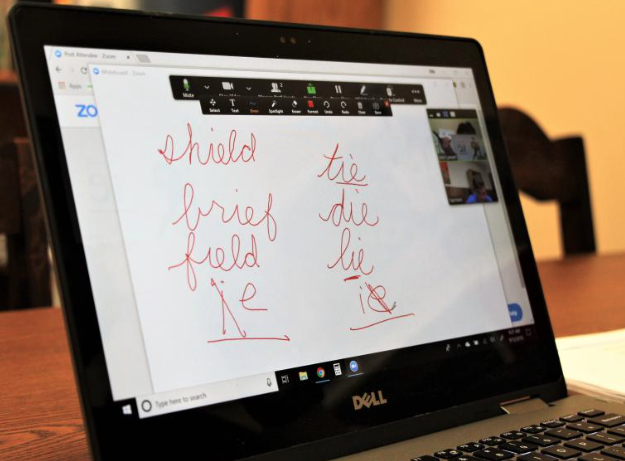
A computer screen shows some of the tricky spelling rules that Ann Lawyer, a teacher at Cradle to Career Literacy Center in Emporia, shared with one of her students during a recent online lesson. CELIA LLOPIS-JEPSEN / KANSAS NEWS SERVICE
But she says she knows how they can flourish.
Schreiber’s private teaching service in Emporia uses an approach known as structured literacy. The method drills students on myriad rules of English sound and spelling that most of us never learned consciously.
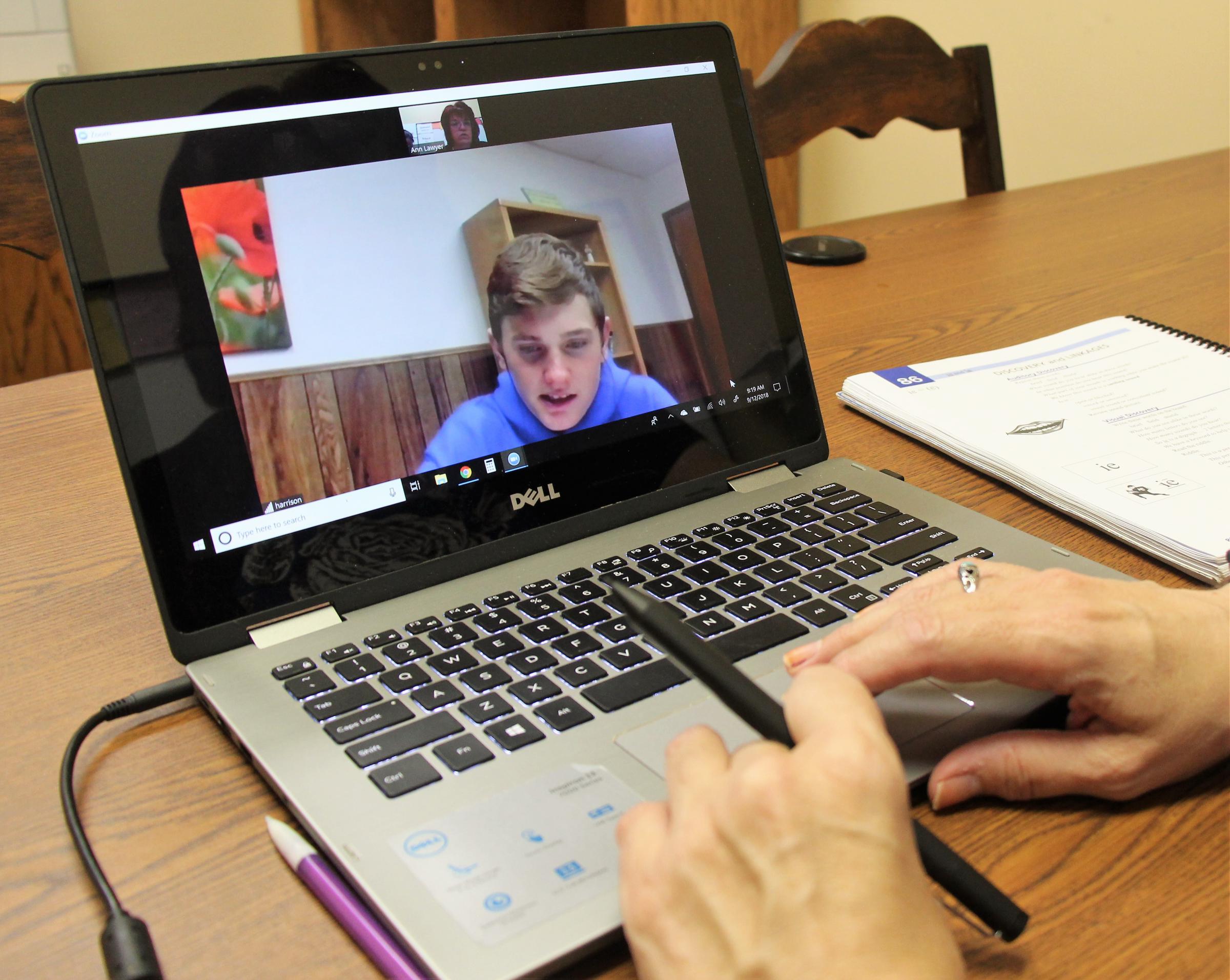
On a recent Wednesday, one of her instructors fired up a laptop for a lesson with Harrison Leniton, an eighth-grader in the southeast Kansas school district of West Elk.
“If I have the ‘kuh‘ sound,” special education teacher Ann Lawyer asked him through their remote video connection, “and I’m using that with an A, O, U — or another consonant — what do I use?”
Harrison: “C.”
Lawyer: “Excellent.”
West Elk eighth-grader Harrison Leniton reviews advanced phonics rules with his teacher, Ann Lawyer.
CREDIT CELIA LLOPIS-JEPSEN KANSAS NEWS SERVICE
For years, dozens of parents of children with dyslexia have gone to the Kansas Legislature with stories of students who don’t get what they need in school — or get it years late, when catching up is many times harder.
Many want the type of lessons Harrison receives.
Now, a state task force could make that happen — with potential, and controversial, effects for how schools teach all children to read.
Skeptics of that structured literacy approach watch uneasily. The state’s colleges of education — where proponents of a different kind of instruction dominate — barely show up on the roster for the task force that could determine the next generation of reading instruction in the state.
Ken Weaver, dean of the Teacher’s College at Emporia State University, says literacy professors were left out by design.
“That is a purposeful mistake,” he said, “to ensure that that voice is not heard.”
Rote rules and reading
The structured literacy classes that Harrison takes can feel like “i before e except after c” for grad students.
Harrison spent the past year catching up multiple grade levels in reading. To do that, he memorized many explicit guides to the maddening world of English orthography. His lessons are peppered with advanced phonics terms. Digraph. Diphthong. Dieresis.
“We take them back to the beginning and say, what we need is to show you a different way to learn to read and spell,” Schreiber said.
Emporia-based teacher Ann Lawyer counts as her student, Harrison Leniton, parses out individual phonemes, or sounds, in a list of words.
CREDIT CELIA LLOPIS-JEPSEN /KANSAS NEWS SERVICE
Many children fret when they fall behind their classmates, even though studies show students with dyslexia are as smart as their peers without it. When schools don’t offer structured literacy, its proponents say, reading drifts farther and farther out of reach. Children with dyslexia pay the price in anxiety, depression and higher dropout rates.
In the past six years alone, American Public Mediasays, more than 30 states have passed laws meant to address concerns that children with dyslexia don’t get help, or even diagnosed.
Some of those laws require teachers colleges to teach structured literacy or the basics of dyslexia. Others make schools screen for the disability and offer intensive phonics. Still others mandate annual dyslexia training for educators.
Kansas doesn’t have any such state law or regulation — yet.
The reading gap
A staggering number of students in the U.S. struggle with reading, whether they’ve been diagnosed with dyslexia or not.
In Kansas, more than half aren’t likely to be able to handle college-level complexity by the time they finish high school. More than a quarter are so far behind they’re not even reading at grade level.
Poor academic outcomes often get attributed to demographic factors, such as poverty. But dyslexia researchers argue the disability — and the way it often goes untreated — likely contributes to a large chunk of the problem.
“The nation has to recognize this is one of the major things holding back millions of children,” said Sally Shaywitz, a professor of pediatrics at Yale University.
The co-founder of the Yale Center for Dyslexia and Creativity, she says one in five people has dyslexia. That translates to a handful of children in any given classroom — a strong argument for training teachers and screening students.
But other sources peg the prevalence of dyslexia at possibly fewer than one in 20. Those figures have some educators concerned that a national movement of vocal parents is pushing schools to overdiagnose children, or focus too much on what is just one of a wide range of student issues that teachers juggle, from childhood trauma to autism.
More phonics?
Then there’s the second big rift that makes conversations between parents and schools difficult: The fight over how children best learn to read.
Literacy specialists at colleges of education today largely push balanced literacy, an approach that relies more on learning through context and deduction, less on detailed lessons in sounds and orthography.
Dyslexia advocates say decades of well-settled research shows that being more explicit benefits all children, not just those with dyslexia. They say it could mitigate the nation’s literacy problems.
The International Literacy Association and International Dyslexia Association have sparred over the matter. (Read their arguments here and here.)
Annie Opat, a literacy expert at Emporia State, said she attended some of the teacher training that structured literacy advocates favor. She wasn’t impressed. Rather, Opat worries that drilling students takes away the enjoyment and context that stimulate learning.
“They’re learning this letter and it’s not related to meaning,” she said. “So that, to me, is not the optimal way for the brain to take on new learning.”
Instead, Opat said, children need to see significance in what they learn.
“If you’re going to learn the letter ‘A’ and my name is ‘Annie,’ that ‘A’ would mean something significant to me knowing it’s part of my name,” she said. “As human beings, if we enjoy something, we’re going to get better at it with more practice.”
That view rankles parents of children with dyslexia, who say context and interest aren’t enough to flip a switch in a brain that’s wired differently. The rules that some teachers dismiss as arcane and tedious can be the difference between whether or not a kid will ever make it through Seuss or Salinger.
Lori McMillan, a Topeka mother whose 8-year-old, Wyatt, has dyslexia, worried when he continued to struggle with basic words in first grade. She recalls writing “the” on a cue card and studying it with him at home.
“By the end of about 20 minutes, you know, he was picking it out of paragraphs,” she said. But 20 minutes later, after practicing the next word, “is,” McMillan showed Wyatt “the” again.
“It was like he’d never seen it before in his life.”
What finally worked for Wyatt, McMillan says, was the explicitness of structured literacy.
The building blocks
On a recent Monday, a few children learned one-on-one with the staff at Pittsburg State University’s Center for Research, Evaluation and Awareness of Dyslexia in southeast Kansas.
The center serves children from multiple states, like 8-year-old Dylan Brooks, of Missouri.
“‘King’ without ‘kuh,’” Courtney Hensler prompted Dylan. “Ing,” he replied. “‘Man’ without ‘mmm’?” she followed up. “An,” came his answer.
Structured literacy drills aim to stimulate sound awareness in children with dyslexia. Doing the mental calculation of deleting a word’s first sound requires an awareness that those individual sounds exist, and can be pulled apart that way.
But the brain pathways that make this connection don’t seem to function the same way in people with dyslexia, researchers say. Helping them hear and manipulate phonemes like “mm” and “kuh” are a first and crucial step to pulling the curtain back on symbols “M” and “K.”
“If you don’t understand that words are made up of sounds,” Pitt State psychology professor David Hurford said, “then when you get to the point where you’re decoding words, that makes no sense to you.”
Hurford leads his college’s dyslexia center and is the sole professor on Kansas’ new dyslexia task force, created by the Legislature last spring.
But academics who teach balanced literacy — the other side of the debate — aren’t convinced their approach is so lacking in the skill sets that Hurford says their colleges should teach.
“Phonemic awareness, sound-symbol associations, decoding,” said Debbie Mercer, dean of the Kansas State University College of Education. “Our program is very strong there. Our students take more coursework in reading methodology than anything else.”
Changes likely
Pitt State’s dyslexia center offers discounts for low-income families, but in other parts of the state, parents say they can’t find such options — if they can find dyslexia specialists at all. Private-practice specialists can cost hundreds of dollars a month.
The state’s dyslexia task force wants to address the lack of access through schools.
Dylan Brooks and his teacher, Courtney Hensler, take short breaks for fun during his after-school reading lessons. Here Dylan aims to hit a ball with a foam bat.
State board chairman Jim Porter, who also heads the task force, believes his colleagues there will be eager to act.
“There are students,” he said, “whose needs are not being met.”
But education groups wary of overregulation — and a proposal last spring to require dyslexia screening — told lawmakers that Kansas teacher colleges already prepare teachers to help struggling readers. Kansas classrooms, meanwhile, should already be monitoring children for academic deficits and giving stragglers extra help.
The state’s associations for school boards and special education administrators agreed.
But Harrison’s mother, Cynthia Leniton, says structured literacy classes changed her son’s outlook. Now, she says, he sees college as a possibility.
“The education system didn’t know what dyslexia really was,” she said, recalling how she moved him to a different school district in search of better help and signed him up for private lessons in structured literacy.
When it seemed to work, she showed his new superintendent the results and found him willing to offer the remote lessons at school.
The remote lessons cost about $2,500 per student per year. West Elk is now spending about $11,000 for three of its teachers to learn the technique.
The task force exploring whether to roll out dyslexia or structured literacy training on a broader scale hopes to calculate statewide cost estimates for doing so by January.
That could mean training not for three teachers, but for thousands.
Celia Llopis-Jepsen is a reporter for the Kansas News Service. You can reach her on Twitter @Celia_LJ.
With unemployment rates at 4 percent or below, one might think the Employment Services department at Catholic Charities of Kansas City-St. Joseph would be on extended vacation. But, nothing could be further from the truth.
“We’re seeing more people at our classes now than we did in the spring,” said Kathy Ficcadenti, director of Employment Services, “plus, we’re dealing with high-risk individuals who are often striving to overcome the challenges of poverty. For this group, landing the job is huge, but equally important, is keeping it.”
This can be difficult for a person locked into generational poverty who might not have been exposed to a good role model with a sound work ethic. A recent poll of the top 100 employers in the St. Joseph area indicated “work ethic” was one of the top deficiencies among current job applicants and yet employers rated this trait most important to their business.
PETTIS COUNTY — One person died in an accident just after 1:30a.m. Sunday in Pettis County.
The Missouri State Highway Patrol reported a 2005 Chevy passenger vehicle driven by Caleb J. Stathem, 23, Sedalia, was southbound on U.S. 65 just north of route BB.
The vehicle traveled off the right side of the road and struck a guardrail. The driver overcorrected the and the vehicle began to skid. It rotated across the median into the northbound lanes, hit another guardrail and the driver was ejected. Stathem was pronounced dead at the scene. He was not wearing a seat belt, according to the MSHP.
ST. JOSEPH, Mo. – The Missouri Court of Appeals – Western District will again convene on the campus of Missouri Western State University.
According to a press release, on October 2nd, a three-judge panel consisting of Chief Judge Karen Mitchell, Judge Victor Howard, and Jackson County Circuit Judge George Wolf will hear oral arguments in three cases (click here for a summary of the three cases).
The cases originated in area circuit courts. The judges will hear oral argument and then take time after the arguments to discuss the court system and take general questions from the audience.
These cases are appeals from previously held trials in area circuit courts. The judges will hear attorneys argue whether the trials had errors that should cause them to be retried, or the trial court’s judgment reversed.
The judges will read written arguments before the court session, and may interrupt the attorneys’ arguments with questions.
The judges will break sometime during the arguments to give a general overview for students of the judicial system and the appellate judiciary in particular.
The session begins at 9:30 a.m. Tuesday, Oct. 2 in the Kemper Recital Hall, Spratt Hall room 101. The court session, expected to last until approximately noon, is free and open to the public.
For further information, please contact Department Chairperson and Legal Studies Program Coordinator Suzanne Kissock in the Department of Criminal Justice, Legal Studies and Social Work at (816) 271-4454.
This event is sponsored by the MWSU Department of Criminal Justice, Legal Studies and Social Work.
SHAWNEE, Kan. (AP) — An infestation of bedbugs has closed a Kansas City suburb library until further notice.
Johnson County Library Director Sean Casserley says the Shawnee branch library on Johnson Drive will be closed at least until Wednesday so the building can be treated to get rid of the infestation.
Updates on the state of the branch will be posted on the library’s website and social media accounts.
Casserley says library staff spotted the pests in a book turned in Thursday. Dogs trained to detect the pests were brought in, and officials learned Friday that the pests had spread to furniture in the building.
Bed bugs have recently been discovered in other public places in the Kansas City area, including in a Kansas City International Airport terminal.
BELTON, Mo. (AP) — Police in the Kansas City suburb of Belton say two pedestrians have been hit and killed on a city street.
Police say the incident was reported around 8:20 p.m. Friday on Peculiar Drive in Belton, south of Kansas City, Missouri.
Arriving officers reported finding two males dead at the scene. It was not known Saturday whether the males were men or boys.
Police say the vehicle suspected in the deaths has been located, and the suspected driver has been contacted. Police had not reported any arrests by Saturday morning.
Neither the names of those killed nor the suspected driver have been released.
TOPEKA, Kan. (AP) — Uber will pay Kansas more than $730,000 after hackers obtained names and driver’s license information of some Uber drivers.
Kansas Attorney General Derek Schmidt filed a lawsuit against the ride-hailing company. A consent judgment was entered Thursday in Shawnee County District Court.
In 2016, hackers obtained the names and driver’s license information from about 600,000 of its drivers, but didn’t immediately reveal the breach. Schmidt argued the lack of transparency violated the Kansas Consumer Protection Act. He also said Uber didn’t maintain reasonable security measures.
Uber’s attorney, Tony West, said the company has reached agreements with the attorney generals of all 50 states and the District of Columbia. According to the consent judgment, Uber will pay a total of $148 million.