We have a brand new updated website! Click here to check it out!

Kobach aims to drive out migrants living in Kansas illegally

TOPEKA, Kan. (AP) — Kris Kobach highlights his national reputation as an immigration crusader in running for Kansas governor by promising voters that if he’s elected he’ll work to drive out illegal immigrants to halt what he says is the $377 million in benefits provided to them by the state each year.

Photo courtesy Kris Kobach campaign

The conservative Republican’s plans echo President Donald Trump’s crackdown on immigration — an agenda Kobach has helped to shape. The president has endorsed Kobach , the Kansas secretary of state, who won a narrow primary victory over the state’s GOP governor.

Plenty of immigration policy analysts suggest Kobach’s push could harm the state’s economy, but they start by questioning the dollar figure he is citing repeatedly as the annual cost of illegal immigration to Kansas. Kobach is undeterred.

“My election would send a signal that the public-benefits gravy train is going to end,” Kobach said during a recent interview.

While states such as California and Illinois have offered immigrants sanctuary, Kobach wants Kansas to catch up to others including Missouri, Alabama and Arizona in setting policies designed to prevent immigrants living in the U.S. from getting jobs or obtaining benefits. Kobach has falsely described Kansas as the “sanctuary state of the Midwest.”

His figure for what Kansas could save annually comes from a September 2017 report by the Federation for American Immigration Reform.

The group backs Trump’s call to build a wall on the border with Mexico and opposes “amnesty,” for immigrants living in the U.S. illegally, including a pathway to citizenship for those willing to serve in the military. Its website argues for cutting legal immigration 70 percent and says “immigration levels must fall” for U.S. wages to rise.

The group calculated figures for each state by tabulating a 50-state total for various costs and working from an estimate of how many immigrants living illegally in the U.S. reside in each state. FAIR estimated more than 84,000 immigrants live illegally in Kansas; other sources have lower figures. The total is between 2.2 percent and 2.9 percent of Kansas’ population.

Almost half of the total costs the study cites are for public schooling for immigrant children. But a 1982 decision by the U.S. Supreme Court prohibits states from denying those children an education.

Roughly a third is a combination of policing, court expenses and even general services, such as garbage collection.

In short, much of the spending is for services a state can’t avoid unless immigrants are deported or leave voluntarily.

Kobach acknowledged that he couldn’t cut off much spending immediately and might not be able to completely eliminate his $377 million a year entirely over time but maintains reducing it sharply is worth doing. He’s outlined multiple proposals for combatting illegal immigration.

FAIR research director Matt O’Brien, one of the report’s authors, said the burden to federal and state governments from providing services “offsets any measurable gain” from money “illegal aliens are alleged to inject into the economy.”

“In fact, illegal immigration simply amounts to a massive wealth redistribution scheme,” O’Brien said in an email.

Critics contend the report that Kobach is citing overestimates how many immigrants live in the U.S. illegally and fails to adequately consider immigrant contributions to the economy. A senior policy analyst for the libertarian Cato Institute called it “fatally flawed” — and said it might overestimate net government costs by as much as 97 percent.

“It’s disappointing that a candidate for such an important office is relying on such shoddy research to make his point,” said Alex Nowrasteh, the Cato analyst. He argues for allowing “peaceful” immigrants to stay in the U.S. even if they arrived illegally.

The Democratic nominee for governor, state Sen. Laura Kelly, described the FAIR report as “widely discredited,” adding in an email, “Kris Kobach is deceiving Kansans to further his personal political agenda.”

And independent candidate Greg Orman, a Kansas City-area businessman, said: “We’re not going to grow the Kansas economy by driving workers out of the state.”

Federal law generally prohibits government health coverage and food assistance for illegal immigrants, though Kobach says Kansas is not aggressive enough in policing fraud in those programs.

But FAIR argues that costs for states are bigger and include general services that legal residents also receive, as well as the costs of prosecuting and incarcerating illegal-immigrant criminals and medical care that poor immigrant families can’t afford but are entitled to by law.

In 2016, a study from the National Academies of Sciences, Engineering and Medicine concluded that first-generation immigrants are more costly in the short-term to states and local governments than native U.S. citizens, largely because of education costs. Kim Rueben, a senior fellow at the Urban Institute, which participated in the academies’ study, said immigrant parents have more children on average.

But, she added, “Those kids are also going to be the future labor force.”

Studies by the University of Missouri-Kansas City in 2013and the University of Kansas in 2014 concluded that immigrants benefit the Kansas economy and pay for government services they use. Both also concluded that immigrants expand the Kansas economy.

Watch Replay: Missouri Senate candidates square off in first debate

MARYLAND HEIGHTS, Mo. (AP) — Republican U.S. Senate candidate Josh Hawley pushed hard at a debate Friday to paint Claire McCaskill as “another Washington liberal,” a phrase he repeated over and over, while the incumbent Democrat touted herself as a moderate compromiser.


The Missouri Press Association hosted a candidate forum that featured the two front-runners and two other candidates. It marked the first time the candidates have debated.

The stakes are huge: The race in Missouri is among the nation’s most closely-watched campaigns, one of a handful expected to decide which party controls the Senate, where Republicans currently hold a 51-49 advantage.

Both sides are spending heavily, and outside groups are buying up ad time across the state. Polls indicate the race is a toss-up.

Hawley, the state’s 38-year-old first-term attorney general, has the support of President Donald Trump, who carried Missouri by 19 percentage points in 2016. At least seven times during the hour-long debate he referred to McCaskill as “another Washington liberal.”

McCaskill, 65 and seeking her third term, said she supports the president when it benefits Missouri and opposes him when it does not. She said she wakes up every day wondering what she can do for Missouri, “the red parts and the blue parts.”

Hawley also attempted to portray McCaskill as an obstructionist to the president’s policies as well as an out-of-touch elitist. He repeated claims used in political ads that her husband has received $131 million in federal subsidies to build low-income housing.

McCaskill, clearly angered, said that as a senator she had no role in approving tax credits for projects in which her husband, Joseph Shepard, was a minority partner.

McCaskill said Shepard “started out with nothing and he built a fabulously successful business, creating thousands of jobs and great wealth. I met him, I fell in love with him, and we have a wonderful family. He’s done nothing wrong.”

Hawley, meanwhile, took exception to McCaskill’s long-standing criticism of his decision as attorney general to join a lawsuit against former President Barack Obama’s health care law. McCaskill said families would lose coverage for pre-existing conditions if the lawsuit is successful.

Hawley said his own young son has a bone condition and he would never support any change that wouldn’t cover pre-existing conditions.

“It’s not true,” Hawley said of McCaskill’s characterization. “She knows it’s not true, and the repetition, frankly, is turning into an outright lie.”

The two candidates differed on several other issues. McCaskill said Trump’s escalating trade war is hurting farmers as well as manufacturers. But Hawley applauded the president for standing up to unfair trade practices in other countries, particularly China.

Hawley said he supports Trump’s nomination of Brett Kavanaugh to the Supreme Court. Speaking to reporters after the debate, Hawley said the Senate should confirm the nomination despite a new allegation of sexual misconduct when Kavanaugh was in high school.

Hawley said he never disregards sexual misconduct allegations but this one “appears to be another attempt to stall and delay” Kavanaugh’s confirmation.

McCaskill said she was concerned about thousands of pages related to Kavanaugh that were not initially turned over to the Senate, and was also troubled by his rulings on dark money. She said she was still undecided on her confirmation vote.

The debate during the press association’s annual meeting in suburban St. Louis also included independent candidate Craig O’Dear and Green Party candidate Jo Crain.

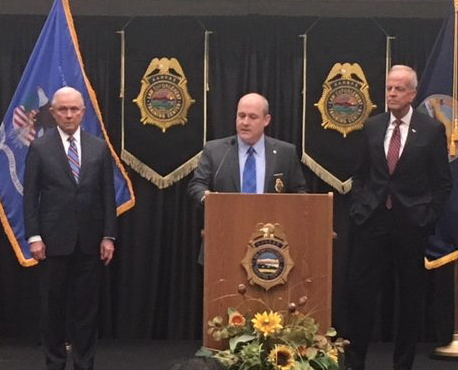
Attorney General Sessions makes presentation in Kansas

Attorney General Sessions during Friday afternoon’s event at the Law Enforcement Training Center

RENO COUNTY — United States Attorney General Jeff Sessions was in Kansas Friday afternoon to speak to law enforcement and cadets of the Kansas Law Enforcement Training Center.

Sessions also announced a $700,000 grant to Kansas City to continue crime reduction effort.

Sessions was the guest of Kansas Senator Jerry Moran, who praised Sessions for his work:


Sessions says the uptick in the crime rate is something that needs to be addressed. He spoke on the vigilance of the U.S. Attorney’s office and the support law enforcement has from the president:


Missouri judge bars redistricting measure in win for GOP

JEFFERSON CITY, Mo. (AP) — A Missouri judge on Friday ordered a redistricting measure to be knocked off the November ballot, a win for Republican critics of the proposal to tie state legislative seats to the parties’ share of the statewide vote.

Cole County Circuit Judge Daniel Green ruled that the ballot initiative unconstitutionally addresses multiple topics and directed the secretary of state to remove it from the Nov. 6 ballot.

Chuck Hatfield, an attorney for the campaign pushing the measure, says the group will appeal.

The proposal by Clean Missouri would replace Missouri’s system for drawing state legislative districts with a model designed to have the number of seats won by each party reflect the parties’ share of the statewide vote in previous elections for president, governor and U.S. senator, where Democrats typically run closer to Republicans. Criteria such as compact and contiguous districts that keep communities together would carry a lower priority.

Republicans currently hold commanding majorities in the Missouri House and Senate, with Democrats primarily relegated to representing residents in the state’s largest cities.

The measure also would limit lobbyist gifts to lawmakers to $5, slightly lower Missouri’s campaign contribution limits for legislative candidates, bar them from raising political money on state property, alter the waiting period for ex-lawmakers to become lobbyists and make lawmakers subject to the state open-records law.

Lawyers for the initiative’s sponsors and GOP Attorney General Josh Hawley, whose office is legally responsible for defending ballot measures, had argued in court last month that its various provisions all have a single focus on the Legislature.

“We have always thought that this legal matter would be decided at the Appeals Court level,” Hatfield said. “This is a speed bump, but the law is on our side, the people are on our side, and Amendment 1 will be passed in November to clean up Missouri politics.”

Missouri Republican Party spokesman Chris Nuelle in a Friday statement applauded the ruling, claiming the redistricting would unfairly benefit Democrats.

Trump’s Supreme Court nominee denies allegation of sexual misconduct

WASHINGTON (AP) — Supreme Court nominee Brett Kavanaugh on Friday denied an allegation of sexual misconduct from when he was in high school, seeking to defuse a potential threat to his confirmation as a handful of key senators remained silent on whether they would vote for him.

Supreme Court nominee Brett Kavanaugh photo courtesy Senate Judiciary Committee

In a statement released by the White House, Kavanaugh said: “I categorically and unequivocally deny this allegation. I did not do this back in high school or at any time.”

Senate Republicans insist Kavanaugh’s confirmation remains on track. But the allegation has inflamed an already intense political battle over President Donald Trump’s nominee. It also pushes the #MeToo movement into the court fight, less than two months before congressional elections that have seen a surge of female Democratic candidates.

The New Yorker magazine reported that the alleged incident took place at a party when Kavanaugh, now 53, was attending Georgetown Preparatory School. The woman making the allegation attended a nearby school.

The magazine says the woman sent a letter about the allegation to Democrats. A Democratic aide and another person familiar with the letter confirmed Friday to The Associated Press that the allegation is sexual in nature. Two other people familiar with the matter confirmed it concerned an incident alleged to have occurred in high school. They were not authorized to speak publicly and spoke on condition of anonymity.

The AP has not confirmed the details of the incident alleged in The New Yorker’s account.

Rallying to Kavanaugh’s defense, 65 women who knew him in high school issued a letter saying Kavanaugh has “always treated women with decency and respect.” The letter was circulated by Republicans on the Senate Judiciary Committee.

“We are women who have known Brett Kavanaugh for more than 35 years and knew him while he attended high school between 1979 and 1983,” wrote the women, who said most of them had attended all-girl high schools in the area. “For the entire time we have known Brett Kavanaugh, he has behaved honorably and treated women with respect.”

The show of support for Kavanaugh was organized by his former law clerks. Three women reached by AP said they were first asked to sign the letter on Thursday.

The swift pushback comes after the Senate Judiciary Committee’s top Democrat, Dianne Feinstein of California, notified federal investigators about information she received about the nominee.

Feinstein won’t disclose the information publicly, but the FBI confirmed it has included it in Kavanaugh’s background file at the committee, now available confidentially to all senators.

Kavanaugh’s nomination has divided the Senate and the new information complicates the process, especially as key Republican senators, including Susan Collins of Maine and Lisa Murkowski of Alaska, are under enormous pressure from outside groups seeking to sway their votes on grounds that a Justice Kavanaugh might vote to undercut the Roe v. Wade ruling. One activist group favoring abortion choice, NARAL, called on Kavanaugh to withdraw from consideration.

The Judiciary Committee, which has finished confirmation hearings for Kavanagh, still plans to vote next Thursday on whether to recommend that he be confirmed by the full Senate, a spokesman said.

The White House called Feinstein’s move an “11th hour attempt to delay his confirmation.”

Collins held an hour-long phone call with Kavanaugh on Friday, her spokeswoman confirmed. It had been a previously scheduled follow-up to an initial visit that Kavanaugh made to her office in August. It was not immediately clear if they discussed the new information.

If Collins or Murkowski should vote for Kavanaugh, he is likely to be confirmed. Every other Republican in the Senate is expected to vote yes — and some Democrats from Trump-won states may join them — though it remains to be seen if the misconduct allegation will cost him any support.

Feinstein said in a statement Thursday that she “received information from an individual concerning the nomination.” She said the person “strongly requested confidentiality, declined to come forward or press the matter further, and I have honored that decision.”

The FBI confirmed that it received the information Wednesday evening and included it in Kavanaugh’s background file, which is maintained as part of his nomination. The agency said that is its standard process.

Feinstein’s statement that she had “referred the matter to federal investigative authorities” jolted Capitol Hill and threatened to disrupt what had been a steady path toward confirmation for Kavanaugh by Republicans eager to see the conservative judge on the court.

Feinstein, who is up for re-election this year, has held the letter close. Democratic senators on the panel met privately Wednesday evening and discussed the information, according to Senate aides who were not authorized to discuss the situation publicly and spoke on condition of anonymity.

Some senators, including the No. 2 Democrat, Dick Durbin of Illinois, learned about the information for the first time at the meeting, according to one of the aides.

A spokeswoman for Rep. Anna Eshoo, D-Calif., declined to confirm reports that the congresswoman had forwarded a letter containing the allegations to Feinstein. The spokeswoman said the office has a confidentiality policy regarding casework for constituents.

A White House spokeswoman, Kerri Kupec, said the FBI has vetted Kavanaugh “thoroughly and repeatedly” during his career in government and the judiciary.

She said Kavanaugh has had 65 meetings with senators — including with Feinstein — has sat through over 30 hours of testimony and publicly addressed more than 2,000 questions. “Not until the eve of his confirmation has Sen. Feinstein or anyone raised the specter of new ‘information’ about him,” she said.

Sen. John Cornyn of Texas, the second-ranking Republican and a member of the committee, was also skeptical.

“Let me get this straight: this is statement about secret letter regarding a secret matter and an unidentified person. Right,” he tweeted.

Chairman Chuck Grassley, R-Iowa, was unaware of the information until it was made public, according to a GOP committee aide. Kavanaugh has undergone six federal background checks over his time in government, including one for the nomination, the aide said.

___

Missouri nursing home bathroom where woman drowned lacked call system

COLUMBIA, Mo. (AP) — A state investigation has found that a Columbia nursing home where a 77-year-old woman drowned lacked a legally required call system in a communal bathroom.

The woman died in March at Parkside Manor after asking to bathe in private. A police report says her death was ruled accidental.

Reports say the nursing home was installing an emergency call system. An inspection of the nursing home last month found no violations of state requirements.

Pilot not injured in plane crash Thursday in Livingston County

Pilot safe after crash Thursday. Photo courtesy the Livingston County Sheriff’s Office.

A pilot was uninjured after a plane crash in Livingston County Thursday.

According to the Livingston County Sheriff’s Office, shortly before 4 p.m. on Thursday, dispatch received a call from the F.A.A. reporting a possible aircraft down seven to 10 miles southwest of Chillicothe in Livingston County with the pilot possibly injured.

The LCSO, Missouri State Highway Patrol and Chillicothe Department of Emergency Services responded with a variety of emergency equipment and UTV. The Chillicothe PD sent an officer and a drone, Dawn First Responders assisted, Missouri Department of Conservation Agent from Caldwell County Bill Kieffer used his plane to help search as did Life Flight Eagle, and several citizens assisted in the search.

A while later the F.A.A. advised, according to the mapping, the plane was south of the railroad tracks in Ludlow and east of the first house south of the railroad tracks. LCSO Captain Sindy Thomas was finally able to make contact with the pilot by phone. The pilot reported he was in a field, could see a home about a quarter of a mile away, and was able to walk to that house and checked the mail in the mailbox for an address. At 5:02 p.m., the pilot was soon located a few miles south east of Dawn and reported being uninjured. The pilot is from the state of Wisconsin.

The Missouri State Highway Patrol is investigating the crash and the F.A.A. reportedly will also be investigating.

The LCSO said they appreciate the help from the public through social media as the sheriff posted information in an attempt to get visual help from anyone in the area to aide in locating the pilot. The post was quickly shared 178 times and was viewed by over 6,700 people.


GM recalls pickups, SUVs for power steering problem

DETROIT (AP) — General Motors is recalling 1.2 million big pickup trucks and SUVs mainly in North America because of power-assisted steering problems that have been cited in a number of accidents.

GM says the power steering can fail momentarily during a voltage drop and suddenly return, mainly during low-speed turns. Such a failure increases the risk of a crash. The company says it has 30 reports of crashes with two injuries, but no deaths.

The recall covers certain 2015 Chevrolet Silverado and GMC Sierra 1500 pickups as well as Chevy Tahoe and Suburban SUVs. Also affected are 2015 Cadillac Escalade and GMC Yukon SUVs.

Dealers will update the power steering software at no cost to owners. No date has been set to notify customers, but GM says the software is available now, so owners can contact dealers to schedule repairs.

More than 1 million of the trucks are in the U.S., and most of the rest are in Canada and Mexico. There’s a small number in other countries.

GM recalled 2014 model year trucks last year for the same problem.

Missouri Senator stands by Kavanaugh, expects confirmation by October

ST. LOUIS (AP) — U.S. Sen. Roy Blunt of Missouri believes Supreme Court nominee Brett Kavanaugh will be confirmed by the time the court convenes in October, and is unconcerned about the revelation that the FBI has been notified about something related to the nominee.

The Republican spoke Friday at the Missouri Press Association meeting in suburban St. Louis and called Kavanaugh “a great jurist.”

Democratic Sen. Dianne Feinstein has notified federal investigators about information she received — but won’t disclose publicly— that relates to Kavanaugh. A Senate Democratic aide and another person familiar with the matter say it refers to an incident that happened while Kavanaugh was high-school age.

Blunt told the press association gathering that he doesn’t “have much comment on people’s high school behavior.”

Copyright Eagle Radio | FCC Public Files | EEO Public File