CAMDEN COUNTY — One person was injured in an accident just after 10:30p.m. Sunday in Camden County.
The Missouri State Highway Patrol reported a 1995 Buick Regal driven by Brian B. Means, 56, Linn Creek, was northbound on Route V just past Country Meadows Drive. The vehicle traveled off the road, struck a culvert, returned to the road, overturned and the driver was ejected.
Means was pronounced dead at the scene. He was not wearing a seat belt, according to the MSHP.
ANDREW COUNTY— One person was injured in an accident just before 3:30 Sunday in Andrew County.
The Missouri State Highway Patrol reported a 2004 Harley Davidson Road King driven by Jerry A. Kirkpatrick, 58, Westboro, was northbound on U.S. 71, five miles north of Savannah.
The motorcycle traveled off the road, began to skid, overturned, struck the ground and the driver was ejected. Andrew County EMS transported Kirkpatrick to Mosaic Life Care for treatment of serious injuries. He was wearing a helmet, according to the MSHP.
WASHINGTON — Eagle Communications Inc. has been selected by the National ESOP Association as the winner of the 2019 Total Communications, More Than 250 Employees, Annual Award for Communications Excellence. The Total Communications award recognizes overall excellence in efforts to educate the public and employee owners about a company’s ESOP and ownership culture.
Eagle was also selected as the runner-up winner for two other awards: Videos and the Employee Ownership Marketing category.
The Videos award distinguishes excellence in the use of original, printed materials to explain or promote the company’s ESOP to employee owners, customers, or the community. Eagle’s final nomination, in Employee Ownership Marketing, recognizes excellence in advertising and marketing the benefits of employee ownership to customers, the community, and the public.
Andrea Clinkscales
Individually, Andrea Clinkscales was recognized as a finalist for National “Employee Owner of the Year.” She was recipient of the Heart of America “Employee Owner of the Year” Award in 2018.
“The great educational curriculum for employee owners includes ESOP 101 content, information discussed on weekly bulletin videos, a weekly revenue call, an ESOP Facebook group, eight educational videos, and a pre-retirement seminar. A leadership program is a great development opportunity for employee owners looking to take a greater role. The company also engages in local Chamber of Commerce events to share about the company and employee ownership,” commented the AACE judges.
The AACE awards are sponsored each year by the Association to recognize the outstanding communications and educational programs of its members. The awards are presented each May at the Association’s National Conference in Washington, DC to companies who have excelled in communicating the ESOP and its meaning to the company’s employees.
Gary Shorman
AACE Award winners are chosen by a panel of five judges made up of both management and non-management employee owners, each of whom has demonstrated active experience and interest in the field of ESOP’s and employee ownership communications.
Gary Shorman, CEO of Eagle Communications, is Chairman of the National ESOP Association.
“The National Conference brings together some of the best employee owned companies in the country,” he said. “For us to be represented as award winners shows the passion of our Eagle team for providing great customer service and “no excuses” employee ownership in the communities we serve.”
Eagle Communications is the parent company of Hays Post.
PINEVILLE, Mo. (AP) — A judge has dismissed a charge accusing a former southwest Missouri student teacher of having sex with a high school student.
Twenty-four-year-old Caleb Littlefield, of Pineville, was charged in March with having sexual contact with a McDonald County High School student two years ago while he was a student teacher at an elementary school in the district. The Joplin Globe reports a judge dismissed the charge last week.
Littlefield’s attorney argued in his motion to dismiss that state law prohibits teachers from having sex with students in the schools where they work.
In this case, the student was of the legal age of consent and Littlefield did not teach at the high school where she was a student.
KANSAS CITY – A Kansas City woman pleaded guilty in federal court Thursday to her role in conspiracy to illegally transfer ownership of firearms, according to the United State’s Attorney.
Iesha T. Boles, 43, waived her right to a grand jury and pleaded guilty before U.S. District Judge Greg Kays to a federal information that charges her with conspiracy to make false statements during the purchase of firearms.
By pleading guilty, Boles admitted that she made false statements regarding the purchase or transfer of six firearms between Nov. 22, 2013, and June 11, 2017. Boles admitted that she was not the actual transferee/buyer for each of the firearms, but was acquiring the firearms on behalf of another person.
According to the plea agreement, a co-conspirator purchased a Jimenez 9mm pistol on Nov. 22, 2013; a Jimenez .380-caliber pistol on Nov. 13, 2013; a Jimenez .380-caliber pistol on Nov. 22, 2013; and a Jimenez .380-caliber pistol on Dec. 10, 2013. Those four firearms were all shipped to Conceal & Carry, a federal firearms licensee in Kansas City, Mo. Ownership was transferred to Boles, who later reported the firearms were stolen. In one instance, she reported a firearm was stolen within two days after purchase.
On Nov. 14, 2013, a Jimenez 9mm pistol was transferred to the same co-conspirator, who then transferred ownership to Boles. On Oct. 27, 2016, that co-conspirator purchased a Jimenez .380-caliber pistol and transferred the firearm to Boles, who reported the firearm stolen 41 days later.
Boles admitted that, on each of those six occasions, she made a false representation to the federally licensed firearms dealer in order to complete the firearm transfer.
Under federal statutes, Boles is subject to a sentence of up to five years in federal prison without parole. The maximum statutory sentence is prescribed by Congress and is provided here for informational purposes, as the sentencing of the defendant will be determined by the court based on the advisory sentencing guidelines and other statutory factors. A sentencing hearing will be scheduled after the completion of a presentence investigation by the United States Probation Office.
This case is being prosecuted by Assistant U.S. Attorney Brad K. Kavanaugh. It was investigated by the Bureau of Alcohol, Tobacco, Firearms and Explosives and the Kansas City, Mo., Police Department.
TOPEKA, Kan. (AP) — A former state commerce secretary whose conduct is being reviewed by the Kansas Bureau of Investigation participated in transferring state data to a private company with ties to him while in office, according to a newspaper report.
Former Commerce Secretary Antonio Soave answers questions in July 2016 at the Kansas Statehouse. CREDIT STEPHEN KORANDA
The Topeka Capital-Journal reports that it used state documents and interviews to link ex-Secretary Antonio Soave to the transfer of state files containing contact, personnel and financial data on more than 10,000 businesses. Soave served as the Department of Commerce’s top administrator from December 2015 until June 2017 under Republican Gov. Sam Brownback.
The data went to Capistrano Global Advisory Services, an Overland Park firm that advises businesses about international commerce, the newspaper said. Soave was its CEO before and after serving as commerce secretary.
Brownback fired Soave over questions about agency contracts for consulting and marketing services, with The Kansas City Star later reporting that at least nine Soave friends or business associates received such contracts. The KBI opened an investigation of Soave’s activities at the department in 2018, and KBI spokeswoman Melissa Underwood told The Associated Press last week that it is ongoing.
Soave did not respond to a Facebook message seeking comment; two home telephone listings for him were disconnected, and there was no answer at the number for Capistrano Global Advisory Services. Soave said previously that he was “very careful to comply with all existing policies” at the department.
The Capital-Journal said that emails and other documents showed that Soave asked Department of Commerce employees to extract information about businesses from agency computers. The newspaper said it obtained the documents recently through an open records request — after being told by the department in 2017 that they didn’t exist or couldn’t be found.
Spreadsheets, reports and lists were forwarded to Soave’s special assistant in the department, who then emailed files to the business development director at Capistrano Global, who later became a state contractor, the newspaper said. The Capital-Journal said it would have been difficult and expensive for outsiders to replicate the same data.
Soave’s Linked-in profile listed him as the company’s CEO from January 1989 until January 2016 and again since July 2017.
Jessica Farrell, a former Department of Commerce information technology administrator, said she pushed back against Soave’s requests about the agency’s data on businesses. Farrell said state employees are trained not to release state data to vendors or contractors without specific instructions in a contract or formal agreement.
“It appears Soave and his associates gained an unfair advantage through information released to private parties,” said state Rep. John Carmichael, a Wichita Democrat and an attorney. “That property was intellectual property of the state of Kansas.”
In a May 2016 email to Soave, Michael Miravalle, his special assistant at the department, said there was consternation within the agency with Soave having access to data about businesses.
AUSTIN, Texas (AP) — Computer files discovered in the home of a Republican operative who died last year contain a blueprint for how the GOP could extend its domination of legislatures in states where growing Latino populations favor Democrats and offer compelling context about a related case currently before the U.S. Supreme Court.
The files from North Carolina redistricting expert Tom Hofeller include detailed calculations that lay out gains Republicans would see in Texas by basing legislative districts on the number of voting-age citizens rather than the total population. But he said that would be possible only if the Census asked every household about its members’ immigration status for the first time since 1950.
The U.S. Supreme Court is expected to rule on that question as early as next month. But Republicans who support adding the citizenship question have rarely acknowledged any partisan political motive. The emergence of the documents now could figure heavily in the case the court is considering.
To civil liberties lawyers suing to block the question, it’s now clear that partisan politics were at work all along. They assert in court filings that Hofeller not only laid out the political benefit for the GOP but also ghost-wrote a U.S. Department of Justice letter calling on the Census Bureau to add an immigration question to next year’s survey.
The Justice Department denied the allegations in a statement on Thursday, saying Hofeller’s Texas analysis “played no role in the Department’s December 2017 request to reinstate a citizenship question to the 2020 decennial census.” In that 2017 letter, Justice said it needed citizenship information to protect the voting rights of minorities.
The U.S. Supreme Court heard arguments on the citizenship question in April and is expected to rule by July whether it will be allowed.
“What it would result in is outrageously overpopulated and underpopulated districts,” said Matt Angle, a Democratic redistricting strategist, adding that the resulting maps would harm Texas’ booming Hispanic population with the aim of benefiting Republicans.
Many of the state’s top Republicans, including Texas Attorney General Ken Paxton , have publicly expressed support for a citizenship question on the Census. On Friday, Texas Gov. Greg Abbott’s office did not respond to questions about whether he would endorse using citizenship data to draw new maps, although a spokeswoman said last year that the Census question would provide greater transparency and was dismissive of fears of under-reporting.
Opponents contend that many noncitizens and their relatives will shy away from being counted, fearing that law enforcement will be told of individuals’ citizenship status. That could cause undercounts in places with large Latino populations, including parts of Texas, California, Florida and Arizona, and could cost them seats in Congress as well as federal funding.
But the political impact of the citizenship question could go beyond an undercount if states use citizenship information to draw the maps for state legislative districts. The concept was introduced in legislation over the last few years in Missouri and Nebraska, where the state constitution already calls for excluding “aliens” from its apportionment. And Alabama has sued the federal government saying it should supply citizenship information.
In Texas, Hofeller calculated in his report that about a half-dozen Latino-dominated districts would disappear, including a portion of one in the Dallas area, up to two in Houston’s Harris County and two or three in the border counties of South Texas. “A switch to the use of citizen voting age population as the redistricting population base for redistricting would be advantageous to Republicans and Non-Hispanic Whites,” he wrote.
There’s a question of whether the switch would be legal.
The U.S. Constitution specifies that congressional districts should be based on how many people — not citizens — live there. But it’s murkier for many state legislative districts.
The case at the heart of Hofeller’s 2015 report was brought by Texas voters who contended it was unfair that noncitizens and minors were counted in making legislative districts because it gave a bigger voice to a smaller number of eligible voters in places with a lot of noncitizens and children. In response, the U.S. Supreme Court ruled in 2016 that states could not be forced to use voting-age citizens as the basis for districting.
Justice Clarence Thomas agreed with that decision but wrote a separate opinion that seems to invite states to do it on their own. “It instead leaves states significant leeway in apportioning their own districts to equalize total population, to equalize eligible voters, or to promote any other principle consistent with a republican form of government,” Thomas wrote.
If a state tried to use a limited population count for redistricting, a lawsuit would be likely.
“They’re always trying to argue that only citizens should be counted for drawing the lines. They think it’s to their advantage,” said Luis Vera, a San Antonio-based lawyer for the League of United Latin American Citizens who has spent decades in court with the state over redistricting battles and said he’d sue if Texas switched to citizen-based districts.
Justin Levitt, a constitutional law professor at Loyola Law School in Los Angeles, said lawmakers may be reluctant to change which count is used for redistricting knowing they’d face legal challenges.
He said that even if a switch could be approved under a state constitution, it could run afoul of the federal Voting Rights Act, which bars state and local governments from restricting equal voting access based on race.
But Rogelio Sáenz, a sociologist at the University of Texas-San Antonio, said he expects it will be considered in Texas, where Democrats picked up 12 seats in the House last year, now giving them 67 of the 150.
“The Republican Party is really anxious to gain back those few seats they lost in the last election,” Sáenz said.
KANSAS CITY, Kan. (AP) — A young pregnant woman and her 2-year-old son were hospitalized after being wounded when gunfire erupted at a family birthday party in Kansas City, Kansas.
Investigators on the scene photo courtesy KCK Police Chief
Police say the shooting was reported late Saturday in the city’s Armourdale community. The injured woman and child were in an upstairs bedroom when they were shot from outside the home. The woman lived at the house.
Family members said more than 20 relatives, including several children, were in the back yard of a house when an altercation started in a nearby alley. They say when shots rang out, everybody ran inside the house.
Family members said they don’t know if anyone from the party was involved in the altercation.
They said the wounded victims’ conditions were improving Sunday.
KANSAS CITY, Mo. – A Missouri business owner pleaded guilty in federal court Friday to a more than $544,000 tax fraud scheme, according to the United State’s Attorney.
William Patrick Vogt, 39, waived his right to a grand jury and pleaded guilty before U.S. District Judge Howard F. Sachs to a federal information that charges him with one count of false statements on a tax return.
Vogt owns and operates By The Blade, LLC, a lawn and landscape company in Parkville, Mo. By pleading guilty, Vogt admitted that he underreported his business receipts on individual federal income tax returns for 2013-2015. This fraudulent criminal conduct resulted in a total federal tax loss of $468,587.
According to the plea agreement, Vogt deposited business receipts into his personal account in order to conceal his business income. Vogt also cashed By The Blade checks rather than deposit them into his business bank account. Vogt only reported as business income the receipts he chose to deposit into his business bank account. When the IRS audited him, Vogt made false statements to the revenue agent and others.
Vogt also understated his income on his Missouri state income tax returns for 2013 – 2015. The state tax losses for those years total $75,712, for a combined federal and state total tax loss of $544,299. Under the terms of today’s plea agreement, Vogt must pay restitution to the IRS of $468,587 and restitution to the state of Missouri of $75,712.
Under federal statutes, Vogt is subject to a sentence of up to three years in federal prison without parole. The maximum statutory sentence is prescribed by Congress and is provided here for informational purposes, as the sentencing of the defendant will be determined by the court based on the advisory sentencing guidelines and other statutory factors. A sentencing hearing will be scheduled after the completion of a presentence investigation by the United States Probation Office.
A teenager wakes up, gets ready for school. Slips a smartphone into her pocket on the way out the door.
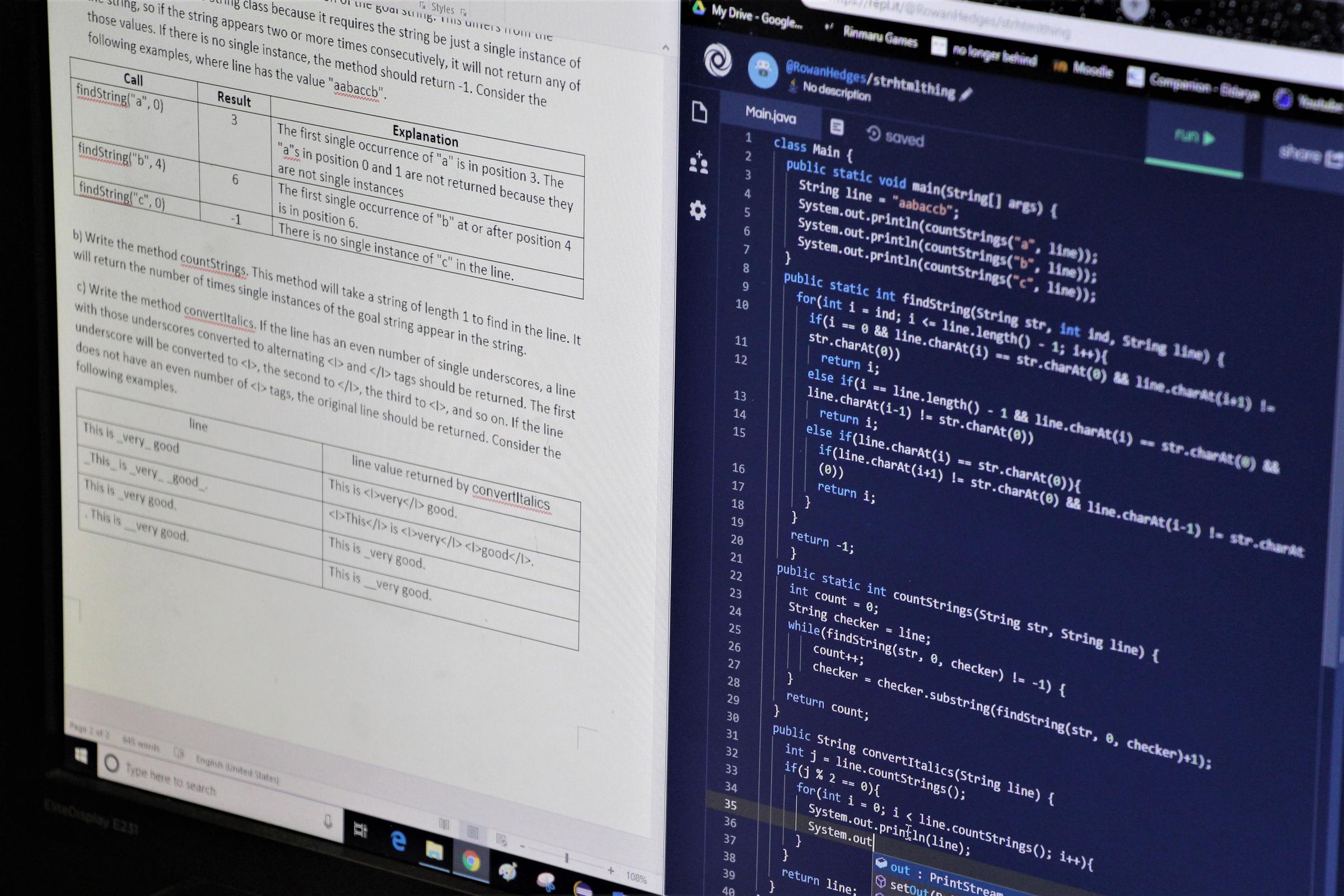
Taylor Howell works on a Java coding assignment in Lisa Whallon’s class at Olathe Northwest High School. CELIA LLOPIS-JEPSEN / KANSAS NEWS SERVICE
Her day may well include some biology or chemistry, history, algebra, English and Spanish. It likely won’t include lessons on how that smartphone — more powerful than the computers aboard the Apollo moon missions — and its myriad colorful apps actually work.
That worries some Kansas businesses, lawmakers and educators who see a disconnect between what students learn and the technologies that have transformed everything from tractors in wheatfields to checkout lines at grocery stores.
But barriers to change abound. Computer wizzes earn more money programming in C++ than teaching it to teens. And cramming computer science into more students’ schedules could cut into time spent learning about evolution, trigonometry or the laws of physics.
“We’re no longer at a time where we can just continue what we’re doing,” said Rep. Steve Huebert, an engineer who chairs the education committee in the Kansas House.
Think about the needs that that creates for large employers, small employers … And everybody’s ability to continue to grow and thrive. – Anna Hennes, Cerner
Huebert recalls learning chemistry, physics and biology in school. But in the working world, computers proved a critical tool for his job — one that he had to learn on the go and that only grew in importance.
If some students think computer science may better fit their career goals, he wonders, why not let them swap a traditional science class for a chance to learn skills such as programming?
“If we can do that,” he says, “it’ll be a win-win for everyone going forward.”
Talent-hungry companies
Code.org, a tech-company-fueled advocacy group, says most American high schools not only don’t make students take computer science — many don’t even offer it.
Meanwhile, businesses hunger for tech talent. Computer science, they argue, lifts students and economies alike in a world where even the smallest of startups need websites, apps, databases and analytics.
“Think about the needs that that creates for large employers, small employers,” says Anna Hennes, a program manager at one of the region’s highest-profile tech firms, medical record software giant Cerner. “And everybody’s ability to continue to grow and thrive.”
Teacher Lisa Whallon and student Christian Crabtree workout the kinks in some Java code at Olathe Northwest High School.
CREDIT CELIA LLOPIS-JEPSEN / KANSAS NEWS SERVICE
Kansas City alone has added thousands of tech jobs in the past decade, and jobs in that line of work generally pay much better than the average gig.
Right now, though, where students live affects their chances of picking up HTML or other coding knowhow at school.
Most states let students who take computer science count it as a credit toward graduation.
That doesn’t help students at high schools without computer science, though. So, a third of states also make sure their schools actually offer it.
A few states go beyond that, requiring computer science education for all students in high school or even before then.
Kansas doesn’t do any of those things.
In February, the issue landed in the House Education Committee, where Cerner lobbied for a bill to let computer science count as a graduation credit. (The original bill called for mandatory computer science education, but Cerner says that version was a mistake.)
Expect the topic to surface again next year. In the meantime, education officials, lawmakers and businesses are meeting, talking, puzzling through the matter.
But it’s tricky. Right now, high school computer science counts as an elective. Requiring all students to take the subject would put districts in a bind. They’d need the right curriculum, technology and software.
Maybe the bigger question is: Where would all those teachers come from? Schools already struggle to find and keep other specialized teachers, such as those for science and math.
Yet letting students instead count computer science toward core graduation requirements means excusing them from something else. Different states take different approaches. Usually, they let students ditch some math or science. More rarely, students can take programming as a foreign language or other credit.
Either way, professor Perla Weaver says, you’ll upset someone.
“There’s things that we have for decades — if not centuries — assumed are part of basic education,” said Weaver, who heads the computer science department at Johnson County Community College and who used to teach high school.
Maybe you could you make a case that computer science would come in handier for a lot of students than knowing the details of DNA, she said, but “boy, don’t say that in front of science teachers. … It’s an insult.”
Many educators and scientists worry students already don’t get enough math and science, and that the nation’s supply of young scientists and its public understanding of critical concepts such as climate change suffer as a result.
A survey by Yale University, for example, found only about half of Kansans believe humans are driving climate change.
Kansas high schools currently require at least 3 years of math and science each for graduation.
New state guidelines
Kansas has long had standards for math, English and other subjects: guidelines that tell teachers when their students should learn about fractions and persuasive essays.
But when should they understand what a space bar is? How passwords work? The risks of social media and the implications of documenting their daily lives online?
In April, Kansas adopted standards for incorporating computer and internet concepts into student learning at all ages. The Kansas State Board of Education gave the go-ahead after months of educators and computer scientists hammering out details, asking for public input. Tweaking, writing, tweaking again.
Even digital natives need explicit instruction about computers, says Lisa Whallon, a computer programmer turned educator at Olathe Northwest High School.
CREDIT CHRIS NEAL / FOR THE KANSAS NEWS SERVICE
Students whose thumbs and index fingers fly across the screens of iPhones and iPads to text friends and do homework land in her coding classes hunting and pecking their way across traditional desktop keyboards.
Whallon makes them build the muscle memory needed to type with ease.
“I have adults say to me, ‘Really? Don’t kids know how to type?’” she says. “I feel like we’re doing our children a disservice by thinking that they just learn stuff.”
The new state standards remain effectively voluntary for schools, but educators still consider them a big deal. The guidelines open the door to creating a specialized license for computer science teachers, preparing students at the state’s colleges of education, and training teachers already working in schools.
And they emphasize “computational thinking” — breaking down problems and then seeing and designing solutions as a series of smaller steps.
“People look at computer science and they think it’s just coding,” said Stephen King, who helped develop the standards at the Kansas State Department of Education. “The reality is, it’s far more widespread, far broader than that.”
Whallon’s coding students at Olathe Northwest make flow charts, bounce ideas off each other and brace themselves for bugs in their code.
Coding an algorithm for a virtual card game took Eric Zhuo five class periods to write in Java.
“That’s the code that I struggled with the most,” the aspiring computer engineer says. “But when I figured out how to complete it, it was a very good feeling.”
None of this conflicts with science education, says Paul Adams, the dean of education and a professor of physics at Fort Hays State University. Kansas standards for science already ask schools to teach computational thinking through that subject.
Students work on Java code at Olathe Northwest High School
CREDIT CELIA LLOPIS-JEPSEN / KANSAS NEWS SERVICE
But if the goal is for more students to try their hand specifically at coding, Adams would prefer integrating programming concepts into other subjects as a tool, much as scientists use it for their work.
“If you present your research in physics, you present your Python code,” he said, referring to a popular coding language used both to calculate results and share methodology. “It’s what we learn to do our science.”
“To say, well, ‘Don’t worry, we’re going to remove, for example, earth and space science, or we’ll take out a biology’” in school and allow coding instead, “then you’ve lost that whole suite of knowledge.”
Equity in education and careers
Just 10 percent of graduating computer science majors at Kansas colleges in 2017 were women. That ratio seems to hold true in Kansas AP Computer Science classes.
It’s a nationwide problem. Students of color are underrepresented, too. That restricts access to good jobs, says Code.org, and hinders diversity among the people who develop the technologies that serve and shape our world.
“We can’t just have white males creating these things and being involved in these things and knowledgeable about these things,” says Pat Yongpradit, the group’s chief academic officer. “We really need everyone to be knowledgeable and involved in creating the future.”
Rowan Hedges, another of Whallon’s Java students aiming for a tech career, is used to being either the only girl or one of just a few in her programming classes.
“I feel like I have to be better than I am at all times,” she said, “or else I’ll be failing the female population.”
“Even though it’s not a hostile environment,” she said, “it just is intimidating to see a ton of guys who … might have people who encouraged them to do the field throughout their life, just because they’re guys.”
If schools pick up on Kansas’ new computer science guidelines and expose more students to computing earlier, teachers hope it could make more girls and students of color feel at home in the world of code.
If the Kansas State Board of Education takes another step by letting computer science count toward graduation (or if the Legislature forces its hand), that could effect change, too. Code.org says computer programming enrollment seems to become more diverse when states count it toward high school graduation.
Yet this would stop short of making sure all Kansas schools offer coding. Nor would it address the fact that wealthy, suburban schools can find teachers and offer specialized classes more easily than those in poorer, more rural or predominantly black or Hispanic parts of the state.
That’s a serious conundrum, says Rep. Rui Xu, another member of the House education committee. And it has no easy solution.
“If we want everybody to have the same opportunity,” says Xu, “then I don’t know that a voluntary program like this solves that.”
Celia Llopis-Jepsen is a reporter for the Kansas News Service. You can reach her on Twitter @Celia_LJ or email celia (at) kcur (dot) org.