Horace Mann Outdoor Classroom dedication, spring 2018. Photo courtesy Brandon Bland | Northwest Missouri State University.
MARYVILLE, Mo. – Dozens of children, teachers, staff, parents and local leaders gathered Thursday morning to celebrate the opening of a unique classroom space outside the Horace Mann Laboratory School on the Northwest Missouri State University campus.
Children crowded onto the Pentagode M – a 16-foot climbing tower that stands as a centerpiece of the classroom – while University and community leaders gathered to cut a nature-inspired ribbon of leaves and other natural materials created by children in Horace Mann’s summer school program.
“We have progress and momentum at Northwest Missouri State University and you’re standing in part of that right here today,” Northwest President Dr. John Jasinski told the crowd gathered for the celebration. He added that the transformation of the landscape adjacent to Everett W. Brown Education Hall is “a good description of innovation and agility” at the University as well as an example of its emphasis on collaboration.
Northwest received a $93,336 grant last year from the Missouri Department of Natural Resources to assist the University with constructing the outdoor classroom. With that award, the DNR, Land and Water Conservation Fund agreed to fund half of the total project costs, and Northwest funded the remainder of the project, which totaled about $187,000.
The finished outdoor classroom provides a recreational space unlike any other in Maryville or the northwest Missouri region. It is designed as a next-generation space that goes beyond a single sport or activity, and it aligns with Horace Mann’s emphasis on curriculum-driven outdoor education, health and wellness, and environmental stewardship.
Additionally, it enhances Northwest’s ability to train aspiring educators who benefit from the clinical teaching environment at Horace Mann and the Phyllis and Richard Leet Center for Children and Families. Northwest’s School of Education emphasizes innovative teaching practices and creating learning experiences that stimulate each child’s creative learning abilities and problem-solving skills.
“Our role at Northwest has long been to prepare educators for the nation’s schools, regional schools, and local schools,” Dr. Tim Wall, the dean of Northwest’s School of Education said. “What better way to learn to teach than to practice teaching in ways that we haven’t been taught to teach. It’s more than a playground; it constructs our ability to reach into the future.”
Distinct learning spaces within the outdoor classroom focus on nature art, outdoor music and messy materials while blending natural materials. It includes a stage for creative play, a place for art, and a gathering area. Other features include a slide, swings, Adirondack chairs, a basketball hoop and a 1/10th mile walking-running path. Rain barrels and polished tree stumps, among other features, encourage sustainable stewardship of the space. Native grasses and flower gardens separate learning spaces and align with the natural beauty of the Northwest campus, which also serves as the Missouri Arboretum.
All of the outdoor classroom’s features also adhere to the Americans with Disabilities Act, ensuring all individuals may enjoy the park.
The outdoor classroom is located directly north of Everett W. Brown Education Hall and is available for use by community members when it is not in use by Horace Mann students and staff.
Tat Hidano still gets the usual questions when he’s overseas recruiting international students to Wichita State University. The big one: Where is Wichita?
A signpost at Wichita State University signifies the direction and distance of the home countries of some of the university’s international students. STEPHAN BISAHA / KANSAS NEWS SERVICE
But lately Hidano has been hearing another question: Will I be safe in the United States?
“The questions about safety in the United States have been dominant,” Hidano said. He says his job has begun to feel less like recruiting and more like diplomacy.
Universities across Kansas saw enrollment by international students — who often pay higher tuition — drop significantly last year, placing a further strain on already tight higher education budgets. At Wichita State, a 10 percent drop in the number of degree-bound international students on campus last fall left a nearly $1 million hole in the university’s budget.
Each year represents the academic year — for example, 2016 represents fall 2015 and spring 2016. SOURCE: Kansas Board of Regents. CREDIT STEPHAN BISAHA / KANSAS NEWS SERVICE
The decline is especially pronounced at Midwestern schools that lack the name recognition and appeal of more prestigious coastal institutions.
“I don’t think the NYU’s and the Harvards and the Yales of the world have anything to worry about but it’s other instutions that may not be as globally known,” said Rajika Bhandari, head of research and policy at the Institute of International Education.
New enrollments dropped about 7 percent for fall 2016 and universities reported that drop continued in fall 2017, though Bhandari says it’s too soon to tell if it’s a blip or a trend.
Since the 2016 presidential campaign and the start of the Trump administration, some students appear to be thinking twice about studying abroad in the U.S.
“If you have an administration that is sending signals to immigrants within this country and sending an ‘America first’ message, which can be easily perceived as ‘America only,’ it’s not surprising that students are re-evaluating whether this is the place where they’ll be able to achieve their academic dream,” said Jill Welsh, the deputy executive director of public policy at the non-profit National Association of Foreign Student Advisers.
The fear factor
Pooja Odedra came from India initially intending to study at American University in Washington, D.C., and then transferred to Butler Community College — partly because tuition at the two-year school near Wichita was cheaper, but also because of the harassment she says she experienced just walking down the street in Washington.
Odedra says Kansas has been kinder, but comments like, “you don’t deserve to be here” and “you’ll be sent back soon anyway” have stuck with her.
“It does make me feel insecure and question if I should be here, if some other country would be better,” she said.
Odedra is still interested in working in media in the United States, but she is concerned about whether she would be able to get a work visa.
There are still well over 1 million international students in the United States — many more than any other country.
“Students still see (the United States) as the best choice for themselves in terms of obtaining a world class, top quality higher education,” said Rajika Bhandari with the Institute of International Education.
At the same time, Saudi Arabia and Brazil have have reduced state-sponsored scholarship programs, leading to fewer students coming to the U.S from the two countries. Also, higher education offerings in other countries have become more competitive, giving foreign students looking to go abroad more options and encouraging others to study domestically.
“There’s been a concern for more than a decade about increasing competition from abroad for the best and brightest,” Welsh said.
Fewer visas
The number of F-1 student visas issued by the U.S. State Department has dropped by about 27 percent in fiscal year 2016 and continued to decline during the first year of the Trump administration by another 17 percent.
The State Department doesn’t break down the data, so it’s unclear to what extent that’s due to a drop in applications. But there does appear to be an increase in visa denials.
SOURCE: U.S. State Department CREDIT STEPHAN BISAHA / KANSAS NEWS SERVICE
“For Spring 2018, we had a much larger number of students that were denied visas,” said Vince Altum, the executive director for international education at Wichita State.
Altum says he’s heard from other recruiters and students from places like India and Sri Lanka indicating that the number of visa denials may have doubled.
“It’s kind of depressing,” he said. “You go through all this work to recruit the students that are excited about coming to Wichita and then they go through a three-minute interview in their home country, they’re denied a visa and their dreams are basically shattered at that point.”
Odedra had her visa interview a few days after the 2016 presidential election. She says several friends and acquaintances of hers have since been denied.
“A high school friend of mine was going to come here (to the U.S.) but then he decided to go to Australia because already quite a lot of our friends were rejected,” Odedra said.
Stepping up recruitment
Many American universities tout the benefits of having a more global campus, but there’s also the money from tuition.
International students pay a lot more than in-state students. At Wichita State, tuition and fees are more than double for international students — about $8,500 a semester compared to $4,000.
Tuition and fees for a semester as an undergraduate in Kansas can be as much as three time more expensive for out-of-state and international students. SOURCE: Kansas Board of Regents. CREDIT STEPHAN BISAHA / KANSAS NEWS SERVICE
Altum and his recruiting team are spending more time visiting community colleges, including Butler Community College, to entice students into continuing their education at the four-year institution. Wichita State recruiters have also visited community colleges out of state, in Dallas and Seattle.
Spending a day at a community college that may have only five or six international students is worth it, says Altum, because those students have already had their visas approved.
“The pie of international students in the U.S. is definitely shrinking,” Altum said. “So in order to maintain our share, we have to work a lot harder to make sure even we get the same number.”
The university recently reduced international tuition by a third for some qualifying international students to draw in more recruits. And the effort has prompted a big spike in the number of applications coming in — Altum is seeing about twice as many applications coming in compared to this time last year.
“These scholarships are giving us a glimmer of hope that we didn’t have last year at all,” Altum said.
Normally at this time, universities would be moving on from fall admissions and shifting to the next recruitment cycle. But Wichita State has extended its recruitment season for fall 2018 in an effort to keep international enrollment from sliding further.
“At this point I’m hoping to at least maintain the students that we have,” Altum said.
Stephan Bisaha is an education reporter for the Kansas News Service. Follow him on Twitter @SteveBisaha.
KANSAS CITY – Law enforcement authorities continue to investigate a shooting and reported abduction.
Just before 6:00p.m. Saturday, Brajaean Sledge walked into a Kansas City Missouri Police Station and identified herself to authorities, according to a media release from KC Police.
She was uninjured. She was talking with detectives in connection with investigation into the shooting and robbery. Anthony King still remains a person of interest that police would like to talk to.
——–
KANSAS CITY —The Amber Alert issued for a missing 15-year-old Kansas City girl was canceled Friday afternoon but she is still missing.
Based on extensive investigation today, we can no longer confirm that Brajean Sledge was abducted, according to Kansas City police.
Police believe Sledge is in the company of a person of interest Anthony King.
Authorities described King as an 18-year-old black male, 5-feet-8 and weighs 140 pounds.
Sledge and person of interest King- courtesy photo
King is considered to be a person of interest in several crimes in connection with this incident, according to police.
Sledge was reported missing after her grandfather was found shot.
Police were called Thursday night to a home where the grandfather was found wounded. He is hospitalized in stable condition.
The man told police he didn’t know the suspect who shot him before leaving with the victim’s granddaughter, Brajaean Sledge. The suspect drove away in the victim’s car.
————–
KANSAS CITY —Authorities have issued an Amber Alert for a 15-year-old girl abducted in Kansas City on Thursday.
Brqajaean Sledge was reported missing after her grandfather was found shot.
Sledge is described as 5-foot-8, weighs 125 pounds with black hair and brown eyes. Police are searching for a 2017 Kia Forte with the Missouri license plate, MB5-G5B.
The suspect drove away in the victim’s car.
Authorities believe the suspect is between the ages of 18 and 20 and may be armed and dangerous.
Authorities are looking for this 2017 Kia Forte with Missouri license plate MB5-G5B.
A potential motive for the shooting has not been disclosed.
(UPDATE 1:19 p.m. Friday) The Kansas City Police Department issued an Amber Alert for an abduction incident that occurred at 2711 Elmwood in Kansas Cityat 5 p.m. on Thursday.
Abducted Is:
Brajean L Sledge a black, female, age 15
Possible suspects or associates are believed to be:
a black male, hgt 5’7”, last seen wearing a gray hooded sweatshirt
The abducted child is:
Brajean L Sledge, is a black, female, age 15, hgt 5’08”, 125 lbs, black hair CURRENTLY STYLED WITH A BLONDE WEAVE , brown eyes, last seen wearing a white V-NECK t-shirt and dark pants.
Brajean Sledge-courtesy photo
Brief circumstances regarding the abducted child incident:
On 06/21/2018, at approximately 5:00pm. officers of the Kansas City, Missouri Police Department responded to 2711 Elmwood regarding a shooting. Upon arrival, it was determined that a shooting occurred and that the juvenile may be in immediate danger as a result of the incident. The suspect should be considered armed and dangerous. He is described as a black male, 18-20 years old, 5 feet 7 inches tall last seen wearing a grey hooded sweatshirt.
There is currently no suspect vehicle.
Anyone seeing the abducted child, suspect, associate, or vehicle, or anyone having any information related to the Amber Alert should immediately dial 911 to contact the nearest law enforcement agency or call the Kansas City Police Department at 816-234-5000.
=====
KANSAS CITY, Mo. (AP) – Police in Kansas City, Missouri, are searching for a 15-year-old girl who was reported missing after her grandfather was found shot.
Police were called Thursday night to a home where the grandfather was found wounded. He is hospitalized in stable condition.
The man told police he didn’t know the suspect who shot him before leaving with the victim’s granddaughter, Brajaean Sledge. The suspect drove away in the victim’s car.
Authorities believe the suspect is between the ages of 18 and 20 and may be armed and dangerous.
A potential motive for the shooting has not been disclosed.
KANSAS CITY, Mo. (AP) – Kansas City police are investigating the shooting death of a man near a house in the Oak Park Northwest neighborhood, just west of Central Park.
Police say officers patrolling the area around 1 a.m. Saturday heard gunshots and went to investigate.
Officers found 30-year-old Justin Powell shot near a house. He was declared dead at the scene.
Police have not made any arrests and say they have no suspect description. Police are asking anyone who may have seen anything to call the TIPS hotline.
SALINA, Kan. (AP) — The Latest on the Republican primary race for Kansas governor (all times local):
Kansas Gov. Jeff Colyer is attacking Secretary of State Kris Kobach’s anti-abortion credentials in the Republican gubernatorial primary.
Colyer raised abortion an issue in his opening statement during a debate Saturday in Salina. The influential anti-abortion group Kansans for Life has endorsed both of them and also says Insurance Commissioner Ken Selzer is “pro-life.”
But Colyer quoted from a newspaper-questionnaire statement by Kobach in a failed run for the state Senate in 2000, expressing support for abortion rights.
Colyer said: “We need a governor who is pro-life and will always tell the truth.”
Kobach acknowledged he supported allowing abortions in some circumstances as a law student. He said seeing a sonogram of his first daughter in the womb made him “100 percent pro-life.”
He added: “Don’t believe the lies.”
____
2:30 p.m.
Kansas Secretary of State Kris Kobach is defending his seeking a pardon for a corporate campaign donor’s vice president that Gov. Jeff Colyer recently denied because the police said the crime involved threatening a cab driver with a gun to the head.
Colyer asked Kobach during a Republican gubernatorial debate Saturday whether Kobach would pardon Ryan Bader.
Kobach was Bader’s attorney for the pardon. Bader pleaded guilty to attempted robbery stemming from a 2009 cab ride after a round of drinking. His record was expunged in 2014.
Kobach accused Colyer of lying about the incident, saying a judge found a gun wasn’t involved.
The judge who sentenced Bader checked a box on a sentencing form saying a deadly weapon wasn’t involved. But a police affidavit said the cab driver reported the threat and a gun was found in Bader’s home.
___
12:11 p.m.
Illegal immigration is a key issue for Kansas Republicans as their primary contest for governor grows increasingly contentious.
Secretary of State Kris Kobach is a hardliner who has advised President Donald Trump. He made potential state initiatives against illegal immigration an important theme during a debate Saturday in Salina.
Illegal immigration is a critical issue for our state. The Left is fighting hard and we need someone in the governor’s office who will fight back. I’m your man. #ksleg#ksgov#TeamKobachpic.twitter.com/3ZLDJ3QLwE
He’s trying to unseat Republican Gov. Jeff Colyer in the Aug. 7 primary. Colyer said he supports Trump and believes the U.S. government needs to get illegal immigration under control.
The debate’s third major GOP candidate, Insurance Commissioner Ken Selzer, said the first priority is securing the U.S.-Mexico border.
Colyer and Selzer also are appealing to business and agriculture interests nervous about tough immigration policies while wooing conservatives. Colyer attacked Kobach on multiple other issues.
TULSA, Okla. (AP) — A Kansas-based company is seeking proposals from private rail carriers to provide passenger service between Tulsa and Oklahoma City.
image courtesy WATCO
The request for proposals by WATCO Companies of Pittsburg, Kansas, would create passenger rail service from downtown Tulsa through the cities of Sapulpa, Bristow, Stroud, Chandler and Midwest City into downtown Oklahoma City.
Legislation adopted in 2011 created a task force to study ways to link northeastern Oklahoma with the existing Heartland Flyer passenger service between Oklahoma City and Fort Worth, Texas. The state sold an existing rail line to Watco, which currently operates freight service over the line and plans upgrades to accommodate passenger cars.
Proposals are due on July 27. State Rep. Monroe Nichols of Tulsa says bringing passenger rail service to Tulsa is a “fantastic economic development opportunity.”
Bike safety drills at the St. Joseph Police Department’s Cops Care Youth Camp 2017. Photo by Sarah Thomack.
The St. Joseph Police Department works to invest in youth with programs throughout the year and is hoping to implement a mentorship program soon.
“We’re really trying to invest in our youth and that’s something that we see as the future of our community,” said St. Joseph Police Chief Chris Connally. “We’re in our strategic planning process, we had a lot of feedback with interest in seeing that involvement as well. We feel like the more we can have an impact, the more we can development a relationship, the stronger that makes the community and, particularly at-risk kids, hopefully we can have a positive influence and help them go a positive direction.”
A recent event the department put on was a picnic at the Bartlett Center and upcoming events include the yearly Cops Care Camp and a new Junior Police Academy.
Connally said they are in the planning stages of implementing a mentoring program for older at risk youth.
“We’re already planning on seeing how we can interact with the 15 to 18 year-olds, hope to get them exposed to career opportunities that are available in the community, work with them on everything from interview skills to… how to tie a tie, things to that nature,” Connally said. “Some of our kids in the community don’t always get that mentoring… so if we can do that, and we can help some of them be more successful or create a relationship when they have a challenge in their life, that they can come to us and we can refer them somewhere or help them directly, I think that’s something we really need in the community.”
For more information about the St. Joseph Police Department’s youth programs or school resource officers, click here, or visit the department’s Facebook page.
RANDOLPH COUNTY — One person died in an accident just before 2p.m. Friday in Randolph County.
The Missouri State Highway Patrol reported a 2010 Mack trash truck driven by Nathan D. Dunlap, 36, Macon, was westbound on County Road 2655 three miles north of Clark.
The driver failed to yield at the railroad tracks. A southbound General Electric Train struck the truck. Dunlap was pronounced dead at the scene.
He was wearing a seat belt at the time of the accident, according to the MSHP.
TOPEKA, Kan. (AP) — Kansas’ child welfare agency conducted a snap inspection Friday of Topeka group homes housing unaccompanied immigrant children after Democratic state lawmakers accused Republican Gov. Jeff Colyer of not being aggressive enough in pressing for information about the children.
The afternoon inspection ordered by Colyer resulted a few hours later in a two-paragraph report from the state Department for Children and Families that the five homes operated by The Villages on a wooded 400-acre site just outside Topeka are meeting the immigrant children’s needs. The statement from agency spokeswoman Taylor Forrest did not elaborate on the inspector’s findings.
The Villages has had a contract with the federal government — worth more than $5.9 million over two years — to house 50 unaccompanied immigrant children ages 6 to 18 since February 2017. It’s not clear exactly how many now in the homes were separated from their parents during a recent crackdown on illegal crossings of the U.S.-Mexico border.
Colyer spokesman Kendall Marr said the state “does not manage or have control over” The Villages’ contract but can inspect its homes to ensure that they meet state standards. DCF licenses youth residential centers; The Villages also has two other group homes in Lawrence.
“Our hope and expectation is that these children are returned to their families as soon as possible,” Marr said.
Colyer ordered the inspection only hours after Democratic legislators criticized him during a Statehouse news conference. They suggested that he’s been too passive about seeking answers because he’s in a tough Republican primary race to retain the governor’s office this year.
One of Colyer’s leading GOP rivals is Secretary of State Kris Kobach, a conservative firebrand nationally known as an advocate of tough policies against illegal immigration, and he’s advised President Donald Trump on homeland security issues.
“I believe that would explain his reluctance to enter the fray,” Hensley said of Colyer during the Democrats’ news conference.
Two other Democrats at the news conference, House Minority Leader Jim Ward, of Wichita, and Rep. John Alcala, of Topeka, said Colyer’s decision to order an inspection was a good first step. The three lawmakers, joined by Rep. Ponka-We Victors, a Wichita Democrat, demanded more transparency and details about how the federal dollars are being spent.
Alcala said he also wants to know whether immigrant children are being mixed with troubled youth. He said checking on conditions at The Villages’ homes was his “lowest priority.”
“I don’t think there are any questions about the condition of the facilities,” Alcala said. “They’ve had a pretty good reputation.”
Forrest said in the DCF statement that Secretary Gina Meier-Hummel was satisfied that the immigrant children “are being provided excellent service.”
“From our visit, the children seem to be adjusting well, and are having their needs met,” Forrest said.
Trump on Wednesday ordered an end to family separations amid the political backlash it inspired. Marr said Colyer “stands behind the president and his executive order” ending separations.
The Villages had not been saying how many immigrant children in its care were separated from their parents, as opposed to those who were unaccompanied. Executive Director Sylvia Crawford told Kansas News Service on Friday that The Villages began taking children separated from their parents about two weeks ago but a majority of the immigrant children in the homes were unaccompanied.
The Democrats said they called their news conference after Colyer’s office told them it had no information about the immigrant children at The Villages. Also, they said, The Villages told them it needed two weeks’ notice for a tour — something they had hoped to do Thursday.
Ward and Hensley said they’re skeptical that Trump’s administration did not at least notify a Republican governor that children separated from their parents would come to his state. Ward later said he doubts the federal government would bring the children to Kansas if Colyer objected.
But Marr said it’s unfair for Democrats to accuse Colyer of “colluding with the Trump administration” when they don’t have “any sort of evidence.”
————–
TOPEKA, Kan. (AP) — Democratic lawmakers are demanding that Republican Gov. Jeff Colyer be more aggressive in seeking answers about immigrant children housed in northeast Kansas group homes.
Several Democrats had a news conference Friday to argue that Colyer is too passive about reports that children separated from their parents at the U.S.-Mexico border are being housed by the nonprofit agency The Villages.
Colyer spokesman Kendall Marr said the federal government didn’t notify the administration of its plans and the state has sought information.
Protestors at the Texas border -Photo courtesy People’s Action
The Villages confirmed Thursday that it has a federal contract to house 50 unaccompanied immigrant children at its seven group homes in Topeka and Lawrence. But it would not say whether any of them had been separated from their parents during recent crackdown at the border.
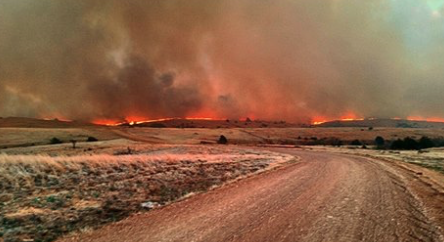
A legislative audit released this week concluded that while wildfires in Kansas are becoming more frequent, a lack of resources and coordination are hampering the state’s ability to fight them.
South Central Kansas wildfire
Firefighting duties and resources are spread across three separate agencies, which auditors said is complicating wildfire response and communication between state and local officials.
The Kansas Fire Marshal’s Office is the lead agency for wildfire response, but it has no firefighting resources. Those resources are held by the state Forest Service, which doesn’t have enough funding to deploy the equipment. The Division of Emergency Management also serves a supporting role.
The state agencies join firefighting efforts when they’re requested by local officials.
“Local jurisdictions do not always know when to call for state assistance, what resources are available through the state or how the state wildfire suppression system is supposed to work,” the report found.
It’s a similar situation when it comes to training 13,000 local firefighters, the audit found. The Forest Service has the expertise, but not enough funding to provide adequate training.
Republican Rep. Melissa Rooker, one of the lawmakers who requested the audit, says she wasn’t surprised by the results.
“We have a lot of work to do. I think the most significant thing we can do is provide (funding),” she said. “It won’t take a lot of funding. A million dollars more would make a significant difference.”
According to the audit, Kansas spends less per square mile on preparedness and fighting wildfires than other Great Plains states. At the high end, Texas spends $144.83 per square mile. At the low end, South Dakota spends $19.20 per square mile. Kansas spends much less — just $4.50 per square mile.
More dollars would be used to boost staff, equipment and especially training, says State Forester Larry Biles.
“At this point, we’ve got the equivalent of one full-time (teacher) trying to serve 13,000 students,” he said.
If the agency receives more funding, Biles says they would hire more staff for teaching and establish regional offices that can more easily coordinate with local agencies.
“If we’re going to be responsive to the wildfire challenges,” he said, “additional staff will make a great deal of difference.”
Kansas Fire Marshal Doug Jorgensen agrees more funding is needed, but he is pushing back on some of the details.
Jorgensen says the audit overcounts the number of fires in recent years, making the situation appear worse than it really is. He says the audit relied on a study using satellite fire tracking and that study didn’t differentiate between wildfires and purposeful fires like controlled burns.
While some large recent fires have led to a hundreds of thousands of acres burned, the state fire marshal says responders have had fewer to deal with.
“Overall, actual fires have decreased in the last three or four years,” Jorgensen said.
And he says recent recent improvements to training and communication aren’t reflected in the audit.
“There wasn’t anything in the report about the improvements that we’ve made and how we lessened the amount of fires and the length of fires this year,” he said.
Stephen Koranda is Statehouse reporter for KPR a partner in the Kansas News Service. Follow him on Twitter @kprkoranda.