TOPEKA, Kan. (AP) — Political and industrial trade group leaders in Kansas are urging President Donald Trump not to scrap the North American Free Trade Agreement, fearing that doing so would hurt major Kansas export industries like agriculture and aviation.
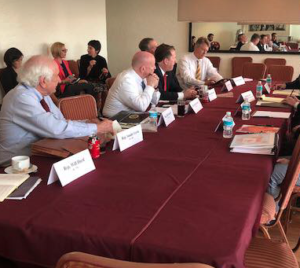
Marshall and negotiators met in Mexico City on March 3-photo courtesy Rep. Roger Marshall
The Trump administration has been in talks with Canada and Mexico to renegotiate NAFTA, a deal Trump once called “the worst trade deal maybe ever signed anywhere” during the 2016 campaign.
Republican Kansas Gov. Jeff Colyer supports the negotiations, but is among those who wrote to Trump earlier this month in support of maintaining NAFTA, KCURreported this week.
“We want to make sure that Kansas industries continue to thrive and grow,” Colyer said. “We’re a very competitive state.”
Canada and Mexico are key destinations for farm products grown in Kansas, said Josh Roe, deputy secretary of the Kansas Department of Agriculture. He said that agriculture and aviation in 2016 accounted for more than half the dollar value of Kansas’ exports.
Some lawmakers also are concerned about tariffs on steel and aluminum recently announced by Trump. State Rep. Jim Ward, the top Democrat in the Kansas House, worries about retaliatory tariffs.
“Agriculture would be devastated by tariffs or a trade war,” Ward said.
During a recent visit to Spirit AeroSystems in Wichita, Republican U.S. Sen. Jerry Moran pointed to an airplane fuselage as an item that could be impacted by aluminum tariffs.
“The fuselage that we’re celebrating here at Spirit is 100 percent aluminum,” Moran said. “(A tariff) has a consequence in the price.”
NEW ORLEANS (AP) — A change-of-plea hearing has been set for a former official of a company that abandoned tons of potentially explosive artillery propellant in Louisiana.
Koons photo Bayou Dorcheat Correctional Center
Lionel Koons was inventory control manager for Explo Systems when it went bankrupt in 2013, leaving 7,800 tons (7,100 metric tons) of M6 propellant on land leased from the Louisiana National Guard.
He has pleaded not guilty to 31 counts.
Online court records show that Friday, Judge Elizabeth Foote scheduled a change-of-plea hearing for Koons next Friday in Shreveport.
One company co-owner pleaded guilty in December to reduced charges.
Trial is scheduled in June for the other owner and four co-defendants.
Prosecutors say they will show the second owner also ordered employees of a Kansas company to store explosives in unsafe conditions from 2000 into 2002.
A decade ago, Kansans felt an earthquake once every few years. Now ground tremors come regularly. One of the hardest hit areas is Harper County in the south central part of the state.
Anthony, Kansas, has been at the heart of Kansas earthquakes after the proliferation of wastewater disposal wells. BRIAN GRIMMETT / KANSAS NEWS SERVICE
It’s no coincidence, scientists and state regulators agree, that Harper and Sumner counties are also where massive amounts of wastewater has been pumped below ground by outfits drilling for oil and natural gas.
Right in the middle of the heart of Kansas’ earthquake problem is the city of Anthony, Kansas. The mayor, Greg Cleveland, also happens to be an insurance agent.
“I would have never thought, in my life, that I’d be selling earthquake insurance,” he said. “Man, I tell you when those first few hit, I mean, our office just went nuts.”
Still, the debate about what’s causing the earthquakes, and how to prevent more, rages on.
Scientists know that wastewater injection wells can cause earthquakes, but only if the conditions are right. They say many solutions proposed by environmentalists are too broad.
And even though geophysicists are beginning to better understand what spots might be vulnerable to earthquakes, predictions are never fully certain.
Regulations the Kansas Corporation Commission uses to evaluate new well applications don’t take into account the likelihood of it causing an earthquake either. Regulators are focused mainly on preventing one of the state’s more than 4,500 injection wells from contaminating fresh water.
So there’s no rule that demands action be taken to avoid earthquakes until they are already happening.
Cleveland said his company’s never paid out on earthquake insurance claims because coverage only applies to catastrophic damage — things such as the collapse of an entire wall.
Cracks in walls and foundations just aren’t that big of a deal. It’s also difficult to prove an earthquake caused them and that it’s not just the regular settling of an old house.
Members of the Anthony, Kansas, City Council have seen the economic stimulus, and the earthquakes, that came with oil and gas drilling. CREDIT BRIAN GRIMMETT / KANSAS NEWS SERVICE
“It was super alarming, and very scary at first,” said Jan Lanie, an Anthony city commissioner. “Then we kind of got used to it.”
Even with the earthquakes, she said, it was hard to not like the economic development the oil and gas boom was creating in her town.
It’s a trade-off many in the region welcome.
“If it hadn’t of been for the oil that we had and some of the money that the farmers were able to get, it could have been pretty tough for this county,” Gwen Warner, executive director of the Anthony Chamber of Commerce said.
At first, Warner worried about the earthquakes, too. But, like others in Anthony, she eventually got used to them. She’s also felt significantly fewer quakes since the Kansas Corporation Commission put a cap on the amount of wastewater that could be injected into the area. She said she thinks they’re doing a good job of addressing the known problems.
The Kansas Geological Survey has found that since the restrictions went into place in Harper County, the number of detected earthquakes has dropped by more than half.
From September 2015 to February 2016 the affected area saw 2,263 earthquakes. During that same period spanning 2016-2017, the number of earthquakes dropped to 668.
“What that order showed was that with targeted regulation, that we can have an impact,” said Rick Miller, Senior Scientist with the Kansas Geological Survey.
But not everyone is happy with how the KCC is handling the issue.
Cindy Hoedel, who lives in a small town in Chase county in the Flint Hills, became concerned with the issue after she felt an earthquake shake her home.
She lives more than 100 miles from the epicenter of most of the earthquakes. But when a company wanted to put a wastewater injection well just North of her home, she and a group of friends filed a protest with the KCC.
They didn’t really know what they were doing, however, and ended up losing.
The group needed to show that the well was an immediate threat to the public. Without a history of seismic activity nearby, the commissioners decided it wasn’t.
The defeat didn’t discourage Hoedel. In many ways, it emboldened her group.
“We know that they’re causing earthquakes,” Hoedel said. “So, I would like to see these wells shut down. … I’m not convinced the damage is being mitigated or prevented.”
Rick Miller, senior scientist with the Kansas Geological Survey, has seen the increase in earthquakes and success of some measures to reduce their frequency. CREDIT BRIAN GRIMMETT / KANSAS NEWS SERVICE
Hoedel’s group has begun protesting as many wells as their limited resources allow. They’ve also been lobbying the legislature to make changes to how the KCC regulates injections wells. That includes a bill that would expand the injection limits in Harper County statewide.
But Miller says that isn’t necessary. The ground isn’t shaking in western Kansas, where huge amounts of wastewater injection is also happening.
“It all has to do with the geology,” he said.
The Kansas Geological Survey continues to monitor earthquakes around the state and are beginning to gain a better understanding of where people should and shouldn’t put new wastewater injection wells.
Miller said that he’d recommend against giving a permit to anybody who wants to put a disposal well where they have already seen a lot of seismic activity.
JEFFERSON COUNTY — Law enforcement authorities are investigating a murder and now have three suspects in custody three
Just before 10a.m. Wednesday, The Jefferson County Sheriff’s Office received a call from a Douglas County Detective advising he had received a call from a subject stating they witnessed a murder Tuesday night at Perry Lake, according to Sheriff Jeffrey Herrig.
Blevins -photo Jefferson Co.
Jefferson County Sheriff’s Office responded to the reported area at Perry Lake. They found the body of an unidentified man with apparent gunshot wounds. The victim was later identified as 22-year-old Taylor Sawyer.
Following an investigation, deputies made an arrest in Lawrence.
They booked Jonathan Blevins, 22, Topeka, Kansas into the Jefferson County Jail Wednesday afternoon on requested charges of Intentional 2nd Degree Murder.
Sarah Hammerling -photo Jefferson Co.
On Friday night, deputies arrested 18-year-old Ashlyn Hemmerling on a requested charge of first degree murder, according to the sheriff’s office booking report. They also booked 37-year-old Sarah Hemmerling on a requested charge of Obstructing apprehension of prosecution; Committed or charged with felony. Both are being held on a $100,000 Bond, according to the sheriff’s department.
LEE’S SUMMIT, Mo. (AP) – Authorities say charges have been dropped against a teen initially accused of being among a group who brought guns onto Lee’s Summit High’s campus.
Landon Mikle
The Kansas City Star reports that 18-year-old Landon Mikle no longer faces a felony weapons count. The Jackson County Prosecutor’s Office says a closer review of evidence led to the dismissal.
Eighteen-year-old Tynan B. Mullen, 17-year-old Tanner Nicholson and 19-year-old Scott Ryan are still each charged with unlawful use of a weapon, a felony count punishable by up to four years in prison.
A witness reported seeing suspects in a car with an assault-style rifle, a shotgun and a handgun after classes ended for the day on March 1 at the school. Court documents say at least one suspect threatened a person and flashed the guns.
Lee’s Summit police later tracked down the car at a home and found the AR-15 rifle and other weapons.
A St. Joseph man was killed in a crash early Saturday morning on I-29.
According to the Missouri State Highway Patrol, 55-year-old Jesus J. Faudoa-Morales was driving a Ford Explorer south on I-29 in Holt County at 4:18 a.m. Saturday. Around mile marker 75, five miles north of Oregon, the vehicle skidded, went off the west side of the road, returned to the road and skidded off the east side of the road into the median. The vehicle overturned onto the northbound lanes of I-29. Faudoa-Morales was ejected through the driver’s window.
He was pronounced deceased at the scene at 5 a.m. by Holt County Coroner Susan Lentz.
According to the crash report, Faudoa-Morales was not wearing a seatbelt.
OLATHE, Kan. (AP) — The Johnson County Health Department says eight measles cases have been confirmed in the eastern Kansas county.
The department said Thursday that seven of the cases were reported at a child care facility. The other case was associated with the center but was seen at a doctor’s office and is being investigated to determine if the child was the source of the exposure.
The department said three of the cases reported were in children less than a year old, who are too young to be vaccinated against the disease.
The affected children and others who may have come in contact with them will be barred from the center for 21 days following the last exposure to the disease.
Johnson County is part of the Kansas City, Missouri, metropolitan area.
DUNKLIN COUNTY — One person died in an accident just before 8:30p.m. Friday in Dunklin County.
The Missouri State Highway Patrol reported a 2010 Chevy Camaro driven by Jason D. Wommack, 29, Gobler, was eastbound on MO. 164 just west of Arbyrd.
The vehicle was passing another vehicle and hit a pedestrian identified as Jacob E. Mangrum, 14, Cardwell in the road. Mangrum was pronounced dead at the scene.
Wommack was not wearing a seat belt and not injured, according to the MSHP. Authorities released no additional details.
Maryville, Mo. – Northwest Missouri State University recently competed against cities in seven Midwest states to win Ripple Glass’ inaugural Glass Recycling Program of the Year Award.
According to a press release, as the award’s first recipient, Northwest will receive a semi-truck load of Owen’s Corning fiberglass insulation, a $10,000 retail value, which will be used for energy conservation projects.
Northwest grew its glass recycling program from 59.60 tons in 2016 to 63.39 tons in 2017. Additionally, Northwest is preparing its recycling and pellet plant to serve as a regional recycling drop-off location.
A panel of independent judges scored Northwest’s application against a group of competing programs that also offer glass recycling programs.
“Northwest scored highly because of their dedication to providing recycling solutions to their community,” said Lauren Henry, regional program manager for Ripple Glass. “In order to meet the continuing need, the recycling plant staff refreshed the collection site on campus and expanded its infrastructure to accommodate intake from the community.”
Northwest’s recycling program has been recognized three times by the Missouri State Recycling Program. The University’s recycling annually generates revenues of more than $25,000 and helps Northwest avoid paying more than $17,000 in landfill fees while diverting about 361 tons from the local landfill.
March madness has many Kansans filling out their NCAA brackets. Kansas lawmakers are considering legislation that could tap into that market by legalizing sports gambling in the state.
A bill before the House Federal and State Affairs Committee would allow sports betting through the Kansas Lottery. At least one major professional league says it wants some input on the rules, and a cut of the winnings.
Federal law doesn’t allow legal sports betting in most states — yet. FILE PHOTO by SAM ZEFF
Currently, federal law bars most states from allowing sports gambling. However, a lawsuit surrounding a New Jersey law and pending before the U.S. Supreme Court could knock down the federal rule. That would let Kansas and other states authorize sports gambling, and to tax it.
“You never know what the Supreme Court’s going to do, but a number of states have kind of jumped on the bandwagon looking at this,” said Republican Rep. John Barker, chairman of the Kansas House committee considering the bill.
Yet Barker said he doubts the bill will make any headway. He said he’s still considering his stance on the issue, but he said the committee could consider other proposals this year to allow sports betting.
“There’s a possibility,” Barker said. “It’s a great revenue source. It would not be a big revenue source, but it would be a good revenue source.”
The hearing Tuesday had the attention of some major sports organizations. Major League Baseball sent Bryan Seeley, its senior vice president of investigations and deputy general counsel.
He said the league has opposed gambling for years, but he didn’t urge lawmakers to reject the idea. Instead, he said if Kansas legalizes sports gaming it needs to put controls in place so games aren’t fixed.
“Anything that gives players an incentive to not perform at their absolute peak is a huge danger to our business and can cost us tens, if not hundreds, of millions of dollars,” Seeley said.
Fixing can be more subtle than deciding the winner of a game, or even the point spread, Seeley said. Pro sports officials fret about much more specific bets — over a single pitch in a baseball game or the first foul in a basketball game.
“Those are the kind of bets we worry about,” Seeley said. “That’s why we want to have a say in whether casinos can offer those kinds of bets.”
The league wants rules over data sharing so they can spot betting trends that might indicate a player or umpire was planning to make a pre-arranged move.
Seeley said all that number crunching won’t be cheap. So MLB is also asking for a cut of the gaming revenue to help cover the league’s costs.
That didn’t sit well with Richard Klemp, director of governmental affairs for Boyd Gaming. The group owns the Kansas Star Casino in Mulvane. He said the firm opposes the so-called “integrity fee” going to sports leagues because there’s no such fee for sports gaming operations in Nevada.
“Which have been operating for decades in Nevada with a spotless record in terms of integrity,” Klemp said.
Casino representatives and MLB also disagreed on how the gaming should take place. Seeley argued for mobile apps allowing people to gamble on their phones. Without that, he said, people would continue to use illegal gaming apps for convenience.
Whitney Damron spoke to lawmakers on behalf of Kansas Entertainment, the company that owns the Hollywood Casino in Kansas City, Kansas. He said sports gaming should take place inside casinos or other gaming facilities.
“The public does have an interest in this kind of wagering,” Damron said. “It can be provided in a protected manner.”
Stephen Koranda is Statehouse reporter for Kansas Public Radio, a partner in the Kansas News Service. Follow him on Twitter @kprkoranda.