DEKALB COUNTY — One person was injured in an accident just after 5p.m. Sunday in DeKalb County.
The Missouri State Highway Patrol reported a 2004 Nissan Sentra driven by Bryson T. McDowell, 22, St. Joseph, was northbound on Northwest Polk Road just north of Northwest Bray Road one mile north of Union Star.
The driver lost control of the vehicle. It traveled off the road, struck a fence post, a utility pole and a second fence post.
Grand River EMS transported McDowell to Mosaic Life Care. He was not wearing a seat belt, according to the MSHP.
FAIRBANKS, Alaska (AP) — A man who became lost on an Alaska mountain trail has been safely located by searchers.
26-year-old Logan Holmer of Missouri was among four hikers on Far Mountain Trail Thursday who were reported overdue.
Searchers located Holmer in good condition on a ridge around 4 p.m. Saturday.
Alaska State Troopers, Alaska Wildlife Troopers, Wilderness Search and Rescue, Civil Air Patrol, Alaska State Park Rangers and PAWS search dog teams began searching for Holmer after he was reported missing.
Police say the other three hikers in his party returned to the Chena Hot Springs Resort near Fairbanks, but Holmer remained missing until Saturday.
Authorities did not provide details of when the three hikers returned or how they were separated from Holmer.
KANSAS CITY – A Kansas City man was convicted by a federal trial jury Friday for his role in a three-months-long conspiracy that included at least 27 armed robberies, culminating in the armed robbery of a Walgreens in Blue Springs, Mo., in which a suspect was fatally shot by law enforcement officers.
Police on the scene of the pharmacy robbery in 2016 photo courtesy KMBC
According to the United State’s Attorney, Shannon R. Thomas, 28, was found guilty of participating in the conspiracy as well as participating in ten armed robberies. He was also found guilty of ten counts of brandishing a firearm in furtherance of a violent crime, and one count of being a felon in possession of a firearm. Thomas faces a mandatory minimum sentence of 70 years in federal prison without parole.
Evidence introduced during the trial indicated that Thomas and co-conspirators robbed 27 businesses in Blue Springs, Independence, North Kansas City, Raytown, Kansas City, Mo., and Kansas City, Kan., at gunpoint from Jan. 2 to March 24, 2016. In addition to the armed robberies charged in the indictment, evidence was introduced during the trial of other, uncharged robberies that were committed in furtherance of the conspiracy. Victim businesses included convenience stores, pharmacies, and other businesses.
The robberies followed a similar pattern: Two or three conspirators entered the business armed with handguns, wearing gloves, hoodies, and/or masks. The hoodies were drawn tightly over their faces to obscure their features. The employees were forced at gunpoint to hand over money from the cash register and the safe. The thieves wore the same hoodies in nearly all the robberies; Thomas wore a blue Kansas City Royals hoodie for the majority of the robberies he committed.
The spree of robberies culminated on March 24, 2016. Thomas, along with co-defendant Deonte J. Collins-Abbott, 24, of Grandview, Mo., and Jermon Seals of Shawnee, Kan., robbed the Walgreens at 7 Highway and Duncan in Blue Springs. Thomas placed a Springfield Armory .40-caliber semi-automatic pistol to the back of an employee’s head and took money from the front register. Collins-Abbott and Seals went over the pharmacy counter and took prescription grade cough syrup at gunpoint from the pharmacist. They left the business but were confronted by law enforcement officers as they were walking back to the vehicle. They failed to comply with the officers’ commands; Seals turned towards the officers, pointing a gun in their direction. Officers returned fire and Seals was fatally struck in the exchange. Thomas and Collins-Abbott were apprehended by officers after a short foot chase.
Collins-Abbott pleaded guilty and was sentenced to 25 years in federal prison without parole. Collins-Abbott admitted that he committed eight armed robberies between Feb. 3, 2016, and March 24, 2016.
Co-defendants Kevin T. Thompson-Randell, 23, and Demetrius Nelson, 26, both of Kansas City, Mo.; and Parrise K. Black, also known as “Kilo,” 26, and Frank A. Garner, Jr., 25, both of Grandview, have also pleaded guilty and await sentencing.
Following the presentation of evidence, the jury in the U.S. District Court in Kansas City, Mo., deliberated for approximately three hours before returning the guilty verdict to U.S. District Judge Greg Kays, ending a trial that began Monday, May 6, 2019.
Under federal statutes, Thomas is subject to a sentence of up to 20 years in federal prison without parole for participating in the conspiracy, and up to 20 years in federal prison without parole for each of the ten armed robberies. Thomas is also subject to a mandatory minimum sentence of seven years in federal prison without parole for each of the ten counts of brandishing a firearm in furtherance of a crime of violence, which must be served consecutively. The maximum statutory sentence is prescribed by Congress and is provided here for informational purposes, as the sentencing of the defendant will be determined by the court based on the advisory sentencing guidelines and other statutory factors. A sentencing hearing will be scheduled after the completion of a presentence investigation by the United States Probation Office.
ST. JOSEPH, Mo. – The following is a list of general highway maintenance and construction work the Missouri Department of Transportation has planned in the Northwest Missouri region for the week of May 13 – 19.
Continued flooding may cause schedule changes in some of the planned work. There may also be moving operations throughout the region such as pothole patching, striping, signal work, etc., in addition to the work mentioned below.
All work is weather permitting and subject to change.
Andrew County
Route O – CLOSED at the Platte River Bridge for a bridge replacement project. The bridge will be closed through the end of September. Click here for more information.
I-29 – Bridge joint repair, southbound only, at the Nodaway River Bridge, May 13 – 16. This includes a 12-foot width restriction.
Business U.S. 71 – Resurfacing project from Main Street in Savannah to just south of Interstate 29, May 13 – 17. One lane, each direction, will remain open at all times. A 14-foot width restriction is in place.
Atchison County
Route CC – CLOSEDUNTIL FURTHER NOTICE due to a damaged culvert under the roadway.
Route J – CLOSED at the Tarkio River Bridge for a bridge replacement project through the end of August. Click here for more information.
U.S. Route 136 – Pothole patching from 10th Street to 1st Street, May 13 – 17
U.S. Route 59 – Pothole patching from Walnut Street to Park Street, May 13 – 17
Routes J, N and W – Pothole patching, May 13 – 17
Buchanan County
U.S. Route 36 – CLOSED at the ramp from westbound U.S. Route 36 to Route 759 through the end of May.
U.S. Route 36 – Milling and resurfacing on various ramps between the ramps at 22nd Street and the ramps at the Belt Highway, May 13 – 16
U.S. Route 59 – Drainage work in the city limits of Halls, May 13 – 17
Route HH – Drainage work one mile south of DeKalb, May 14
U.S. Route 169 (Belt Highway) – Permit work in the southbound lanes just north of Pear Street, May 15 – 16
Caldwell County
U.S. Route 36 – Pavement repair from Route A to U.S. Route 65 (Livingston County), May 13 – 16
Carroll County
Route C – CLOSED until further notice at the Branch of Turkey Creek Bridge due to damage from flooding.
Chariton County
U.S. Route 24 – Bridge maintenance at the Long Creek Bridge and Chariton River Bridge near Keytesville. The bridges will be narrowed to one lane with a 15-foot width restriction through May 31.
Route 129 – CLOSED for a culvert replacement from Route HH to Eccles Road, May 13, 8 a.m. to 2 p.m.
Route WW – Pavement repair from Route KK to the end of state maintenance, May 13 – 15
U.S. Route 24 – Bridge inspections at the Mussel Fork and Chariton River bridges near Keytesville, May 13 – 16
Route 5 – Resurfacing project from the city limits of Marceline to the city limits of Keytesville, May 13 – 18. This includes a 10-foot width restriction.
Route YY – CLOSED for a culvert replacement just west of Pershing Road, May 14, 8 a.m. to 2 p.m.
Route KK – Pothole patching from Route WW to U.S. Route 24, May 16 – 17
Route J – CLOSED for a culvert replacement from Route C to the Clay County line, May 13 – 17, 7:30 a.m. to 4:30 p.m. daily
Daviess County
I-35 – Bridge maintenance at the Grand River Bridge and the Grand River Overflow Bridge, May 13 – 17. A 16-foot width restriction is in place.
DeKalb County
U.S. Route 169 – CLOSED at the Third Fork Platte River Bridge for a bridge replacement project through the early July. Detour along Routes 48 and M. Click here for more information.
Gentry County
U.S. Route 136 – Pothole patching from U.S. Route 169 to the city limits of Stanberry, May 13 – 14
U.S. Route 136 – Guardrail installation and striping from just east of U.S. Route 169 to 0.5 miles west of Route C in Albany, May 13 – 16
Grundy County
Route B – CLOSED for a culvert replacement one mile west of Route Y, May 15, 8 a.m. to 3 p.m.
Harrison County
I-35 – Resurfacing project from Eagleville to the Iowa state line, May 13 – 17. A 14-foot width restriction is in place.
Holt County
I-29 – Bridge joint repair, southbound only, at the Nodaway River Bridge, May 13 – 19. This includes a 12-foot width restriction.
Linn County
Route 129 – CLOSED for a culvert replacement from Mesa Road to Nutmeg Road, May 13, 8 a.m. to 2 p.m.
Route 5 – Shoulder work from Route C to U.S. Route 36, May 13 – 16
U.S. Route 36 – Pothole patching from the Macon County line to Route 139, May 13 – 17. This includes overnight lane closures.
Livingston County
Route C – CLOSED for bridge maintenance at the Shoal Creek Drain Bridge through late May. The bridge was closed after flooding damage.
U.S. Route 36 – Pavement repair from Route A (Caldwell County) to U.S. Route 65, May 13 – 16
Nodaway County
Route 46 – CLOSED for core drilling at the Stream and White Cloud Creek bridges, May 13, 12 p.m. to 4:30 p.m. and May 14 – 16, 7:30 a.m. to 12 p.m. daily
Route 46 – Pothole patching from U.S. Route 136 to the city limits of Parnell, May 13 – 14
U.S. Route 71 – Pothole patching, May 13 – 17
Route NN – CLOSED for bridge maintenance at the Platte River Bridge, May 13 – 17, 7:30 a.m. to 3 p.m., daily
Route 148 – Resurfacing project from the Iowa state line to U.S. Route 71 near Maryville, May 13 – 18
Route 46 – Pothole patching from the city limits of Maryville to Route 113, May 15
Route ZZ – Pothole patching, May 16 – 17
Putnam County
U.S. Route 136 – Scrub seal project from the city limits of Mount Moriah to Route FF, May 13 – 15. This includes a 12-foot width restriction with a pilot car directing traffic through the work zone.
Sullivan County
Route PP – CLOSEDUNTIL FURTHER NOTICE at the East Medicine Creek Bridge after a regularly scheduled inspection revealed critical deterioration to the structure. The bridge is currently scheduled for replacement in fiscal year 2020. Click here for more information.
Route BB – CLOSED for a bridge deck replacement project at the Rooks Branch Bridge through mid-June.
Route 6 – CLOSED for a bridge replacement project at the West Locust Creek Bridge through early July. Click here for more information.
Route ZZ – CLOSED for a bridge replacement project at the West Fork Locust Creek near Harris through mid-July.
Route T – CLOSED for a culvert replacement at Sumter Road, May 13, 8 a.m. to 2 p.m.
Route PP – CLOSED for a culvert replacement from Route E to Cooper Drive, May 14, 8 a.m. to 2 p.m.
Route N – CLOSED for a culvert replacement from Antelope Drive to West Locust Creek, May 15, 8 a.m. to 2 p.m.
Worth County
Route YY – CLOSEDUNTIL FURTHER NOTICE at the Middle Fork of the Grand River after a regularly scheduled inspection revealed critical deterioration to the structure. The bridge is currently scheduled for replacement in fiscal year 2021. Click here for more information.
KANSAS CITY, Mo. (AP) — Missouri U.S. Sen. Josh Hawley is taking on the tech industry, including apps and tools aimed at children.
Hawley last week introduced legislation that would ban “pay-to-win” apps like Candy Crush that he said are targeted at children. The Kansas City Star reports the games are often free, but users can buy upgrades and bonus features.
“When a game is designed for kids, game developers shouldn’t be allowed to monetize addiction,” Hawley said in a statement announcing the bill. “And when kids play games designed for adults, they should be walled off from compulsive microtransactions. Game developers who knowingly exploit children should face legal consequences.”
The bill is one in a series of moves the freshman Republican has made against the tech industry. In a recent speech to Stanford University’s Hoover Institution he questioned the value of social media and slammed the industry for profiting off the addiction of its users. And in other action last week, Hawley and Sen. Richard Blumenthal, D-Connecticut, sent a letter to the Federal Trade Commission calling on the agency to conclude its investigation into Facebook’s alleged violation of a 2011 consent agreement by improperly sharing data of 80 million users and to impose deterrent penalties.
Hawley had previously introduced a bill to restrict internet companies from collecting data from users under the age of 13.
Josh Golin, the executive director of the Campaign for Commercial-Free Childhood, applauded Hawley.
“It is beyond unfair for developers to rig their games to manipulate children into making purchases themselves or nagging their parents to do so. Games that require additional payments to advance take advantage of children’s natural inclination to master new skills and compete,” Golin said in a statement.
Candy Crush, a popular puzzle game that Hawley’s office said has “a Candy Land style cartoon aesthetic,” is a key target of the bill. The app enables users to pay $149.99 for 24 hours of unlimited lives and other bonus features.
Activision, which distributes Candy Crush, declined to comment and deferred questions to the Entertainment Software Association, a video game industry trade group.
Stanley Pierre-Louis, acting president and CEO of the association, said in an email that apps already come with features meant to prevent kids from making purchases without parental consent.
Carl Szabo, vice president and general counsel of NetChoice, a group which represents the tech industry, called Hawley’s bill well-intentioned but overly broad. He said most of the games like Candy Crush are aimed at adults, and parents should be the ones to choose what games are appropriate for their children.
If a new Mississippi law survives a court challenge, it will be nearly impossible for most pregnant women to get an abortion there.
Or, potentially, in neighboring Louisiana. Or Alabama. Or Georgia.
The Louisiana legislature is halfway toward passing a law — like the ones enacted in Mississippiand Georgia— that will ban abortions after a fetal heartbeat is detected, about six weeks into a pregnancy and before many women know they’re pregnant. Alabamais on the cusp of approving an even more restrictive bill.
State governments are on a course to virtually eliminate abortion access in large chunks of the Deep South and Midwest. Ohio and Kentucky also have passed heartbeat laws; Missouri’s Republican-controlled legislature is considering one.
Their hope is that a more conservative U.S. Supreme Court will approve, spelling the end of the constitutional right to abortion.
“For pro-life folks, these are huge victories,” said Sue Liebel, state director for the Susan B. Anthony List, an anti-abortion advocacy group. “And I think they’re indicative of the momentum and excitement and the hope that’s happening with changes in the Supreme Court and having such a pro-life president.”
For abortion rights supporters, meanwhile, the trend is ominous. Said Diane Derzis, owner of Mississippi’s sole abortion clinic, the Jackson Women’s Health Organization: “I think it’s certainly more dire than it ever has been. They smell blood and that’s why they’re doing this.”
Already, Mississippi mandates a 24-hour wait between an in-person consultation. That means women must make at least two trips to her clinic, often traveling long distances.
Other states have passed similar, incremental laws restricting abortion in recent years, and aside from Mississippi, five states have just one clinic — Kentucky, Missouri, North and South Dakota, and West Virginia. But the latest efforts to bar the procedure represent the largest assault on abortion rights in decades.
Lawmakers sponsoring the bans have made it clear their goal is to spark court challenges in hopes of ultimately overturning the 1973 Roe v. Wade decision legalizing abortion.
Those challenges have begun. Derzis’ attorneys are scheduled to go before a judge on May 21, seeking to prevent Mississippi’s heartbeat law from taking effect July 1.
A judge in Kentucky blocked enforcement of that state’s heartbeat ban after the American Civil Liberties Union filed suit on behalf of the clinic in Louisville.
Similar legal action is expected before bans can take effect in Ohio and Georgia, where Republican Gov. Brian Kemp signed the latest heartbeat bill into law Tuesday. Kemp said he welcomed the fight, vowing: “We will not back down.”
Georgia’s ban doesn’t take effect until Jan. 1. But the impact was immediate.
An abortion clinic operated by The Women’s Centers in Atlanta began receiving anxious calls from patients soon after Kemp signed the law. Many callers had plans to travel from outside the state for abortions. Georgia’s heartbeat ban would have a wider impact because the state has 17 abortion clinics — more than the combined total in the other four Southern states that have passed or are considering bans.
“On a typical day we will see people from North Carolina, Tennessee, Alabama, South Carolina — all over the region,” said Dr. Lisa Haddad, the Atlanta clinic’s medical director. “And my thought is we’re not going to see those people coming here because they assume it’s already illegal in Georgia.”
Dr. Ernest Marshall, co-founder of Kentucky’s last remaining abortion clinic in Louisville, said in an email that banning abortions before most women know they’re pregnant would “have a disproportionate impact on poor women and communities of color throughout the South.”
Advocates for abortion rights expect judges to halt enforcement of any new bans while lawsuits work their way through the courts. That could take years.
“These laws are blatantly unconstitutional,” said Elisabeth Smith, chief counsel for state policy and advocacy for the Center for Reproductive Rights, which also has filed suit over Mississippi’s ban. “But if they were allowed to go into force, they would have devastating consequences for the residents of all of these states.”
If heartbeat bans are upheld, many women who are poor and have limited means to travel would have few options other than to try to terminate their own pregnancies, Haddad said, possibly using abortion drugs purchased online.
Others would have to drive or fly across multiple states, said Elizabeth Nash, a state policy analyst for the Guttmacher Institute, a research group that supports abortion rights.
“People would go to Florida, people would continue to go to Memphis,” Nash said. “How many states do you have to cross before you can access abortion services? It exacerbates all the issues we’ve already seen around taking time off from work and having the money to travel.”
Proposed heartbeat bans failed to pass this year in several Republican-led states, including Texas. There, GOP lawmakers lost ground to Democrats in the 2018 elections, and some abortion foes were wary after courts struck down prior abortion restrictions in the state. Such efforts also fell short in Florida, South Carolina, Tennessee and West Virginia.
Alabama lawmakers postponed until next week a vote on a proposal that would make performing nearly all abortions a felony. The measure has passed the state House, and the Senate suspended debate Thursday amid a heated dispute over whether exemptions for rape and incest should be stripped from the bill.
“You can’t put a price on unborn life,” Eric Johnston, president of the Alabama Pro-Life Coalition, said Wednesday, as a legislative committee heard testimony on the state’s proposed ban. “What you have to do is protect the people that live in this state and that includes unborn children.”
But Jenna King-Shepherd told Alabama lawmakers she believed the abortion she had at age 17 allowed her to finish college. She said her father, a part-time Baptist preacher furious about her pregnancy, drove her to the abortion clinic because he trusted her to make the right choice.
“I’m not asking you to support access to abortion,” King-Shepherd said. “I’m only asking you to let women, their families, their physicians and their God make this decision on how they want to start their families in private and trust them to do that.”
CEDAR RAPIDS, Iowa (AP) — A fifth farmer has pleaded guilty to his role in an organic grain fraud scheme that involved at least $140 million in sales of grain.
John Burton, of Clarksdale, Missouri, pleaded guilty Friday to one count of conspiracy to commit wire fraud, as part of a plea agreement with federal prosecutors.
Burton, 52, admitted that grain grown on his non-organic fields was marketed and sold as organic and that unapproved substances were used on fields certified as organic. Federal prosecutors are seeking to require that he forfeit $2.2 million that was traced to the scheme.
Burton’s plea comes months after one of his associates, 61-year-old Randy Constant of Chillicothe, Missouri, pleaded guilty to charges alleging he masterminded the scheme.
Constant made many of the fraudulent sales through an Iowa grain brokerage that he owned. Three other Nebraska farmers have also pleaded guilty in the case.
The nurse practitioner landed in the state’s rural southwest — where she saw patients in Garden City, Dodge City and Liberal — through a federal program aimed at stubborn health care shortages in urban and rural America.
Nursing school. Many nurses eventually work on master’s or doctorate degrees to become nurse practitioners. BETHANY WOOD / FOR THE KANSAS NEWS SERVICE
But why stay? Adams has her eyes on Nevada, a state that lets its most educated nurses roll up their sleeves and work without permanently needing, as they do in Kansas, permission from a physician.
“I want to practice in a state that recognizes our qualities and our academic experience,” she said.
Kansas makes advanced practice nurses ink deals with doctors that physicians say protect patients by ensuring those nurses will collaborate with their more educated colleagues.
Nurses disagree. They insist the contracts do little more than limit patient options, allow doctors to fend off unwanted competition, and, in some cases, give them a cut of nurses’ earnings for little to no work.
Nationally, one state after another has come around to that way of thinking — dropping contract requirements like those in Kansas. Physicians trying to stop the trend fight back with less and less success.
That’s like the days back in the 1950s, when a physician would go to medical school and then do a rotating internship. – Dr. John Eplee, state lawmaker
“This has kind of been painted like it’s a turf war,” said Rep. John Eplee, an Atchison family physician and state lawmaker opposed to lifting Kansas’ restrictions on nurse practitioners. “What this boils down to is, we just want patients to have access to safe care.”
If Kansas scraps the contracts, he argues, why would physicians stick around in a state where nurse practitioners can take a shortcut through less schooling?
“That’s like the days back in the 1950s,” he said, “when a physician would go to medical school and then do a rotating internship and then go out and practice. No one does that anymore because society requires more training and higher standards.”
That’s not how the National Academy of Medicine, the Federal Trade Commission, and many public health and health workforce researchers see it. To them, physicians in holdout states don’t have the goods to back their alarmism.
“No studies suggest that (advanced practice nurses) are less able than physicians to deliver care that is safe, effective, and efficient,” the National Academy of Medicine says, “or that care is better in states with more restrictive scope of practice regulations. …
“In fact, evidence shows that nurses provide quality care to patients, including preventing medication errors, reducing or eliminating infections, and easing the transition patients make from hospital to home.”
Welcome to the NP ‘revolution’
Walk into your local medical clinic and you’re increasingly likely to be seen by a nurse practitioner instead of a physician. In the span of about a decade, the number graduating from nursing schools has more than tripled.
Ed Salsberg calls that “phenomenal.”
The founder of the National Center for Health Workforce Analysis at the U.S. Department of Health and Human Services and of the Center for Workforce Studies at the Association of American Medical Colleges suspects nurse practitioner graduates will rocket past the nation’s supply of new physicians within a few years.
“It really has been sort of a revolution,” says Salsberg, now a faculty researcher at the George Washington University School of Nursing.
He originally raised red flags, worried the nation was charging toward a surplus of NPs unable to put all that graduate education to use.
But so far, he says, the U.S. has “soaked them up.”
More than two-thirds work in primary care, something that nurses, physicians and policymakers alike see as a blessing. Studies show those NPs can offer much of the routine health care that doctors provide, then refer cases beyond their training to the physicians.
But many doctors want to retain oversight or other control of that burgeoning cadre, including by requiring NPs to enter contracts that Kansas calls “collaborative practice agreements.”
About half of states have dropped such contracts for all NPs or all those with more than a couple years of experience, a trend that began decades ago.
In states that haven’t, the same legislative wrestling match between advanced practice nurses and physicians plays out one year after the next. Emboldened by research validating their safety and by health care shortages affecting millions of Americans, nurses refuse to back down.
The U.S. doesn’t have enough doctors — or at least, parts of it don’t. Its population is growing and, since the 2010 Affordable Care Act, more of those people are insured.
Exacerbating that: The giant Baby Boomer generation is reaching an age that requires more health care. The generation’s doctors are retiring. One in threeKansas physicians is over 60 years old, at a time when 1 million Kansans already live in areas with primary care shortages.
Researchers say states that roll back restrictions on NPs have more of them, with notable benefits for underserved communities. Skeptics argue that government could plot a different course instead, with targeted dollars for medical residencies and other incentives to reinforce physician ranks in the right places.
“The reality is, it’s probably a little of all of it,” says Candice Chen, former director of the medical and dentistry division at the federal Bureau of Health Workforce and an expert on graduate medical education at GWU’s School of Public Health.
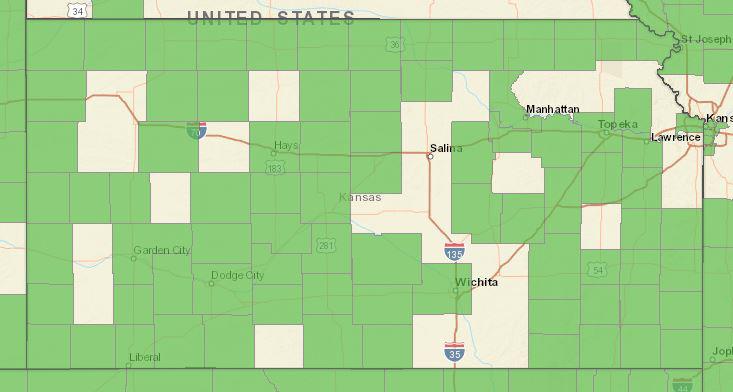
A map showing Kansas counties, in green, with shortages of primary care providers, generated by data.hrsa.gov.
The National Center for Health Workforce Analysis, she notes, predicts a shortage of more than 20,000 primary care doctors by 2025. NPs can help fill the gap.
Where doctors tend not to go
Sofia Navarro was a pediatric nurse at Children’s Mercy Hospital when she headed back to school to become a nurse practitioner.
She envisioned going into private practice, in a shiny new office with all the nicest gadgets and equipment that a health care pro could want.
That changed when a professor suggested Navarro wrap up her gynecological studies working public health in one of the state’s poorest places, Wyandotte County.
“I ended up falling in love with public health,” she said.
More than a decade later, she’s still there, screening women for cervical and breast cancer and explaining puberty to teens. About half her patients, she estimates, have no insurance or policies that don’t pay for much.
Peter Buerhaus is chairman of the National Healthcare Workforce Commission, a body created by the Affordable Care Act to puzzle out health care access.
He and others have plowed ahead with research for the commission on their own, mining Medicare and other data. Their findings?
NPs are more likely than doctors to serve people on Medicaid or without insurance, and people of color. The same goes for another of Kansas’ sore points — rural areas.
“There’s a strong body of evidence now,” said Buerhaus, a professor at Montana State’s School of Nursing. “Nurse practitioners are more likely to work in rural areas than physicians.”
Medicare data also suggests their care costs less, Buerhaus says, and not just because Medicare pays them less. NPs appear to order fewer tests and procedures and pick cheaper options when they do.
Goal No. 1: Protecting patients
LaDona Schmidt knows what it’s like to be a nurse practitioner. And a physician. The Lawrence doctor has been both.
What she learned from that transition opened her eyes. She went from knowing the basics of prescription drugs, she says, to understanding their workings at the cellular level.
Medical school, she testified to Kansas lawmakers, helped her save the life of a 4-year-old whom an NP had diagnosed with stomach flu.
“She recommended Tylenol, fluid, and ‘time,’” wrote Schmidt, the Kansas Medical Society’s president-elect. The mother sought care again the next day. Schmidt noticed the child’s enlarged liver, ordered tests and put him in the hospital.
“He continued to progress to liver failure,” she said, “and fortunately was able to receive a liver transplant two weeks later.”
Schmidt declined an interview. She and other Kansas physicians opposed to ditching collaborative practice agreements point to training. Family doctors slog through four years of medical school and three years of residency. Many specialty residencies last even longer.
NPs typically attend a two-year master’s program, though universities in Kansas and elsewhere are shifting to doctorates.
Stories like Schmidt’s frustrate Monica Scheibmeir, dean of Washburn University’s School of Nursing in Topeka.
“Whenever my well-respected physician colleagues make comments about errors, they should remember they live in a glass house,” she said. “And that never gets brought up.”
Other researchers with medical and nursing backgrounds agreed. Absent data, physicians’ anecdotes remain just that — anecdotes.
“There are horror stories about physician providers like that too, right?” said Chen at GWU, a trained pediatrician. “We have to figure out how to prevent those horror stories.”
That means training providers of all stripes to know their boundaries, she said, and when to involve doctors or nurses with expertise different from their own to address a patient’s care.
The FTC is unconvinced that restricting NPs is needed to achieve that. Collaboration is “‘the norm” even in states that don’t make NPs secure physician contracts, it says. NPs still refer their patients to physicians and hospitals.
The FTC warns of a one-way street that positions doctors as market gatekeepers. That can stifle competition and stick consumers with higher bills.
There are horror stories about physician providers like that too, right? We have to figure out how to prevent those horror stories. – Dr. Candice Chen, George Washington University
Though some states, such as Kansas, call their contracts “collaborative agreements” and dodge words like “supervision,” the power dynamic is clear:
Doctors don’t need the deals, nurse practitioners do.
A V.A. treasure trove
In 2014, a research team at the Department of Veterans Affairs that included physicians dug into past studies in search of the impact of NPs on patient health, quality of life and hospitalizations.
They found no negative impacts, but noted that recent, rigorous research was thin — and weaker than advertised by some proponents of unfettered NPs. Still, they said the lack of fresh studies wasn’t surprising.
“Well-publicized, well-conducted randomized trials conducted in the 1970s proved the concept” that independent advanced practice nurses “can deliver care comparable to that provided by a primary physician.”
The team suggested the VA could dig further by mining its own extensive quality and error data.
In 2016, the VA dropped collaborative contract requirements for NPs — including those working in states such as Kansas. A spokeswoman said the VA expects to complete a fresh study next year on the effects of independent practice.
Kansas NPs point to the VA’s 2016 decision to try to win over state lawmakers. They’ll try again next year after this year’s bill died in a legislative maneuver to expand Medicaid. Their new version offers to make new NPs work a few years before dropping their contracts with doctors.
Kansas physicians say they’re open to compromise of a different sort. They remain skeptical of granting NPs independent practice and distrust the Board of Nursing’s ability to oversee NPs if they get it.
So keep the contracts, they suggest. Just improve them. Make sure doctors don’t abuse them for financial gain and slack off on giving NPs meaningful help.
“We work side by side with these folks every day,” says Jeremy Presley, a private practice doctor in Dodge City and president of the Kansas Academy of Family Physicians. “We value the care they provide.”
Presley teaches nurse practitioners, works with them daily and sits on the advisory board for one of Kansas’ doctoral nurse practitioner programs.
Kansas lets doctors ink deals with as many NPs as they want, and charge as they see fit. Some may work in the same building as the NPs. Others, across town. Still others, 100 miles away.
NPs offer anecdotes of physicians overseeing and charging half a dozen NPs in scattered locations without consulting regularly or at all.
“I feel bad for those folks,” Presley said. “Frustrated for them, that those agreements aren’t in a better — you know, aren’t set up in a better way.”
But it’s unclear how common such situations might be because neither the nurses nor the doctors report contract details to the state.
Nor is it clear how much income Kansas physicians collect this way.
A new national study found advanced practice nurses face contract fees more often if they work in rural areas or at nurse-operated clinics. In those cases, contract prices charged to the nurses or their clinics often topped $6,000 and ranged up to $50,000 annually.
In a small and not necessarily representative survey conducted by the Kansas Advanced Practice Nurses Association, half of 180 respondents said their collaborating physician got monetary compensation.
SPRINGFIELD, Mo. (AP) — Fire officials in southwestern Missouri say a man has been critically injured in a house fire in Springfield.
The Springfield Fire Department says in a news release that the fire was reported Saturday morning on the northeast end of the city. Officials say firefighters on the scene found a man who was taken to a regional burn unit with life-threatening injuries. The man’s name has been released.
The cause of the fire remains under investigation.
LIVINGSTON COUNTY —One person was injured in an accident just before 7a.m. Saturday in Livingston County.
The Missouri State Highway Patrol reported a 1989 Chevy Silverado driven by Charles S. Henson, 29, Carrolton, was southbound on Route D one mile north of Ludlow. The pickup traveled off the east side of the road, struck a culvert and became airborne and came to rest facing southeast.
Livinston County Ambulance transported Henson to Carrol County Memorial Hospital. He was not wearing a seat belt, according to the MSHP.