PLATTE CITY, Mo. (AP) – A drunk driver who rear-ended another car on Interstate 29 in northwest Missouri, killing the driver, has been sentenced to six years in prison.
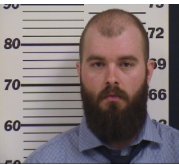
Platte County prosecutor Eric Zahnd says 25-year-old Nicholas Sanders, of Platte City, was sentenced Thursday after pleading guilty in November to involuntary manslaughter in the first degree.
Sanders admitted to driving drunk and causing a crash that killed 58-year-old Michael Sear.
The Missouri State Highway Patrol says the crash happened in the early morning hours of May 28, 2016. Troopers found two vehicles in the median and say Sanders smelled of alcohol, had bloodshot eyes and slurred his speech.
Sear was unresponsive. He was taken to North Kansas Hospital, where he was pronounced dead.
OLATHE, Kan. (AP) — The widow of an Indian man killed last February in a suspected hate crime in suburban Kansas City has spent the year since his death devoting herself to spreading love and positivity in his name.
Srinivas Kuchibhotla, 32, an Indian immigrant who lived in the Kansas City suburb of Olathe, was shot to death last February at Austins Bar & Grill. Adam Purinton is charged with first-degree murder in Kuchibhotla’s death and also faces federal hate crimes charges. Witnesses have said Purinton, who is white, yelled, “Get out of my country,” at Kuchibhotla and another Indian national before opening fire. A third man was wounded when he tried to intervene.
Kuchibhotla’s wife, Sunayana Dumala, become increasingly outspoken against hate in an effort to share her husband’s legacy.
“I can’t let people forget him,” Dumala, told The Kansas City Star . “That is what is making me spread his legacy, and I hope I’m getting there. I hope I succeed and the name Srinivas Kuchibhotla stays there forever.
“People can forget me, but not forget him.”
Dumala has plans for a peace walk in early March, around Kuchibhotla’s birthday, and she is thinking of ways to raise intercultural awareness in younger children.
In the year since her husband’s death, she also has received support, including in the form of letters and donations from around the world. Her husband’s employer, GPS Device-maker Garmin, honored him, and a painting of Kuchibhotla hangs at the company’s Olathe headquarters.
One of the issues Dumala has had to deal with is that her visa ended when Kuchibhotla was killed. U.S. Rep. Kevin Yoder, a Kansas Republican, helped her get a temporary one, and she recently learned she had been granted a new visa that will allow her to travel back to India next month for the anniversary of Kuchibhotla’s death.
“We believe he reached heaven,” she said, “so we’re praying for him to be happy and have that peace.”
LEBANON, Mo. (AP) – A southern Missouri teacher has been arrested and charged with felony sexual contact with a student.
Springfield television station KOLR reports that 30-year-old Elizabeth Morgan, of Lebanon, was arrested and jailed Friday. She was released the same day on $5,000 bond.
Officials say that on Jan. 5, they became aware of an investigation pertaining to sexual contact with a teacher and a male high school student.
Investigators spoke with the student and witnesses and gathered electronic evidence they say show Morgan was having an inappropriate relationship with one of her students.
An attorney is not yet listed for Morgan in online court records.
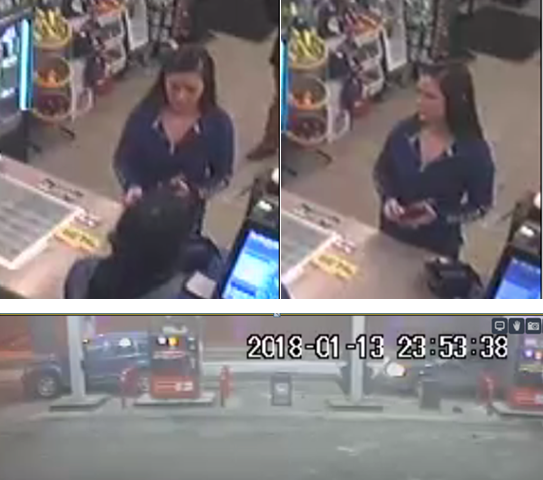
SHAWNEE COUNTY — Law enforcement authorities are investigating a fatal shooting and have asked for help to identify a woman shown in security camera images.
Just after 12 a.m. Sunday, police officers responded to a report of a gunshot heard in the area of 22nd Park and Mulvane near the Washburn University campus in Topeka, according to Lt. Steve Roth.
Officers found a passenger car in the tree line with the driver deceased.
Late Sunday morning, police requested the public’s help in identifying a woman seen in security camera images. She is believed to have been in the SUV which is parked at the gas pumps in the photo.
Police did not indicate how she might be connected to the shooting.
Anyone with information regarding this attempt to identify is encouraged to call The Topeka Police Department Criminal Investigations Bureau at 785-368-9400
———–
Police on the scene of Sunday’s suspicious death-photo courtesy WIBW TV
SHAWNEE COUNTY — Law enforcement authorities are investigating a fatal shooting.
Just after 12 a.m. Sunday, police officers responded to a report of a gunshot heard in the area of 22nd Park and Mulvane near the Washburn University campus in Topeka, according to Lt. Steve Roth.
Officers found a passenger car in the tree line with the driver deceased.
This investigation is ongoing. Anyone with information regarding this incident is encouraged to call the Topeka Police Criminal Investigations Bureau at 785-368-9400 or Crime Stoppers at 785-234-0007.
BLUE SPRINGS, Mo. (AP) – Police in the Kansas City suburb of Blue Springs say a teenager has been shot and killed.
Police say 18-year-old Jack Price, of Blue Springs, died Friday night. Officers were called to the scene on Northwest Vesper Street around 9:30 p.m. and found Price gravely injured. He was taken to an area hospital, where he died.
Police had not announced any arrests by midafternoon Saturday. Investigators told the Kansas City Star that they were looking into some strong leads and had identified two people of interest.
The Wichita Police Department says the fatal police shooting that killed a man in late December started with a prank phone call, commonly referred to as swatting.
In swatting cases, callers utilize technology to make 911 calls appear local—also known as spoofing—and then report a false emergency at a victim’s home to get a strong police and SWAT team response, which is where the term gets its name. The harassment is often associated with the dark corners of online gaming.
Tyler Barriss, 25, is being charged with making the false alarm call and has been extradited to Kansas to face the charges. Andrew Finch, 28, was killed shortly after police arrived at his house. It’s believed the incident started with an online video game dispute, though Finch’s address was targeted by mistake.
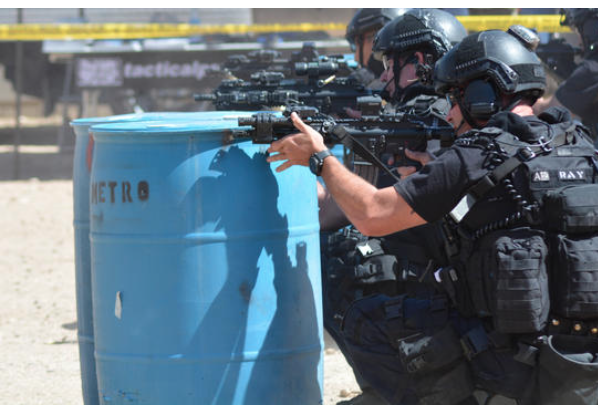
Police in Wichita received no training in dealing with swatting, or prank 911 calls, prior to the fatal shooting. The same is true in many police departments across the country, says Thor Eells, the executive director of the National Tactical Officers Association and the former head of Colorado Springs’ SWAT team.
He spoke with KMUW’s Stephan Bisaha about swatting and what goes through the mind of an officer when he or she responds to a hostage situation.
Stephan Bisaha: There have been talks about this phenomenon of swatting growing lately with more technology, such as spoofing, and with the online gaming community. Is this something you’re seeing?
Thor Eells: We did for a period. I would say roughly two to three years ago we had a dramatic increase in swatting incidents. There was a much higher sense of awareness regarding swatting. And then, for unknown reasons, it seemed to slow down. We didn’t have the frequency of the incidents, but we’re now starting to see a resurgence of it again, and the tragedy that occurred in Wichita has drawn greater attention to the problem.
Is there a sense why this is so prevalent among the online gaming community?
I don’t think we have a really good answer to that. I think the speculative answer is just the technology in that respective community allows for that to take place. … It’s not that gamers are more prone to do this, but those that are prone to do this have that technological savviness, if you will.
Beyond a tragic situation like we had in Wichita, what are the costs associated with a case like swatting?
CREDIT NTOA.ORG
Well, it varies. It’s not inexpensive—it’s certainly not cheap—when an agency responds to a potential hostage situation such as what was portrayed there in the Wichita incident. You’re going to have a significant patrol response, which are the normal officers that are out handling the day-to-day. You’ll have a significant number of them responding to the scene to initially contain it and start to stabilize it. And then subsequently there will be an activation of other specialized units, which could be K-9, crisis negotiations, a SWAT team and other assets that a supervisor believes are necessary to resolve the situation as peacefully as possible. And given that most teams in America—SWAT teams—are not full-time teams there is a lot of overtime involved, a lot of expense. So it’s not inexpensive by any means.
Besides the monetary costs and the man-hour costs, are there any other costs for how this affects law enforcement and the communities?
I think the most obvious fallout from a swatting incident is the difficulty that it presents to the community and law enforcement—in what do you take seriously and what do you not and how do you handle that? And if you continue to respond to too many incidents, it’s the “Chicken Little” or the “boy crying wolf” kind of problem. At some point, do people become somewhat immune or anesthetized to the problem and the dynamics that are involved?
Swatting is a very, very dangerous phenomenon. You know, it’s the latest technological advancement of a 911 hangup where you call in something to see lights and sirens, and there is a tragic accident involving a fire truck or an ambulance or a police car. The same potential for tragedy exists. It’s just accomplished through a different medium.
So this was happening before the technology in swatting became a big phenomenon, these false emergencies?
Yes. I mean false alarms have been in existence probably, you know, since phones were developed. If you pull a fire alarm, fire department is going to respond. If you call in a hostage situation, the police department is going to respond. I mean there is no alternative. It’s going to generate a response because the potential for lives being at risk is too great to ignore.
In Wichita, we were told the police did not receive any training regarding how to deal with swatting. Is that common in police departments across the country?
Yes. Very common.
So most police departments don’t have much training with this?
No, and I don’t know that there’s really much training that can be provided to it other than an awareness that the phenomenon is occurring. But an officer in an agency that’s responding to this type of call because of the life safety issue has very little options other than to treat it as true until proven otherwise.
So if there’s not much that can be done besides making officers aware that the phenomenon does exist, what can be done about this, be it through laws or public awareness or anything?
I think it’s a combination of all that you just mentioned. I think there certainly does need to be a more concerted effort to educate communities—the public—that swatting is, one, occurring. And then secondarily, I think what needs to happen is a very aggressive and vigorous prosecution of the individual that created this incredibly tragic situation—completely unavoidable and for what? And there has to be some degree of personal responsibility attached to it and accountability for the action of the individual who created that scenario.
You have been in charge and led SWAT teams before, from my understanding. Can you put me in the mind of an officer who’s responding to a scenario like this where they’ve received a call that there’s someone with a weapon on the scene, there has been a fatality and there are hostages?
Yeah. That is the worst possible scenario. That is the scenario that, while officers train for it, they hope and pray they never respond to it because there is nothing more dangerous to the officer—but also to the innocent people—than a hostage rescue. There is no margin of error in that, and the officers know that. And the pressure and the stress that’s generated from that is tremendous.
Stephan Bisaha is the education reporter for KMUW, a partner with the Kansas News Service. Follow him on Twitter @SteveBisaha.
HOLTON, Kan. (AP) — A Holton man has been sentenced to nearly 10 years in prison for killing his wife.
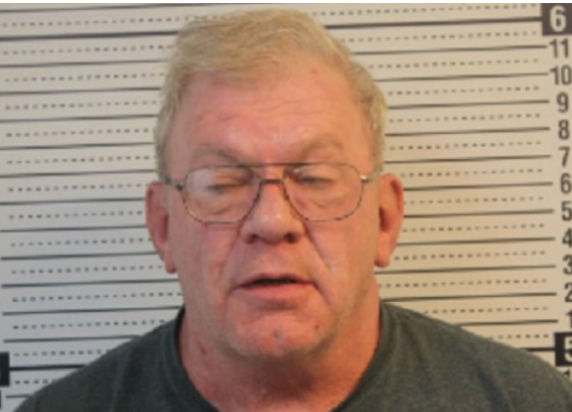
Jackson County authorities say 67-year-old George Fleshman Jr. was sentenced Friday to 9 years and 9 months for second-degree murder.
He was found guilty last month of killing his wife of 25 years, Elizabeth Jane Fleshman, in October 2015.
She died the day after her husband called 911 and said he found her unresponsive at the couple’s home. She was taken to a Topeka hospital where she later died.
HONOLULU (AP) — A false alarm that warned of a ballistic missile headed for Hawaii sent the islands into a panic Saturday, with people abandoning cars in a highway and preparing to flee their homes until officials said the cellphone alert was a mistake.
It wasn’t clear exactly what happened — House Speaker Scott Saiki said someone pushed the wrong button, and the White House said the episode was “purely a state exercise.”
But for nearly 40 minutes, it seemed like the world was about to end in Hawaii, an island paradise already jittery over the threat of nuclear-tipped missiles from North Korea.
The emergency alert, which was sent to cellphones statewide just before 8:10 a.m., said: “BALLISTIC MISSILE THREAT INBOUND TO HAWAII. SEEK IMMEDIATE SHELTER. THIS IS NOT A DRILL.”
On the H-3, a major highway north of Honolulu, vehicles sat empty after drivers left them to run to a nearby tunnel after the alert showed up, the Honolulu Star-Advertiser reported. Workers at a golf club huddled in a kitchen fearing the worst.
Professional golfer Colt Knost, staying at Waikiki Beach during a PGA Tour event, said “everyone was panicking” in the lobby of his hotel.
“Everyone was running around like, ‘What do we do?'” he said.
Richard Ing, a Honolulu attorney, was doing a construction project at home when his wife told him about the alert. His wife and children prepared to evacuate while he tried to figure out what was happening.
Cherese Carlson, in Honolulu for a class and away from her children, said she called to make sure they were inside after getting the alert.
“I thought, ‘Oh my god, this is it. Something bad’s about to happen and I could die,'” she said.
The Hawaii Emergency Management Agency tweeted there was no threat about 10 minutes after the initial alert, but that didn’t reach people who aren’t on the social media platform. A revised alert informing of the “false alarm” didn’t reach cellphones until 38 minutes later, according to the time stamp on images people shared on social media.
The incident prompted defense agencies including the Pentagon and the U.S. Pacific Command to issue the same statement, that they had “detected no ballistic missile threat to Hawaii.”
The White House said President Donald Trump, at his private club in Florida, was briefed on the false alert. White House spokeswoman Lindsay Walters said it “was purely a state exercise.”
Saiki, the House speaker, said the system Hawaii residents have been told to rely on failed miserably. He also took emergency management officials to task for taking 30 minutes to issue a correction, prolonging panic.
“Clearly, government agencies are not prepared and lack the capacity to deal with emergency situations,” he said in a statement.
The alert caused a tizzy on the islands and across social media.
At the PGA Tour’s Sony Open on Oahu, Waialae Country Club was largely empty and players were still a few hours from arriving when the alert showed up. Workers streamed into the clubhouse trying to seek cover in the locker room, which was filled with the players’ golf bags, but instead went into the kitchen.
Several players took to Twitter. Justin Thomas, the PGA Tour player of the year, tweeted, “To all that just received the warning along with me this morning … apparently it was a ‘mistake’?? hell of a mistake!! Haha glad to know we’ll all be safe.”
In Honolulu, hair salon owner Jaime Malapit texted his clients that he was cancelling their appointments and was closing his shop for the day.
“I woke up and saw a missile warning and thought ‘no way.’ I thought ‘No, this is not happening today,'” Malapit said.
Brian Naeole, who was visiting Honolulu from Molokai, said he wasn’t worried since he didn’t hear sirens and neither TV nor radio stations issued alerts.
“I thought it was either a hoax or a false alarm,” he said.
Ing, the Honolulu lawyer, tried to find some humor in the situation.
“I thought to myself, it must be someone’s last day at work or someone got extremely upset at a superior and basically did this as a practical joke,’ he said. “But I think it’s a very serious problem if it wasn’t that, or even it was, it shows that we have problems in the system that can cause major disruption and panic and anxiety among people in Hawaii.”
Others were outraged. Hawaii U.S. Sen. Brian Schatz tweeted the false alarm was “totally inexcusable” and was caused by human error.
“There needs to be tough and quick accountability and a fixed process,” he wrote.
Federal Communications Commission Chairman Ajit Pai said on social media the panel would launch an investigation.
PRATT – The 2018 Kansas Birding Big Year, hosted by the Kansas Department of Wildlife, Parks and Tourism (KDWPT), is underway and you’re invited to participate in the fun. Unlike other big year competitions that span the U.S. in a calendar year, participants in the 2018 Kansas Birding Big Year try to observe as many species of birds as they can within the borders of Kansas from Jan. 1 – Dec. 31.
Participants of all skill levels may compete in one of three age groups: youth (17 and under), adult (18-64), and senior (65 and up). The winners from each category will receive prizes to be awarded next January. See guidelines below.
Participation Guidelines
1. Participants must register via email with the event coordinator Mike Rader at KDWPT: mike.rader@ks.gov on or before April 1 to be part of the program for 2018.
2. Participants must read and abide by the set of rules governing the competition (available at ksoutdoors.com/Services/Wildlife-Diversity/2018-Kansas-Birding-Big-Year). These rules are adapted from the American Birding Association Recording Rules and Interpretations and include the Code of Birding Ethics. Breaking or disregard for these rules will disqualify the participant from the competition.
3. Participants are required to log their data into the online service, eBird, available on the Cornell University website, www.ebird.org. Each participant will need to create an individual profile, with sign-in and password to begin the submission of sightings.
4. Participants will need to submit a running total list of observed species quarterly to the coordinator of the program. This is to help track progress and provide quality control. The program coordinator and competition committee have final say on list totals. Dates for 2018 submission will be: June 30, September 30 and December 31.
5. Winners of the competition in each category will be determined by a committee selected by the program coordinator. Winners will be recognized and prizes will be awarded in mid-January of the following calendar year. Categories are defined as:
Youth – 16 and under
Adult – 17-64 (3 skill levels: Novice, Intermediate and Advanced)
Senior – 65 and up
6. Prizes will be awarded based on availability and appropriateness per division, as determined by program coordinator and competition committee.
KANSAS CITY, Mo. – A St. Joseph man was sentenced in federal court Friday for his second federal bank robbery conviction.
According to a news release from Timothy A. Garrison, United States Attorney for the Western District of Missouri, 50-year-old Terry L. Hager of St. Joseph, was sentenced by U.S. District Judge Fernando J. Gaitan, Jr., to 11 years and one month in federal prison without parole.
The sentence includes a 33-month term of incarceration upon the revocation of Hager’s supervised release in an earlier bank robbery sentence in a separate case.
Hager, who pleaded guilty on Jan. 3, 2017, admitted that he stole $13,957 from UMB Bank, 1211 N. Belt Hwy., St. Joseph, on March 5, 2016.
According to court documents, Hager was wearing a baseball cap, a bandana over his face, sunglasses and clear plastic gloves when he entered the bank. Hager approached a teller and motioned for her to be quiet by placing his finger to his lips then demanded that she give him all the money. After the teller emptied the contents of her drawer, Hager demanded the money from her second drawer, but she was unable to comply because she did not have a key for the drawer. Hager told the teller to get on the floor and called a second teller, who did have the key, over to the teller counter. (As this occurred, a third teller was able to push a panic button to alert law enforcement of the robbery). As the second teller was interacting with Hager, she attempted to press an emergency button, but he placed his hand over the button preventing her from doing so.
After he received cash from both tellers, Hager exited the bank. He later led law enforcement officers on a high-speed pursuit, traveling approximately 80 miles per hour through a densely populated residential neighborhood with groups of children playing near the street. Officers were forced to terminate the pursuit due to the significant danger to the public.
The next day, Hager was located at a local Walmart store and placed under arrest without incident as he left the store.
This case represents Hager’s second federal bank robbery conviction. Hager, who was incarcerated for more than 22 years on his first bank robbery conviction, was released from federal prison and placed on supervised release on Dec. 2, 2013. He was still on supervised release for his first federal bank robbery offense when he committed the second.
On March 26, 2015, while on supervised release for his first federal bank robbery, Hager was arrested in Buchanan County for second-degree domestic assault after a report that he threatened and physically assaulted a woman with whom he shared a domestic relationship. He was convicted of the offense on July 6, 2015, and sentenced to eight months’ incarceration. On Feb. 11, 2016, Hager appeared in federal court for a supervised release revocation hearing. After making a statement on his own behalf, Hager’s supervised release was continued with further instruction that his supervised release would be reviewed in 90 days. Hager committed the bank robbery approximately 23 days later.
This case was prosecuted by Assistant U.S. Attorney Alison D. Dunning. It was investigated by the St. Joseph, Mo., Police Department and the FBI.