We have a brand new updated website! Click here to check it out!

Kansas governor’s budget has fellow Republicans in revolt

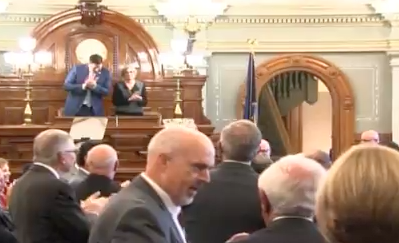
Kansas legislators before Tuesday’s State of the State address in Topeka-photo courtesy office of Governor

TOPEKA, Kan. (AP) — Departing Kansas Gov. Sam Brownback is counting on growing tax revenues from a strong national economy to pay for his proposal to increase spending on public schools, stoking an open revolt Wednesday among fellow Republicans in the Legislature.

The term-limited conservative Republican governor released budget proposals that were supposed to flesh out his plan to phase in a $601 million increase in education funding to meet a court mandate. But his recommendations contained no way to pay for the increase other than relying on growing revenues, and no fiscal projections beyond mid-2019.

Top GOP lawmakers already were upset by the idea even before Brownback outlined his school funding proposal in his eighth and final State of the State address Tuesday evening. They fear they would be forced to consider raising taxes or making deep cuts elsewhere while also shorting public pensions and highway projects next year, when Brownback is out of office.

“I’m not sure what the logic is behind it,” said state Sen. Ty Masterson, a conservative Wichita-area Republican and usual ally of Brownback. “That’s irresponsible, to propose that much new spending without understanding where it’s coming from.”

Brownback’s proposed $16.8 billion budget for the fiscal year beginning in July would leave the state with a small cushion of cash reserves at the end of June 2019, without requiring another tax increase. Lawmakers approved a $600-million-a-year income tax increase last year over Brownback’s veto to help balance the budget.

Lawmakers must come up with more money for schools after the Kansas Supreme Court ruled in October that the state isn’t meeting its funding obligations under the state constitution. Lawmakers have been debating whether the court would accept an increase phased in over multiple years. The $601 million increase touted by Brownback includes $88 million appropriated last year in a previous effort to satisfy the court.

The governor’s proposed budget also includes extra spending to continue pay raises granted in the fall for officers in the state’s stressed prison system, cover gaps in funding for state mental hospitals and raise reimbursements for hospitals and nursing homes providing services to the poor and elderly.

“Thankfully, we have the benefit of a strong national economy that’s on the uptick,” Shawn Sullivan, the governor’s budget director, told reporters during a briefing on the proposals. “The strong revenue growth helps our budget situation.”

Brownback must leave office in January 2019 but President Donald Trump nominated him in July as U.S. ambassador-at-large for international religious freedom. The U.S. Senate’s failure to vote on Brownback’s appointment has created an awkward transition to a new governor.

And top Republican legislators were angry because Brownback strongly criticized last year’s tax increase, which rolled back past income tax cuts he’d championed in 2012 and 2013 following persistent budget woes. He accused them of using the new revenues to finance unnecessary spending.

House Majority Leader Don Hineman, a moderate Republican from western Kansas, described the budget proposal as “a fantasy.”

Senate Majority Leader Jim Denning, a conservative Kansas City-area Republican, initially called Brownback’s proposal “insulting” and said Wednesday after seeing more details, “It doesn’t look any better.”

Brownback’s administration worked on its budget proposals for weeks, allowing hints to leak to lawmakers early.

Republican legislative leaders already had shown their displeasure with Brownback by blocking a plan to build a new prison in the Kansas City area and by criticizing a proposal to have private insurance companies administer the state’s Medicaid health coverage for the poor, disabled and elderly.

Sullivan acknowledged Wednesday that nothing in Brownback’s budget recommendations is likely to quiet the furor.

Legislators already are reviewing projections from their staff showing that even with last year’s tax increase and no extra money for schools, budget problems could arise in 2020 and 2021.

Even Democrats, seeing new funds for schools as desirable, considered Brownback’s proposal unworkable.

“There’s a mean-spiritedness to this because he’s putting the Legislature in a tough position by making these recommendations for all of this spending, which we can’t afford,” said state Sen. Laura Kelly, a Topeka Democrat running for governor. “We’re going to have to be the bad guys.”

Missouri man dies after pickup crash into culvert

ST. CLAIR COUNTY — A Missouri man died in an accident just before 2a.m. Wednesday in St. Clair County.

The Missouri State Highway Patrol reported a 1989 Chevy 1500 driven by Curtis N. Buchanan, 53, Osceola, was northbound on Old Humansville Road just south of Highway WW. The vehicle traveled off the road and struck culvert.

Buchanan was pronounced dead at the scene and transported to Sheldon Goodrich Funeral Home.

He was not wearing a seat belt, according to the MSHP.

Missouri man gets 15 years for robbing Iowa bank

Lundberg-Photo Johnson Co. Iowa

DAVENPORT, Iowa (AP) – A Missouri man with a record of robberies has been sentenced to 15 years in prison for a bank heist in eastern Iowa.

Court records say 60-year-old Peter Lundberg, of St. Ann, Missouri, was sentenced Monday in U.S. District Court in Davenport. Records show Lundberg has two prior federal convictions for bank robbery and one state robbery conviction.

Prosecutors say Lundberg got less than $1,100 from a Bank of the West teller in Coralville, Iowa, when he robbed it on April 20. He and the woman driving him, Bridgette Durborow, of St. Peters, Missouri, were captured a short time later near Davenport.

Durborow has been sentenced to two years in prison.

Brownback: School Spending Boost But No Tax Increase, Lawmakers Roll Eyes

 CELIA LLOPIS-JEPSEN

Gov. Sam Brownback, poised to leave Kansas after a generation of dominating its politics, on Tuesday called for steep infusions of money into public schools — spurring fellow Republicans to accuse him of raising hopes with a “fairy tale.”

Kansas Gov. Sam Brownback told lawmakers Tuesday night the state can solve its school funding woes without a tax hike. It was his final State of the State address.
CELIA LLOPIS-JEPSEN / KANSAS NEWS SERVICE

Brownback said the state can add $600 million over the next five years — without a tax hike.

The push to spend more comes in response to a Kansas Supreme Court order. In his State of the State address to lawmakers on Tuesday, the governor called for a change to the state constitution to keep the courts out of future education politics.

“We must,” Brownback said, “stop the never-ending cycle of litigation.”

Senate Majority Leader Jim Denning called the idea of adding $600 million “personally insulting.”

He’s among staunch conservatives in the Kansas Legislature who — after a long and contentious session — ultimately parted ways with Brownback last June to hike taxes and plug a $900 million void in the state budget.

Denning said, even without more spending on schools, Kansas is on track toward a budget shortfall .

“This is reckless,” he said. “He’s given everybody a sense of false hope that he’s just solved the school issue.”

Brownback frustrated Denning and other Republicans last spring by fighting against any tax hikes. It tore at a relationship between legislative leaders and the governor that had already frayed in the years before. Ultimately, they revolted and scrounged the votes needed to override a Brownback veto.

Tuesday’s speech figures to be one of Brownback’s last high-profile moments as governor. President Donald Trump chose him as the next ambassador for religious freedom, a nomination re-entered this week and that could soon move him from Topeka.

“I have to question how this proposal is any more than a feel-good talking point on the governor’s way out the door,” said Rep. Melissa Rooker, a Republican who advocated for a five-year $750 million school funding increase last year but found no support from Brownback.

Brownback offered no hints Tuesday on where the money for his $600 million plan will come from. His administration’s budget proposal will emerge Wednesday.

Denning predicted the governor wants to divert even more money from the state’s depleted highway funding and from payments into its pension system, which already falls $8 billion short of what it will need to pay for state employee retirements.

House Speaker Ron Ryckman doubted Brownback’s tax hike-free school spending approach.

“I’m not seeing how that’s possible at this time without drastically hurting other core functions of government,” the Republican said.

Rep. Barbara Ballard, a Democrat, said Brownback’s vision for the state should have included expanding Medicaid to combat illness and poverty, shoring up the pension system and paving Kansas roads.

“We need to address the transportation issues,” she said. “Roads are not being maintained, bridges are not being maintained.”

Brownback’s eighth State of the State address found the chief executive sounding almost wistful and proud at times, extolling the state’s quail, its biking trails and its falling obesity rate.

Despite dismal popularity numbers at the close of his time in office, he described his years in Kansas politics as “a successful, long journey.”

Brownback also:

  • Touted lower unemployment rates and the drop in child poverty from 19 percent to 14 percent over five years.

The Brownback administration draws a link between its welfare policies, increases in people working and decreases in childhood poverty, but that connection is a point of debate with advocacy groups.

  • Praised the wind industry.

“I dream of a future Kansas exporting wind electricity across America,” he said.

Brownback opposed attempts in recent years by the fossil fuel industry to repeal incentives that led to a boom in wind energy production.

  • Rattled off business and recreational facilities completed last year, such as a milk-drying plant in Garden City — largest in the country — and the 117-mile Flint Hills Nature Trail. And boasted of lower infant mortality.
  • Said Kansas saw 17,000 fewer abortions in the past six years than it had in the previous six years.

“We must not go back now,” he said.

Brownback signed several anti-abortion laws during his tenure, including some of the most stringent restrictions in the country. Among them, a 2015 ban on certain second-trimester abortions.

  • Threw his weight behind the Kansas State Board of Education’s goals to graduate significantly higher numbers of high school students and send them to colleges and tech schools.

A fine enough aspiration, said lobbyist Mark Tallman of the Kansas Association of School Boards. But he noted that that some of the targets haven’t been reached in any state — and that $600 million might not be enough to make them happen.

  • Called for Kansas schools to pay teachers better than all its neighboring states. Currently pay is better than two of Kansas’ four neighbors. Educators have long called for higher pay, warning that parts of the state are experiencing teacher shortages.
  • Spoke wistfully of his youth and decades-long career in Kansas. He recalled a Ford pick-up truck the then-eager politician-to-be drove, its “three-on-the-tree” manual transmission that shifted gears from a lever mounted on the steering column and the advent “traveling the back roads of Kansas.”

In the years since those days in the Future Farmers of America, he went to Congress and came back. He became governor, dramatically lowered taxes, saw the state budget slip into crisis, won re-election and watched his approval ratings circle the drain.

But in what was essentially his farewell to the legislature, Brownback spoke gratefully of the people he met and the changes he engineered.

“I have,” he said, “been blessed.”

Celia Llopis-Jepsen is a reporter for the Kansas News Service,  You can reach her on Twitter @Celia_LJ.

Judge blocks Trump decision to end young immigrant program

Trump during Tuesday ‘s White House meeting-photo courtesy CSPAN

SAN FRANCISCO (AP) — A federal judge on Tuesday night temporarily blocked the Trump administration’s decision to end a program protecting young immigrants from deportation.

U.S. District Judge William Alsup granted a request by California and other plaintiffs to prevent President Donald Trump from ending the Deferred Action for Childhood Arrivals program while their lawsuits play out in court.

Alsup said lawyers in favor of DACA clearly demonstrated that the young immigrants “were likely to suffer serious, irreparable harm” without court action. The judge also said the lawyers have a strong chance of succeeding at trial.

DACA has protected about 800,000 people who were brought to the U.S. illegally as children or came with families who overstayed visas. The program includes hundreds of thousands of college-age students.

U.S. Attorney General Jeff Sessions announced in September that the program would be phased out, saying former President Barack Obama had exceeded his authority when he implemented it in 2012.

On Tuesday, the Department of Justice said the judge’s decision doesn’t change the fact that the program was an illegal circumvention of Congress, and it is within the agency’s power to end it.

“The Justice Department will continue to vigorously defend this position, and looks forward to vindicating its position in further litigation,” department spokesman Devin O’Malley said in a statement.

Sessions’ move to phase pout DACA sparked a flurry of lawsuits nationwide.

Alsup considered five separate lawsuits filed in Northern California, including one by the California and three other states, and another by the governing board of the University of California school system.

“DACA covers a class of immigrants whose presence, seemingly all agree, pose the least, if any, threat and allows them to sign up for honest labor on the condition of continued good behavior,” Alsup wrote in his decision. “This has become an important program for DACA recipients and their families, for the employers who hire them, for our tax treasuries, and for our economy.”

That echoed the judge’s comments from a court hearing on Dec. 20, when he grilled an attorney for the Department of Justice over the government’s justification for ending DACA, saying many people had come to rely on it and faced a “real” and “palpable” hardship from its loss.

Alsup also questioned whether the administration had conducted a thorough review before ending the program.

Brad Rosenberg, a Justice Department attorney, said the administration considered the effects of ending DACA and decided to phase it out over time instead of cutting it immediately.

DACA recipients will be allowed to stay in the U.S. for the remainder of their two-year authorizations. Any recipient whose status was due to expire within six months also got a month to apply for another two-year term.

The Justice Department said in court documents that DACA was facing the possibility of an abrupt end by court order, but Alsup was critical of that argument.

People took out loans, enrolled in school and even made decisions about whether to get married and start families on the basis of DACA and now face “horrific” consequences from the loss of the program, said Jeffrey Davidson, an attorney for the University of California governing board.

“The government considered none of this at all when they decided to rescind DACA,” he said at the hearing.

The University of California said in a statement after the decision that “UC’s DACA students represent the very best of our country and are a key part of California and our nation’s future.”

The statement says the UC system will persist in legal challenges to the end of the program and will seek permanent protection for the young immigrants.

DACA recipients are commonly referred to as “dreamers,” based on never-passed proposals in Congress called the DREAM Act that would have provided similar protections for young immigrants.

“Dreamers lives were thrown into chaos when the Trump administration tried to terminate the DACA program without obeying the law,” California Attorney General Becerra said in a statement after Tuesday’s decision. “Tonight’s ruling is a huge step in the right direction.”

—————

WASHINGTON (AP) — Seeking a bipartisan compromise to avoid a government shutdown, President Donald Trump suggested Tuesday that an immigration deal could be reached in two phases — first by addressing young immigrants and border security with what he called a “bill of love,” then by making comprehensive changes that have long eluded Congress.

Trump held a lengthy meeting with Republican and Democratic lawmakers seeking a solution for hundreds of thousands of young people who were brought to the U.S. illegally as children. Trump last year ended the Obama-era Deferred Action for Childhood Arrivals program, which shielded more than 700,000 people from deportation and gave then the right to work legally in the country. He gave Congress until March to find a fix.

The president, congressional Republicans and Democrats expressed optimism for a deal just 10 days before a government shutdown deadline. Trump expressed a willingness to be flexible in finding an agreement.

“I think my positions are going to be what the people in this room come up with,” Trump said during a Cabinet Room meeting with a bipartisan group of 20 lawmakers. A group of journalists observed the meandering meeting for an extraordinary length of time — about 55 minutes — that involved Trump seeking input from Democrats and Republicans alike in a freewheeling exchange on the contentious issue.

Trump at one point suggested bringing back “earmarks,” or money for pet projects requested by lawmakers, as a way to bring the two parties together and avoid divisions.

The president said he would insist on construction of a border security wall as part of an agreement involving young immigrants, but he said Congress could then pursue a comprehensive immigration overhaul in the second phase.

House Republicans said they planned to soon introduce legislation to address border security and the young immigrants. Trump said, “it should be a bill of love.”

Kansas man arrested after his wife’s body found in Missouri

Police on the scene of their investigation Tuesday-photo courtesy KCTV

OVERLAND PARK— Law enforcement authorities have arrested a Kansas man after his wife’s body was found across the state line in Missouri.

Police say the man was alone when officers went to his Overland Park, Kansas, residence in the 800 Block of Perry Monday afternoon, according to a media release. Police had received calls about a domestic disturbance. The man called police hours later to return to his residence to report that his wife was missing.

Police said officers became suspicious during the interview and that the man admitted to having a role in her disappearance. Her body later was found later in nearby Raymore, Missouri, and the man was taken into custody. The name of the man and his wife weren’t immediately released.

Police give details of fatal Mo. officer-involved shooting

SPRINGFIELD, Mo. (AP) – Springfield officials say a man who was shot and killed by an officer last week fired first during the confrontation.

Police spokeswoman Lisa Cox said in a news release Tuesday that officers who answered a call about two men trying to break into a shed saw 46-year-old William Oleson in front of the home. When Oleson saw the officers, he ran into the backyard.

Cox says after officer Eric Morgan caught Oleson, the two men struggled and Oleson shot at Morgan, who returned fire. Oleson was shot and later died at a Springfield hospital.

Morgan, a 16-year police veteran, was not injured. He has been placed on administrative leave while the shooting is investigated.

After the shooting, police arrested a 53-year-old man who allegedly was with Oleson at the house.

Governor proposes controversial $600M boost to aid Kansas schools

Governor Brownback during Tuesday’s State of the State address

TOPEKA, Kan. (AP) — Kansas Gov. Sam Brownback proposed Tuesday that the state phase in a $600 million increase in spending on public schools over five years in hopes of meeting a court mandate, without telling legislators how he would pay for it.

The term-limited conservative Republican governor outlined the proposal in his eighth and final State of the State address to a joint session of the Legislature.

Senate President Susan Wagle of Wichita and Senate Majority Leader Jim Denning of Overland Park said Tuesday night that they do not think the state can sustain the spending Brownback is proposing.

Brownback tied the extra money to goals for raising teacher salaries, increasing the number of school counselors and psychologists and offering high school students courses that earn them college credit.

He also told lawmakers in his speech, “My proposal does not include a tax increase.”

Wagle called it a feel-good proposal that will force lawmakers to consider tax increases later. Denning said the plan is “insulting.”

The Kansas Supreme Court ruled in October that the state’s total aid of about $4.3 billion a year to its 286 school districts isn’t sufficient to meet a duty under the state constitution to provide a suitable education for every child. The court mandated more spending even though lawmakers last year phased in a $293 million increase over two years.

The Supreme Court didn’t set a specific spending target but hinted in its decision that spending must rise by as much as $650 million a year. It told lawmakers that a new school funding law must be in place before July 1, and it expressed a growing impatience with delays in boosting spending.

Many lawmakers, particularly Republicans, were frustrated by the court’s ruling because bipartisan majorities raised income taxes last year by roughly $600 million a year to help balance the budget while providing extra money for schools.

Top GOP leaders see no appetite for raising taxes again — or making deep cuts elsewhere in the budget to shift money to schools. Many legislators are skeptical that school funding can rise significantly without either step.

And lawmakers have been debating whether the court would accept a law that phases in an increase in school funding over several years.

Brownback was expected to outline the details of his school funding proposal in budget recommendations released to lawmakers Wednesday.

The governor said he was proposing goals along with the funding because, “the people of Kansas expect results.”

“Money by itself will not solve the problem,” he said in his prepared text.

Brownback is term-limited after winning re-election in 2014, and President Donald Trump has nominated him to serve as U.S. ambassador-at-large for international religious freedom.

He gained national attention for a first-term experiment in aggressive income tax-cutting and saw his popularity wane as the state experienced persistent budget problems. Voters in 2016 turned on his legislative allies, electing enough Democrats and GOP moderates to roll back some of his tax cuts.

In the Democratic response prepared before the speech, House Minority Leader Jim Ward, of Wichita, who is running for governor this year, said funding schools “fairly and sufficiently” is the most important issue facing lawmakers. He also praised the bipartisan majorities that raised taxes last year over Brownback’s veto.

The tax increase approved last year rolled back most of the past income tax cuts championed by Brownback in 2012 and 2013. State tax collections have exceeded expectations each of the past seven months.

“We made significant progress in restoring fiscal responsibility to our state,” Ward said.

Brownback and his aides had not expected him to be giving this year’s address after Trump nominated him for the ambassador’s job in July. They had expected the U.S. Senate to confirm Brownback’s appointment in the fall, triggering his resignation and elevating Lt. Gov. Jeff Colyer to governor.

But the Senate failed to vote on Brownback’s nomination by the end of last year, requiring Trump to renominate him. The delay has created an awkward transition.

Kansas Faced With Money Problems, Questions About Who’s In Charge

Kansas lawmakers must solve serious money problems this year without knowing how long Gov. Sam Brownback will remain in power in Topeka.-photo Kansas News Service

By JIM MCLEAN

Lawmakers arrived in Topeka Monday with monumental money problems facing the state and an executive branch stuck in a confusing transition.

It’s the start of a roughly 90-day session in which they, once again, must juggle the state’s checkbook to meet multiple pressing needs. That includes an ultimatum from the Kansas Supreme Court to find more tax dollars for schools.

It’s a tough job made that much harder by unusual political circumstances.

A lame-duck governor made even less relevant by his desire to jump to a job in the Trump administration as soon as the U.S. Senate can muster the votes to confirm him. A lieutenant governor chomping at the bit to take over. And a herd of wannabe governors inside and outside the Statehouse sure to criticize every move.

Thinking his confirmation was imminent last fall, Gov. Sam Brownback started sharing budget preparation duties with Lt. Gov. Jeff Colyer. That created confusion over who was calling the shots — the existing governor or the one in waiting. And that forced Brownback to reassert himself.

He, not Colyer, will give the annual State of the State address to a joint session of the legislature on Tuesday. And he, not Colyer, will lay out the administration’s plan for addressing the court ruling that once again declared the state’s funding of public schools unconstitutionally low.

“This is the governor’s response,” Brownback said in an interview last week. “I’m the governor.”

But how much influence the governor commands remains an open question. Multiple polls in the last couple of years consistently ranked him among the nation’s least popular governors. That, coupled with the fact that he is widely seen as having one foot out the door, have eroded his influence, said University of Kansas political scientist Burdett Loomis.

“He’s been a non-factor,” Loomis said.

Brownback’s ebbing power was glaring at the end of the 2017 session, when lawmakers overpowered him to pass a bill that rolled back the income tax cuts he championed in 2012. The revolt was led by a group of Democrats and moderate Republicans elected in 2016 on a promise to fix the budget mess in Topeka.

A lack of leadership at the top makes the job of a part-time legislature harder, said House Minority Leader Jim Ward.

“It makes it much, much more difficult to get to a resolution,” said Ward, a Democratic candidate for governor.

Perhaps nothing looks harder to fix than school financing. The court demands could require another $600 million, even as the state searches for a way to pay back money borrowed from its employee pension fund.

Republican leaders have said their members have no appetite for another tax increase. But heading into an election year makes service cuts — to education, highways and the like — just as unsavory.

Tough choices, made tougher by the leadership questions that loom large as lawmakers begin their work.

Jim McLean is managing director of the Kansas News Service. You can reach him on Twitter @jmcleanks.

Kan. lawmaker resigns leadership post after controversial comments

Statement from Alford’s office- click to EXPAND

TOPEKA, Kan. (AP) — A Kansas state legislator who suggested at a public forum that blacks are predisposed to abusing drugs has resigned from two committee leadership jobs.

Republican state Rep. Steve Alford of the western Kansas town of Ulysses stepped down Tuesday as chairman of the House Children and Seniors Committee and vice chairman of a legislative task force on child welfare.

Alford resigned from those positions a day after apologizing for remarks he made Saturday at a public meeting in Garden City.

During the meeting, Alford discussed his opposition to legalizing any use of marijuana and referenced a time in the 1930s when it was outlawed.

Rep. Alford-courtesy photo

He said marijuana and other drugs were prohibited partly because blacks responded “the worst” to them “because of their character makeup — their genetics and that.”

———-

4:45 p.m.

A white Kansas state lawmaker has apologized for suggesting that blacks have a genetic predisposition to abusing drugs.

Republican state Rep. Steve Alford, of the western Kansas town of Ulysses, said in a statement that he was wrong and regrets the remarks he made Saturday during public meeting at a hospital.

He said: “I sincerely apologize to anyone whom I have hurt.”

At the meeting, The 75-year-old Alford argued against legalizing any use of marijuana. He suggested it and other drugs were originally outlawed in part because blacks were “basically users” and “responded worst” to the drugs because of their “character makeup — their genetics and that.”

Alford said in his statement that he opposes legalizing any use of marijuana because doing so opens the door to harder drugs.

___

TOPEKA, Kan. (AP) — A white Kansas state lawmaker arguing against the legalization of any use of marijuana suggested that it and other drugs were originally outlawed in part because blacks were “basically users” and “responded worst” to the drugs because of their “character makeup — their genetics and that.”

State Rep. Steve Alford, a 75-year-old Republican from Ulysses, in the west of the state, made the comments Saturday during a public meeting at a hospital in Garden City. The Garden City Telegram first reported on the statement Monday and posted a video of it to YouTube.

Kansas is one of the few remaining states that haven’t legalized some form of medical marijuana, including low-THC marijuana derivatives that can’t get a user high. But the legalization question has been percolating in Kansas in recent years.

At the meeting, Alford referenced a time in the 1930s when marijuana was prohibited.

“What was the reason they did that?” he asked a crowd of about 60 people, none of whom were black. “One of the reasons why — I hate to say it — is the African-Americans, they were basically users and they responded the worst off to those drugs. It’s because of their character makeup — their genetics and that. And so basically what we’re trying to do, is we’re trying to do a complete reverse of the people not remembering what’s happened in the past.”

Asked about his remarks Monday by The Associated Press, Alford said: “I’m not going make any more remarks about that. To me, that’s neutral. Basically, I got called a racist, which I’m really not, and it’s just the way people — the interpretation of people. To me, I’m trying to look at what’s really the best for Kansas.”

Alford said the marijuana issue is very important to him because he believes it’s a gateway drug that introduces user to other drugs.

“I’m really looking for the safety of the people of Kansas, the children of Kansas, the adults of Kansas,” Alford said during a brief interview.

Copyright Eagle Radio | FCC Public Files | EEO Public File