We have a brand new updated website! Click here to check it out!

Farm Bureaus Make An Attempt At Affordable Health Insurance, But Plans Exclude Some

Editor’s Note: Kansas will allow its state Farm Bureau to offer health care coverage that doesn’t satisfy the Affordable Care Act after Democratic Gov. Laura Kelly on Friday declined to block a Republican-backed effort to circumvent former President Barack Obama’s signature health care law.

JIM MCLEAN
Kansas News Service

In a recent national survey, farmers said the biggest threat to their livelihoods wasn’t low commodity prices or global trade policies. It was the rising cost of health insurance.

Tim Franklin drove to Topeka earlier this year for a hearing on the Kansas Farm Bureau’s insurance plans.
JIM MCLEAN / KANSAS NEWS SERVICE

It’s one of the reasons why state farm bureaus have jumped into the insurance game in Iowa, Tennessee and Nebraska, and are trying to in Kansas.

Members of the Kansas Farm Bureau spend an average of 30 to 40 percent of their annual incomes on health coverage, according to KFB President and CEO Terry Holdren.

“Those are significant costs and they’re larger for most folks than their average mortgage payment,” Holdren told a Kansas legislative committee earlier this year.

Premiums for Tim Franklin, a farmer from Goodland in northwest Kansas, nearly doubled between 2015 and 2018 — and they’re still going up.

“In 2019, we’ll be paying just under $24,000 just in premiums for our family of five,” Franklin said at a hearing in Topeka for which he made the nearly five-hour drive. “Please give us some options.”

The Kansas Farm Bureau is behind a bill that would allow it to market non-insurance “health benefit plans.” According to Holdren, these would be up to 30 percent cheaper than what’s available through the federal health insurance marketplace, mainly, he said, because they would be exempt from state and federal regulations.

“This legislation … would give us the ability to say ‘no’ to folks if they don’t meet our underwriting standards,” Holdren told lawmakers.

In other words, KFB could screen applicants and reject those with expensive health care needs, such as pregnant women or people who need substance abuse treatment or prescription drugs — things that regulated insurance companies can no longer do.

The plans are similar to those offered since the 1990s by the Tennessee Farm Bureau and to coverage that the Iowa Farm Bureau recently began marketing to its members.

The Nebraska Farm Bureau’s health coverage is a bit different. For starters, it is limited to people who work in agriculture, whereas the KFB plans are available to all members as long as they pay the annual member fee.

But importantly, Nebraska also partnered with Minnesota-based Medica in order not to exclude people with pre-existing conditions. That difference, Medica Vice President Jay McLaren told Kansas lawmakers in a letter, guarantees coverage for all Nebraska farmers and ranchers who are “desperate for more affordable solutions.”

It’s that lack of a pre-existing conditions guarantee that has critics of the KFB plans concerned.

“We think the whole concept is unfair,” said Brad Smoot, the lead lobbyist for Blue Cross Blue Shield of Kansas, the state’s largest health insurer.
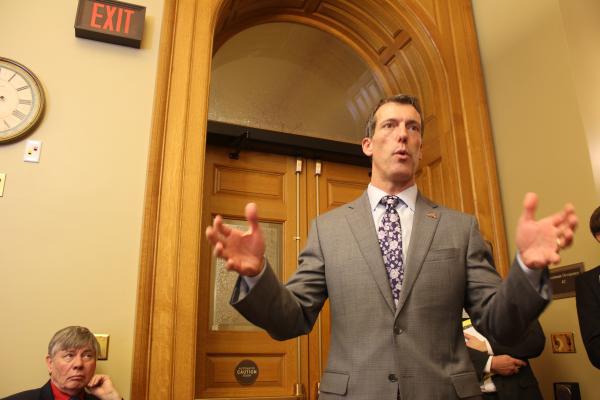
Terry Holdren is the president and CEO of the Kansas Farm Bureau. He says some KFB members have health insurance premiums that surpass the cost of mortgage payments.
CREDIT JIM MCLEAN / KANSAS NEWS SERVICE

Allowing the farm bureau to play by a different set of rules would result in siphoning healthy individuals from the insurance pool, leaving companies like BCBS of Kansas with people who are sicker and more expensive to cover.

Segmenting the marketplace like that would force insurers that are subject to state and federal regulations to raise premiums, former Kansas insurance commissioner Sandy Praeger said.

“The only people who benefit from chipping away at Obamacare are younger, healthier people,” said Praeger, a Republican who believes policymakers should strengthen the federal health reform law, not undermine it.

That’s happened in Iowa, according to Dennis Maggart, executive vice president of the McInnes Group, a regional insurance firm based in Kansas City, Missouri. Average premiums for regulated plans have nearly doubled since the Iowa Farm Bureau began marketing coverage similar to what the Kansas Farm Bureau is planning, he said.

And market disruption isn’t Praeger’s only concern. She believes the lack of state regulation will allow KFB to change the scope of its coverage whenever it needs to rein in costs.

“Even if you saw the plan today, it could change tomorrow and nobody would have the regulatory oversight to stop it,” she said.

Supporters of the Kansas Farm Bureau legislation acknowledge that the coverage it would authorize would be less comprehensive. But, they say, something is better than nothing.

“(Farm families) are not asking us to pass this bill, they’re begging us,” said Republican state Rep. Don Hineman, a farmer and rancher from Dighton.

But it would provide farm bureau members — like Sarah Schmidt and her husband, Jim — affordable options they don’t currently have. Schmidt said they’re trying to hang on to their family farm near Junction City, and health care costs are holding them back.

“This has been one of our greatest struggles, not only financially but emotionally,” Schmidt said, fighting to maintain her composure. “We’ve come back to our fifth-generation family farm and we would like to continue there.”

The bill made it through both chambers of the Kansas Legislature with the help of more than a dozen KFB lobbyists, and is now in the hands of new Democratic Gov. Laura Kelly.

Still, opponents haven’t given up, claiming there are technical problems with the bill’s language in urging Kelly to veto it.

 Jim McLean is the senior correspondent for the Kansas News Service. You can reach him on Twitter @jmcleanks

Police: Missouri man stole 18 spare tires

SPRINGFIELD, Mo. (AP) — A southwestern Missouri man is facing charges accusing him of stealing spare tires off 18 Jeeps over the past month.

Gilland photo Greene Co.

43-year-old James Gilland is charged with felony stealing. Police say he took the iconic spare tire off the back of Jeep Wrangler and Liberty models in Springfield, mostly at parking lots for two hospitals and Missouri State University. He is jailed on $15,000 bond and doesn’t have a listed attorney.

Police say Gilland sold the aluminum rims of the tires as scrap metal, and sold the tires to a car ship. Video surveillance helped lead to the arrest.

Gilland allegedly told police he was stealing the tires for money to support his opiate addiction.

Expansion planned at Kansas City Automotive Museum

OLATHE, Kan. (AP) — A Kansas City-area automobile museum is planning to move, and grow.

Kansas City Automotive Museum has outgrown its 10,000-square-foot space in Olathe, Kansas, which holds only about 30 cars. Leaders say they’re considering various locations for the new museum, which could be as large as 80,000 square feet.

Among the possible sites are downtown Kansas City and the West Bottoms or Village West in Kansas City, Kansas.

The museum opened in 2014 as a nod to the region’s rich automotive history.

Museum officials say Henry Ford built his first plant outside of Detroit in Kansas City, where Model T automobiles started rolling off the line in 1912. Also, the nation’s first African-American-owned dealership opened in Kansas City in the 1920s.

2 Missouri measures could halt local rules over large farms

JEFFERSON CITY, Mo. (AP) — Measures advancing in the Missouri Legislature would limit the scope of rules that local governments can slap on large animal feeding operations.

House lawmakers on Thursday voted 101-42 to pass a bill to give county sheriffs and federal or state agencies with authority over farms the exclusive right to inspect them.

Operations that would be covered under the proposal include facilities that produce eggs, dairy products, livestock or poultry, or the raising “of dogs or other animals that are not used to produce any food product.”

The bill by Republican Rep. Kent Haden would mean that counties couldn’t enforce health ordinances or zoning laws over certain livestock facilities, said Brian Smith, a lobbyist and organizer for the Missouri Rural Crisis Center, a statewide network that works to preserve family farms, the St. Louis Post-Dispatch reported.

Haden said county health officials lack the expertise to regulate the large operations, and that often local governments are biased against the facilities.

“They do not have the training, they don’t have consistency,” Haden said. “And, again, almost all of the health ordinances are designed to prohibit, not to allow.”

Republican Sen. Mike Bernskoetter is sponsoring a related bill that would ban counties from enacting rules that are “inconsistent with or more stringent” than state regulations. The proposal would prevent counties from regulating where livestock facilities are built and from adopting rules to reduce hazardous smells.

“One (bill) is saying you can’t do a health ordinance and the other is saying you can’t enforce a health ordinance,” Smith said.

Opponents argue that emissions from the large farms, which include hydrogen sulfide and ammonia, can pose health risks for neighbors.

Senators debated the measure Tuesday but took no action.

Roughly 20 Missouri counties already have health ordinances that deal with concerns about hazardous odors and downstream pollution caused by concentrated animal feeding operations, or CAFOs, according to the University of Missouri Extension.

Blake Hurst, president of the Missouri Farm Bureau, said Bernskoetter’s legislation would ensure “that regulation of CAFOs is uniform across the state,” which he said would be good for business.

___

Kansas zoo keeper hospitalized after attack by tiger

Sanjiv photo Topeka Zoo

TOPEKA — Authorities are investigating after a zoo keeper was attacked and injured by a male Sumatran tiger just after 9am. Saturday at the Topeka Zoo.

The woman was taken to the hospital and was awake and alert, according Molly Hadfield with the city of Topeka.  She did not release the zoo keeper’s name.

Sanjiv the tiger involved in the attack and the other tigers were put in hold in their enclosure following the incident and the zoo closed temporarily, according to Hadfield.  The tiger exhibit will remain closed.

The Zoo was closed for approximately 45 minutes after the attack. It has since reopened. Zoo visitors  witnessed the incident, according to Hadfield.

“Sanjiv is a wild animal and was just acting on instinct,” Hadfield said.

KSU football player arrested for alleged domestic battery

MANHATTAN —A member of the Kansas State University football team 20-year-old Hunter Andre Rison was arrested just after 2p.m. Friday, according to the Riley County Police Department booking report. He was jailed on requested charges that include Domestic battery; Knowing or reckless bodily harm to family/person in dating relationship on a bond of $1,000, according to the report.

Rison photo KSU athletics

Rison has been suspended indefinitely for a violation of team and departmental policy, according to a statement from KSU Athletics.

“Our program will be one that is built on hard work and integrity and doing things the right way,” said head coach Chris Klieman in the statement. “We have extremely high expectations for our players on and off the field.”

Rison is a red shirt sophomore who transferred from Michigan State and sat out the 2018 season per NCAA transfer rules, according to the online KSU football bio.

University of Missouri to cut space as state money declines

COLUMBIA, Mo. (AP) — The University of Missouri is cutting down on building space to reduce maintenance costs following concerns about state budget cuts for higher education.

University planners have identified where to divest and demolish campus buildings in an effort to remove 750,000 square feet of space by the 2023-2024 school year, the Columbia Missourian reported.

The proposal, which was presented to the university’s Faculty Council on Thursday, excludes residence halls and athletic facilities, instead focusing on buildings funded through tuition or state money. The goal is to bring the school’s total building space in line with its operations budget.

The Alton Building and Green Building have already been divested to the university’s health system under the plan. The Fine Arts Annex has been demolished and will be replaced by a new School of Music. The university will also divest an 80-year-old building that once housed the first state cancer hospital west of the Mississippi River, Mizzou North.

Gerald Morgan, the university’s director of space planning and management, also recommended other space reduction methods, such as online classes, shared conference rooms and working from home.

“We have to do something different because we are going to continue to not get the money we need from the state for maintenance,” Morgan told faculty members. “That continues to dwindle.”

The Columbia campus eliminated nearly 200 jobs last June amid stagnant state appropriations.

The state also recently reported that its revenues are down by 4.3% compared to last fiscal year. Gov. Mike Parson may have to make budget cuts should Missouri fail to meet revenue targets used to craft this year’s spending plan.

Kansas to let Farm Bureau health coverage avoid ACA rules

TOPEKA, Kan. (AP) — Kansas will allow its state Farm Bureau to offer health care coverage that doesn’t satisfy the Affordable Care Act after Democratic Gov. Laura Kelly on Friday declined to block a Republican-backed effort to circumvent former President Barack Obama’s signature health care law.

Kelly allowed an insurance bill to become law without her signature, and it includes provisions that will exempt the bureau from state insurance regulations in the health care coverage it offers to its members.

Kelly, in a statement, said that while she has “serious reservations” about the measure, she will allow it to become law “as a demonstration of my genuine commitment to compromise.”

Kansas Senate President Susan Wagle, a Wichita Republican, said in a statement that the measure helps “Kansans struggling to afford coverage find new, affordable options.”

Kelly’s fellow Democrats strongly opposed the measure, suggesting it would allow the nonprofit to sell skimpy health care coverage while offering false hope to consumers.

The proposal had overwhelming Republican support in the GOP-controlled Legislature. Kelly had not taken a position publicly before allowing the bill to become law.

The new law takes effect in July. It is patterned after one in place in Tennessee for decades and one enacted last year in Iowa.

Its enactment demonstrated the Farm Bureau’s political clout in Kansas, particularly in rural areas, where Republicans dominate politics. The bill also had the support of most urban and suburban GOP lawmakers who continue to oppose the 2010 federal health care overhaul.

Some Democrats argued that rural communities would be better served by expanding the state’s Medicaid health coverage for poor residents as outlined in the Affordable Care Act, as Kelly has proposed. The House passed a Medicaid expansion plan last month, but the Senate has yet to take it up.

“Unfortunately, leaders in the Kansas Senate continue to prioritize their own political ambitions over the health and security of Kansas families and hospitals,” Kelly said. “Despite the will of both their chamber and their state, these three Senate leaders remain devoutly committed to partisan obstructionism.”

Farm Bureau President Rich Felts said in a statement that Kelly’s action “paved the way for lawmakers to advance a comprehensive healthcare solution that will benefit our entire state.” He said the governor’s Medicaid expansion plan “to help rural hospitals, create new jobs, and expand affordable healthcare to non-KFB members remains a critical piece of that puzzle.”

Farm Bureau officials estimated that about 42,000 people would eventually take its coverage and promised lower rates than plans complying with federal mandates. They believed the takers would be individuals without coverage or struggling to pay for individual coverage.

Bureau officials said they pushed for permission to offer the coverage because the group’s members were asking for more choices. The Farm Bureau’s new coverage will avoid state regulation because the law simply declares that it’s not insurance.

Kansas has seen the number of individual coverage plans offered through the federal ACA marketplace decline to 23 for 2019 from 42 in 2016, according to the Kansas Insurance Department. While average rate increases for 2019 were smaller than in past years, they’ve sometimes previously topped 25 percent, according to annual reports from the department.

Republicans repeatedly have cited premium increases as a reason to repeal the ACA since President Donald Trump’s election in 2016, but a drive in Congress to do it stalled when they couldn’t agree on a replacement. Trump has deferred another push until after the 2020 election.

Critics of the Farm Bureau’s proposal said companies offering traditional health insurance coverage would face unfair competition.

They also focused on how the Farm Bureau would be able to set higher rates or reject coverage for people who have pre-existing medical conditions. They also suggested that coverage could be limited for large expenses, such as a pregnancy or cancer treatment.

Gower man hospitalized after truck overturns

CLINTON COUNTY — One person was injured in an accident just before 9p.m. Friday in Clinton County.

The Missouri State Highway Patrol reported a 2011 Dodge 2500 driven by  Anthony L. Nichols, 60, Gower, was southbound on northwest Helberg Road one and one half miles south of Gower.

The vehicle approached a 90 degree curve, began to skid and the driver overcorrected. The vehicle traveled off the south side of the road overturned and continued through a fence and into a field.

Tri-county EMS transported Nichols to Mosaic Life Care. He was properly restrained at the time of the accident, according to the MSHP.

Man sentenced for deadly Kan. police pursuit crash

KANSAS CITY, Kan. (AP) — A 21-year-old man has been sentenced to 20 years in prison for killing two passengers in a crash while fleeing from police in Kansas City, Kansas.

Smith photo Wyandotte Co.

Zackery Smith was sentenced Thursday after pleading guilty in February to an amended charge of second-degree murder. As part of the plea, prosecutors dropped several other charges.

Authorities say Smith crashed into a pickup truck in October 2017 as officers were pursuing suspects from a reported shoplifting at a Cabela’s sporting goods store. The victims were identified as 27-year-old Jason Edwards, of Kansas City, and 23-year-old Amber Bledsoe, of Prairie Village.

The pickup truck’s driver was treated at a hospital.

Copyright Eagle Radio | FCC Public Files | EEO Public File