Photos courtesy of the Missouri State Fair | Missourinet.
(Missourinet) – Finding recording artists that will fit within the Missouri State Fair’s budget and schedule is no small task.
Add that to all of the other popular elements of the eight-day event that have to be organized including amusement rides, carnival games, livestock shows, rodeos, racing pigs, youth competitions and motocross races.
Fair Director Mark Wolfe tells Missourinet affiliate KWIX in Moberly that setting up the concert lineup can be more than a year-long process.
“Over the last several years, we’ve usually had at least one concert booked for the following year before that fair is over. We did that again this year,” says Wolfe. “The entertainment business kind of shuts down for the entire month of December. We don’t hear much this time of year. We’ve got a lot of offers out and we usually have to wait until the awards are over for them to see what folks are going to do and see who’s going to be on tour with who.”
Wolfe says fair officials try to have a diverse lineup of music.
“We’ve been very successful with country music at our fair. Our Christian concert does really well on Thursday nights,” says Wolfe. “We’re always looking for those rock acts that fit.”
The 2018 concert lineup in Sedalia will be announced next year.
Intersection where the carjacking occurred-photo courtesy Fox-4 Kansas Cty
KANSAS CITY, Mo. (AP) – Police say a toddler who was inside a vehicle when it was carjacked in Kansas City has been found safe in a nearby suburb.
The Kansas City Star reports that the carjacking occurred around 11 a.m. Sunday when a man forced himself into the sport utility vehicle and then forced the driver and some children out, except for the 18-month-old boy.
Surveillance video from a nearby business shows the man and another person get in and speed away. The woman gave chase on foot and then in a taxi as the SUV headed south.
Belton police reported finding the SUV and the child about an hour later. An unidentified suspect was taken into custody.
The names of the woman and child haven’t been released.
K-9 Zaki. Photo courtesy Livingston County Sheriff’s Office.
The Livingston County Sheriff’s Office, with some assistance of citizens and businesses, recently sent Deputy K-9 Zaki and handler Deputy Chris Mueller to an advanced K-9 training course for three weeks.
According to a press release from the Livingston County Sheriff’s Office, the training is comparable to a person attending college after high school graduation.
Deputy Mueller and K-9 Zaki attended training in Tulsa, Oklahoma November 27th through December 15th at Torchlight K9. This training was intended to extensively build on what both had already learned at the initial handler course by refining Zaki’s skills and Deputy Mueller’s knowledge as a handler.
Training included but was not limited to the following:
Tracking on a daily basis using open grassy areas, wooded areas and some hard surfaces. Each track was set at varying lengths and aged differently to teach Zaki to keep his nose on the ground to accurately track instead of trailing or air scenting.
Article detection was worked on daily. Objects made of various materials, such as coins, keys, wood and clothing items that had recently been handled by a person were randomly thrown on the ground and Zaki was used to locate the items by merely sniffing for human scent. This is also particularly useful in tracking as people commonly drop items as they flee.
Additional obedience training was given for both daily and stressful situations. Many good tactics were enhanced and useful new ones learned.
Daily work was performed on building searches where Zaki had to use is nose to locate people hiding in a building and for officer protection.
Extensive work on vehicle extractions with various simulations of a felony type traffic stop. Zaki was sent into a vehicle to apprehend a subject who was refusing to exit the vehicle and may potentially be very dangerous for any officer. Zaki was able to enter the vehicle through an open vehicle door and also able to jump through open windows to complete the task.
Zaki received a lot of confidence building during exercises where the trainer put a lot of pressure on Zaki in many different situations and bite scenarios. These exercises were designed to show Zaki that he can win even if being assaulted by a criminal. This ensures that Zaki does not let go of a subject without being removed by the handler. This training minimizes and causes fewer injuries to subjects and a better likelihood the suspects don’t continue to flee from law enforcement.
Deputy Mueller was also given specific training on how to continue enhancing Zaki’s skills and to perform new tasks.
Torchlight K9 is owned and operated by Ted Summer and Scott Tarpley. They have more than 20 years of experience in training dogs for law enforcement and military work, and they also have experience as actual handlers.
In the summer of 2005, the Legislature butted heads with the Kansas Supreme Court over a ruling that ordered an influx of money to public education.
The result? Kansas came closer than ever to a constitutional crisis.
With Kansas facing a similar Supreme Court deadline this spring, state lawmakers are talking about ways to challenge or restrict the court’s authority on the topic of K-12 funding. A special committee formed to address the latest court ruling will meet Monday and Tuesday at the Statehouse.
Key participants in the 2005 special session sat down with the Kansas News Service in recent weeks to share their memories of the 12 days in the House — and 11 in the Senate — when lawmakers debated defying the justices but ultimately backed down.
In the process, they missed a critical court deadline that raised the stakes of the session — and had people who doubted a school shutdown could ever happen rethinking their assessment.
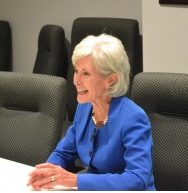
Kathleen Sebelius was governor of Kansas in 2005, when the Legislature and the Kansas Supreme Court sparred over school finance as part of the Montoy v. Kansas case.
‘Time is running out’
Kathleen Sebelius, governor at that time, recalled calling the special session that brought lawmakers back to Topeka in late June 2005.
That spring, the Legislature had attempted to resolve a school finance lawsuit — Montoy v. Kansas — by adding $142 million to the state’s education spending. Sebelius suspected that wasn’t enough. Though she didn’t veto the bill, she declined to sign it.
“I said that over and over during the session,” she said. “So we sent it quickly to the court without my signature.”
Sebelius believed the bill fell short of two requirements the state had to meet: putting enough money into schools to help student outcomes and distributing the money in a way that was fair to resource-poor school districts.
On June 3, 2005, the court agreed, ordering the Legislature to double that $142 million figure by the start of the new fiscal year on July 1 — an important date for school district budgets. The justices settled on that amount based on a school finance study the Legislature had commissioned four years earlier.
“Time is running out for the school districts to prepare their budgets,” the justices wrote in explaining the July 1 deadline. “The Legislature has known for some time that increased funding of the financing formula would be necessary.”
Sebelius wanted the Legislature to comply, and many moderate Republicans agreed.
“We thought we were putting an adequate amount of money in, but the court thought otherwise,” recalled former Senate president Steve Morris, of Hugoton. “So I thought, well we’ll just have to do what we have to do.”
Sebelius set a June 22 start date for the special session and Morris called a few of the Senate’s committees back early to craft legislation that would meet the court’s demands. When the full Senate returned, it passed the bill on its first day.
That’s not to say senators had no reservations about the situation. After passing the legislation, some Senate Republicans set to work pursuing possible constitutional amendments that would tie the court’s hands on school finance in the future.
Court out of bounds?
The House, meanwhile, was at a standstill. Complying with the court ruling was anathema to conservative leaders there who saw it as caving to a branch of government overstepping its authority.
“We were pretty shocked that this court would not only weigh into that issue,” said then-representative Mike O’Neal, referring to school finance, “but literally order the Legislature to appropriate a certain amount of funds.”
The Hutchinson Republican was the longtime chairman of the House judiciary committee and argued that separation of powers doctrine — and in particular provisions in the Kansas Constitution and legal precedent — meant the court was out of bounds.
Democrats and some moderate Republicans disagreed.
“We have equal branches of government, and we need to remember that,” Morris said.
The lack of a resolution frustrated members of the Senate who wanted the House to wrap up its work, get the money to schools and allow everyone to go home.
“At one point I put out a news release where I called it ‘Mays malaise,’” Senate Minority Leader Anthony Hensley said, referring to then-Speaker of the House Doug Mays. “They were unable to do anything.”
Mays, a Topeka Republican who left the Legislature a year later, didn’t respond to an interview request for this article.
Constitutional questions
Talk of potentially defying the court by ignoring its ruling, or asking Kansas voters to amend the state constitution, continued. The Kansas Constitution had — and still has today — a provision requiring the Legislature to suitably fund public schools, and potential ideas in 2005 included adding a line to it barring the court from weighing in on that matter.
In a legislative hearing, Washburn University law professor Bill Rich testified against the idea.
“That would mark a really radical change in the history of the relationship between the judicial and legislative branch,” Rich said.
It effectively would have carved out part of the constitution as unenforceable by the courts, Rich argued, and that could have broader implications. If lawmakers wanted to prevent judicial scrutiny of their compliance with a constitutional duty, Rich said, they should ask voters to remove that duty from the Kansas Constitution.
In this case, that would have meant deleting the clause requiring Kansas to suitably fund public schools. But asking the public to do that may not have been politically palatable.
“I think the Legislature knew that that was not going to pass,” Rich said.
As the impasse continued, lawmakers missed the court’s July 1 deadline, raising the possibility of school closure.
Political and government leaders knew school closure was a risk because a lower court ruling had made that clear. Absent a constitutional school finance system, the judicial branch was prepared to strike down the current one. In doing so, the court would block its implementation, which meant stopping the flow of money to schools.
The missed deadline increased pressure on everyone. School administrators like Randy Weseman, then superintendent of the Lawrence district, weren’t sure how long they would have the authority to keep paying the bills in the new fiscal year.
“When you’re talking about not providing education in August for 11,000 kids, 2,000 employees,” Weseman said, “it’s a huge undertaking to talk about just stopping that train.”
For Weseman, the matter was further complicated by the fact that Lawrence, a growing district, was in the middle of building new schools. He and other administrators watching the stalemate in Topeka began preparing to ask the Kansas Supreme Court to allow schools to continue paying certain critical expenses.
An ‘intense’ July 1 meeting
But the schools never closed. Two things happened in quick succession that appear to have pushed the legislative process forward. One was a closed-door nighttime meeting July 1 in Sebelius’ office, with key players like Morris, Hensley and Mays all present.
Mays reportedly left abruptly, dodging the questions of reporters waiting outside the room.
Hensley described the meeting as “very intense.” Mays knew, he said, that Democrats and moderate Republicans had been discussing a bill to comply with the court.
The other event, the next morning, was an order from the state Supreme Court, which wasn’t pleased with the Legislature missing its deadline. The justices gave state lawyers six days to prepare for appearing in court and presenting any last-minute arguments against blocking the flow of money to schools.
In the days that followed, the House and Senate negotiated.
“We basically had to pay the ransom and make sure the schools were going to open,” said O’Neal, who was one of the six negotiators.
They reached a resolution, and both chambers signed off on it two days before state lawyers were due back in court. That was a relief for moderate Republican leaders like Morris.
“It felt like we had taken a load off,” he said. “We had done what we needed to do.”
‘Quite a bit of reform’
O’Neal said conservative Republicans didn’t leave the negotiating table empty-handed. The final law approved by both chambers on July 6 included a raft of policies O’Neal and others pushed for.
Those included a policy goal for schools to spend at least 65 percent of their state aid on instruction, new procedures for filing school finance lawsuits against the state and provisions barring the courts from enforcing any rulings by cutting off money to schools.
“We felt like we got quite a bit of reform in exchange for writing a bigger check,” O’Neal said.
All attempts in 2005 to pursue a constitutional amendment, which would have required a two-thirds majority in each chamber before proceeding to a public vote, failed.
As for the statutory ban on closing schools, which lawmakers did pass, it’s not clear that the courts consider it binding absent a constitutional amendment. In more recent school finance rulings, cutting off money to schools has remained an option on the table despite the 2005 law.
Celia Llopis-Jepsen is a reporter for the Kansas News Service. You can reach her on Twitter @Celia_LJ.
WEST PALM BEACH, Fla. (AP) — President Donald Trump capped 2017 on Sunday with a video self-tribute touching on what he sees as the high points of his achievements and rhetoric from his first year in office. He gave a plug to American exceptionalism, too.
In the video running 3½ minutes, scenes of Trump with military personnel, Border Patrol agents and other world leaders are set to a stirring soundtrack as he declares of his country: “We gave birth to the modern world and we will shape tomorrow’s world with the strength and skill of American hands.”
Trump cited his success in placing a new justice on the Supreme Court, his efforts to cut regulations and his big win on overhauling taxes, which he falsely described as the “largest tax cut in the history of our country.”
Trump offered the video with a New Year’s Eve message, saying “What a year it’s been, and we’re just getting started. Together, we are MAKING AMERICA GREAT AGAIN! Happy New Year!!”
The president is spending the holidays in Palm Beach, where his Mar-a-Lago club hosts an annual New Year’s Eve bash. At the event last year, hundreds of guests gathered in the club’s grand ballroom, including action star Sylvester Stallone and romance novel model Fabio.
The White House said Trump been briefed on New Year’s Eve security precautions around the country and will continue to monitor those efforts.
Trump offered his condolences Sunday to the victims of a shooting in suburban Denver that killed one sheriff’s deputy and wounded six other people, including four deputies. He tweeted: “We love our police and law enforcement – God Bless them all!”
Trump had lunch with Florida Gov. Rick Scott on Sunday. The White House said they discussed hurricane recovery efforts, the need to improve infrastructure “and many other matters important to the people of Florida.”
The governor came with some specific concerns: the need for repairs to the federally operated Herbert Hoover Dike surrounding Lake Okeechobee and the recovery of Florida’s citrus industry from Hurricane Irma, said his spokesman, John Tupps.
Trump has encouraged Scott to challenge Sen. Bill Nelson, a Democrat, in 2018. Scott said in December that he had not made up his mind, though there have been multiple signs he is considering a run.
Lucas ‘the Tiger’ Glover photo courtesy Team Heartland, Sport Karate
FORDLAND, Mo. (AP) – A 6-year-old taekwondo student in south-central Missouri is fighting for an injured teammate he’s never met.
The Springfield News-Leader reports that Lucas “The Tiger” Glover outranks most of his classmates at G+G Martial Arts in Fordland. He leads the gym in prayer, and makes sure to include one for 16-year-old Julia Shipp.
Shipp broke several bones and suffered a traumatic brain injury Oct. 13 when she was hit by an allegedly drunken driver.
The teenager from Kentucky now uses a wheelchair to get around.
Both belong to Team Heartland, a national team of taekwondo fighters. Though Lucas doesn’t personally know Shipp, he’s fighting for her in his training to soon become a black belt.
Shipp says she will give Lucas a big hug if she ever meets him.
Saturday night crash in Topeka-photo courtesy WIBW TV
SHAWNEE COUNTY — Law enforcement authorities are investigating an injury accident as possibility alcohol related.
Just after 11:30 p.m. Saturday, Police Officers responded to a report of an injury accident at SW Croix Street and SW Topeka Blvd. in Topeka, according to
Upon arrival Officers located a severely damaged van occupied by one adult male (the sole occupant) and a pickup truck occupied by an adult male driver and three children passengers. Officers quickly checked on all occupants and found the driver of the van was suffering from potential life-threatening injuries. The driver and children in the pickup truck were not seriously hurt, according to Lt. Andrew Beightel. They were treated at the scene.
Topeka Fire Department had to extricate the driver from the mangled van, which was exacerbated by the extreme cold weather and wind. The driver was then transported to an area hospital. The driver of the van is now listed in stable condition.
The southbound lanes of Topeka Blvd and SW Croix were closed for a few hours while Officers complete their investigation and diagramed the scene. Alcohol is suspected of being a contributing factor in this collision.
DENVER (AP) — A sheriff’s deputy was killed and four others were wounded Sunday in a shooting in suburban Denver that capped a year of deadly attacks in the United States. Two civilians were also injured.
The shooting happened after deputies were called to the scene of a domestic disturbance in Highlands Ranch, the Douglas County Sheriff’s Office said on Twitter. The suspected gunman was also shot and is believed to be dead and “no longer a threat.”
Shots were fired in the course of the investigation at the Copper Canyon Apartments, a landscaped complex 16 miles south of Denver, the sheriff’s office said. Residents in the vicinity were advised to stay inside and avoid exterior walls and windows.
**Copper Canyon OIS Update**- Deputies responded to a domestic disturbance resulting in shots fired. 5 deputies shot by suspect. 1 deputy confirmed deceased. 2 civilians also shot by suspect. Suspect shot & believed to be dead & no longer a threat. #CopperCanyonOIS
A hospital where three people were taken for treatment says those people suffered noncritical injuries. Another nearby hospital said it received four patients but wouldn’t release their conditions.
The shooting occurred on the final day of a year that saw the deadliest mass shooting in modern U.S. history in Las Vegas.
—————
DENVER (AP) — Authorities say multiple sheriff’s deputies are “down” after being called to scene of a reported domestic disturbance south of Denver.
UPDATE 0513 this morning deputies responded to he Copper Canyon Apartments for a Domestic Disturbance. During the Investigation, shots were fired and multiple deputies were injured. No status on the deputies and no status on civilian injuries. Please avoid this area.
Kansas City, Mo. – The free 23rd Annual Eagle Days at Smithville Lake will offer visitors a chance to view wild eagles and rehabilitated captive raptors.
According to a press release from the Missouri Department of Conservation (MDC), weather dictates where eagles and waterfowl use the lake and where people can watch them. Last year, eagles were feeding on fish in the spillway below the lake dam, where the Little Platte River is once again free flowing. During some years, eagles are seen at other lake locations where waterfowl congregate, especially geese. A bitter cold freeze up of the lake can send eagles and waterfowl south, but in most years, both are seen by visitors.
Eagle Days is hosted by the MDC, the U.S. Army Corps of Engineers, Clay County Parks and Recreation, and private conservation groups. Staff from host agencies will scout the lake ahead of the event and set up spotting scopes at locations where eagles are feeding or roosting. Outdoor viewing locations will be announced at the clubhouse.
The free event will also include wildlife watching indoors and close up at the Paradise Pointe Clubhouse. Operation Wildlife will display raptors, a show that often includes eagles. Friends of the Lakeside Nature Center will display some rehabilitated raptors, such as small owls. The Martha Lafite Thompson Nature Sanctuary of Liberty, Wings of Love, and Clay County Parks will also present nature displays.
Outdoor eagle viewing and indoor activities at the clubhouse will be from 9 a.m. to 3 p.m. on Saturday, Jan. 6, and from 10:30 a.m. to 3 p.m. on Sunday, Jan. 7. The Paradise Pointe Golf Course Clubhouse is located at 18212 Golf Course Drive, in Little Platte Park at the lake at Smithville.
Attendees are encouraged to bring cameras, binoculars, spotting scopes, and warm clothes. Refreshments will be on sale at the clubhouse. For information about Smithville Lake Eagle Days, call (816) 532-0174.
For information about viewing bald eagles at other locations and at MDC events, click here.