OMAHA, Neb. (AP) — No wonder Kansas never wants anything to do with Wichita State.
Behind another steady performance from Fred VanVleet and the hot shooting of Evan Wessel, the No. 7 seed Shockers rolled past the second-seeded Jayhawks 78-65 on Sunday, earning a trip to the Sweet 16 at the expense of the school that has caused them so much chagrin.
Tekele Cotton led the way with 19 points for the Shockers (30-4). VanVleet finished with 17 and Wessel hit four 3-pointers to score 12, sending the Missouri Valley champions to Cleveland for the Midwest Regional semifinal against third-seeded Notre Dame.
Devonte’ Graham and Perry Ellis had 17 points each, and Frank Mason added 16 for the Jayhawks (27-9), who blew an early eight-point lead and never really threatened in the second half.
BASEHOR – A Kansas woman was injured in an accident just before 4 p.m. on Sunday in Leavenworth County.
The Kansas Highway Patrol reported a 1985 Honda Rebel 250 driven by Judith C. Henney, 49, Leavenworth, was northbound on 158th Street in Basehor navigating a curve.
The motorcycle struck sand, left the road and the rider was ejected.
Henney was transported to Overland Park Regional Medical Center.
LAWRENCE, Kan. (AP) — A collection of materials highlighting some of the nation’s radical political beliefs is celebrating its 50th anniversary at the University of Kansas.
The Lawrence Journal-World reports that the Wilcox Collection of Contemporary Political Movements at the Spencer Research Library has more than 100,000 items. They include bumper stickers and posters emblazoned with messages that include “Support gun control, disarm the FBI.” The collection also features books about extremist movements.
Seventy-two-year-old Laird Wilcox, of Olathe, began collecting the materials as a youth. Wilcox sold his collection to KU in 1965, and continues to donate items to it. The library also has a fund with which to purchase new materials to keep it growing.
To mark the anniversary, some pieces are on display at the Spencer Library.
TOPEKA, Kan. (AP) — Shawnee County prosecutors have charged a Topeka city councilman with failing to disclose that he is an officer of a tax-exempt nonprofit corporation.
The Topeka Capital-Journal reports that court records show that Chad Manspeaker was charged with the misdemeanor criminal charge Tuesday. Manspeaker said in a written statement that he would “rather not comment at this time,” noting that the case is pending.
Manspeaker didn’t run for re-election and leaves his city council seat on April 14. His last full meeting on the city council was last week.
It wasn’t immediately clear what tax-exempt entity Manspeaker is accused of failing to disclose in his role as a public officer.
TOPEKA, Kan. (AP) — Republicans who control the Kansas Legislature are boxing themselves into considering tax increases by drafting proposed budgets in both chambers that don’t balance without them.
GOP legislators have repeatedly said that the budget shortfall projected at nearly $600 million for the fiscal year beginning July 1 represents a spending problem, not a revenue problem.
But top Republican lawmakers are now anticipating general tax increases of more than $100 million a year.
The House and Senate expect to debate their committees’ proposed budgets this week and to pass a final spending blueprint for state government before lawmakers start their annual spring break on April 4.
They are set to return from their break on April 29 to finish the year’s business. Their wrap-up will be dominated by tax issues.
OLATHE, Kan. (AP) — Police are investigating the shooting death of a man in the Kansas City suburb of Olathe.
Officers were called Saturday night to a residence where a man was found dead. Police said in a news release that the man appeared to have a single gunshot wound to his upper body. The release said officers are investigating the death as a homicide.
Anyone with information is urged to call police. The name of the victim wasn’t immediately released.
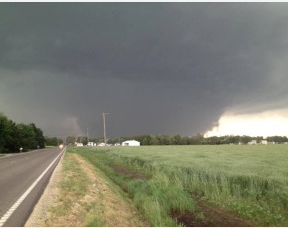
TULSA, Okla. (AP) — The U.S. appears to be locked in a tornado drought as meteorologists have recorded only about two-dozen twisters so far this year during a period when 100 or more are typical.
And there have been no reports of tornadoes so far in March — a sometimes violent period for severe weather. The last time there were no tornadoes in March was 1969.
Forecasters at NOAA’s Storm Prediction Center in Norman have issued only four tornado watches and no severe thunderstorm watches — less than 10 percent of the average 52 tornado watches issued by mid-March.
Warning coordination meteorologist Greg Carbin said there isn’t one answer to explain the sluggish start, but that a persistent weather pattern of cold, stable air prevents a tornado’s ingredients from coming together.
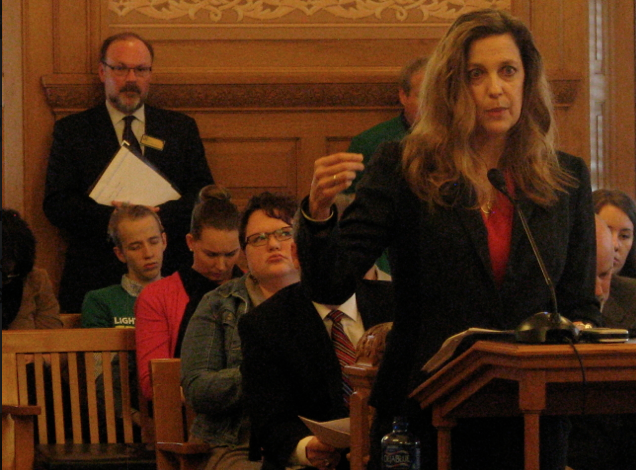
Kansas Department of Health and Environment Secretary Susan Mosier warned legislators Thursday of the potential fiscal pitfalls of expanding Medicaid. Credit Andy Marso / Heartland Health Monitor
by ANDY MARSO
Kansas officials told legislators Thursday that the state’s share of Medicaid expansion costs could start at $100 million per year and increase from there, and those costs could double if the federal government required full funding of waiting lists as a condition of expansion.
One day after her predecessor testified in favor of expansion under the Affordable Care Act, Kansas Department of Health and Environment Secretary Susan Mosier provided neutral testimony that warned legislators of potential fiscal pitfalls.
Mosier said there were “moral implications” of expanding Medicaid to “able-bodied adults” while Kansans with disabilities were still awaiting some services, likening it to “cutting in line.”
“We still do have over 5,000 individuals awaiting services,” Mosier said.
Mosier’s comments and a fiscal note from budget director Shawn Sullivan that included costs of funding the waiting lists in the expansion proposal, House Bill 2319, prompted questions from members of the House Health and Human Services Committee.
Rep. Susan Concannon, a Republican from Beloit, called it “a little bit disingenuous” and suggested it was artificially pumping up the projected cost of the bill.
“This is not part of the bill that the waiting list disappears,” Concannon said. “This is a decision from the administration to include those numbers in the bill?”
Mosier said Gov. Sam Brownback considers funding the waiting lists his top Medicaid priority.
Rep. Jim Ward, a Democrat from Wichita and the leading legislative proponent of expansion, questioned that commitment.
“How do you stand there and pit disabled people against the uninsured when you haven’t spent a dollar on the waiting list?” Ward asked.
“Actually we’ve spent $64 million on the waiting lists since the inception of KanCare,” Mosier responded.
The Medicaid waiver waiting lists Mosier referred to are for home-and-community-based support (HCBS) services for Kansans with disabilities, which is different from the strictly medical coverage that would be extended to Kansans under Medicaid expansion. Kansans with disabilities who are on waiting lists for HCBS services are not waiting for medical coverage.
The Kansas Hospital Association is one of the group’s leading the lobbying effort for Medicaid expansion. At Wednesday’s hearing, the association’s president, Tom Bell, said the group believes expansion will pay for itself through economic development spurred by the infusion of more than $2 billion in federal cash into the health care system by 2020. But he anticipated Thursday’s waiting-list concerns and said that hospitals are willing to talk about how to cover the state’s share of the costs, even if they include the cost of eliminating the HCBS waiting lists.
“We would love to be able to sit down and look at options for how to fund this,” Bell said.
Kansas’ privatized Medicaid program, KanCare, provides medical coverage for about 425,000 children and low-income, disabled and elderly adults. But that number includes relatively few non-disabled adults.
Adults with dependent children can participate in KanCare, but only if they have incomes below 33 percent of the federal poverty level, or a little more than $8,000 annually for a family of four. Adults without children aren’t eligible for coverage no matter how poor they are.
Expansion would make all Kansans with incomes up to 138 percent of poverty eligible for KanCare. The eligibility cap would be set at annual income of $16,105 for an individual and $32,913 for a family of four. Estimates vary, but it’s thought Medicaid expansion would extend coverage to between 140,000 and 170,000 Kansans.
Wednesday’s hearing on expansion brought in more than 150 pieces of testimony from health care providers, business groups and religious leaders who favor expansion and a crowd that spilled out into the hallway.
Thursday’s hearing, which included opponents and Mosier, brought in free-market think tanks like the Kansas Policy Institute, Americans for Prosperity, Foundation for Government Accountability and Wichita-based Kansans for Liberty. AFP supporters, many in the organization’s green t-shirts, filled much of the Old Supreme Court Room.
Akash Chougule, a senior policy analyst in AFP’s Washington, D.C. office, provided a laundry list of states where he said expansion had been fraught with cost overruns due to higher-than-expected enrollment, including his home state of Rhode Island. Chougule also cautioned that having insurance coverage does not guarantee patients will be able to find the doctors and treatments they need.
“Putting an insurance card in everyone’s pocket, by all means, does not ensure access to quality medical care,” Chougule said.
Ward, questioning both Chougule and Dean Clancy of the Foundation for Government Accountability, asked them if both had “one of those dreaded insurance cards.”
“Would you agree that though it may not be perfect, it’s a lot better than not having one?” Ward asked rhetorically.
Chougule and Clancy nodded ‘yes’ in response. Rep. Don Hill, a Republican from Emporia who has quietly helped steer the Medicaid expansion discussion, thanked Chougule, Clancy and other opponents for their testimony but said he thought the hearing had gotten “a little far afield.”
Hill noted that the bill in question does not prescribe a certain type of expansion, but only repeals a previous law that required legislative approval and compels the Brownback administration to begin negotiating with the federal government on an expansion plan.
“It’s really pretty simple,” Hill said. “It’s just saying we, the Legislature, are ready to get out of the way.”
Hill asked the opponents of expansion to offer the administration advice in crafting the best possible plan based on their research.
Nearly all the opponents who testified said they doubted the federal government would maintain the promised long-term 90 percent match. They predicted that costs would balloon and pull money away from other essential state services.
Chougule, whose group flexed its muscle in scuttling an alternative expansion plan in Tennessee earlier this year, predicted political consequences for legislators who vote for expansion or work for its passage.
“We certainly plan to hold accountable any legislator who supports this misguided scheme,” Chougale said.
Even the most conservative members of the committee had questions about how the status quo could be sustained, though.
The ACA cut Medicare payments to hospitals on the assumption that expansion of Medicaid would make up the lost revenue. But the 2012 U.S. Supreme Court decision upholding the ACA also said that states could opt out of expansion, and about half the states — all controlled by Republican legislatures — have done so.
Rep. Jim Kelly, a Republican from Independence, asked Chougule what would happen to rural towns in his district if their hospitals closed and whether they would be able to attract new businesses to an area that was without a medical center.
Rep. Dick Jones, a Republican from Topeka, told Clancy he was not sure KanCare coverage was the ultimate answer. But Jones said he was struck the previous day by the testimony of Marcillene Dover, an uninsured Wichita State University student who said she faced delays getting her multiple sclerosis diagnosed and was further “devastated” when she had to figure out how to pay for costly treatments.
“This is what we want to prevent,” Jones said.
Andy Marso is a reporter for Heartland Health Monitor, a news collaboration focusing on health issues and their impact in Missouri and Kansas.
WEIR-A Kansas woman died in an accident just after 7 p.m. on Saturday in Cherokee County.
The Kansas Highway Patrol reported a 2002 Ford Focus driven by Joshua Coleman, 32, Pittsburg, was south bound on NE 50th Street one mile northeast of Weir.
The driver lost control of the vehicle. It went off the west side of the road and struck a tree.
A passenger in the vehicle Chrystene Weller, 28, Pittsburg, was pronounced dead at the scene and transported to Frontier Forensics in Kansas City.
Coleman was transported to Freeman Health Systems.
MANHATTAN – Saturday was a busy day for firefighters in Riley County. The Manhattan Fire Department, Blue Township Fire Department and Riley County Fire Department were called to numerous brush fires.
According to Riley County Emergency Management Director Pat Collins 140 acres burned near the KSU Animal Science property adjacent to Top of the World Drive.
The fire threatened 5 homes and took 13 apparatus and 27 firefighters 5 hours to get under control.
An outbuilding on Eureka Drive was completely lost in a grass fire.
Fire crews were called to six other grass fires, all less than 10 acres in size on Saturday. There were no injuries reported.

 DAVE SKRETTA, AP Sports Writer