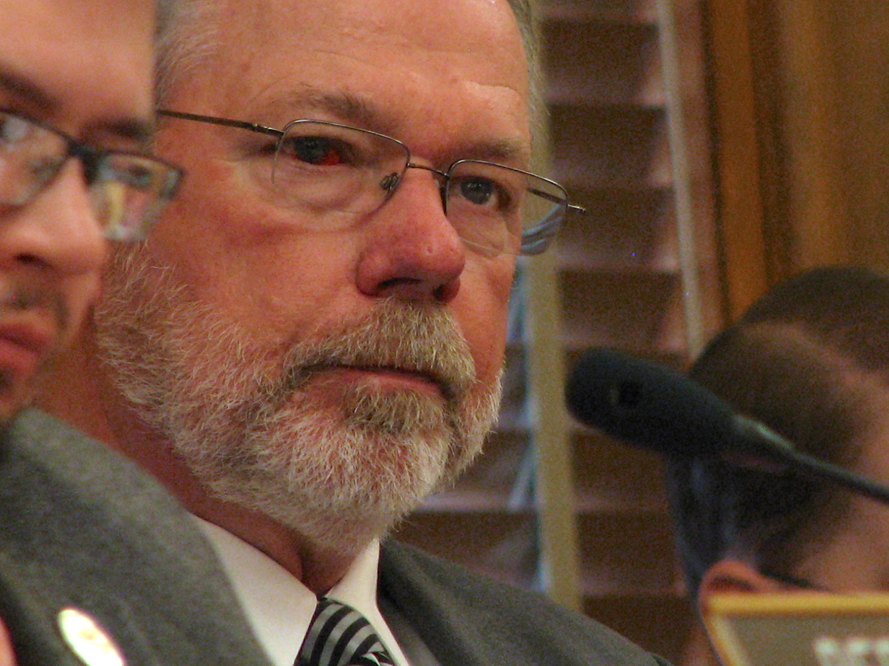
TOPEKA, Kan. (AP) — University of Kansas officials have met with state legislators in Topeka to discuss the school’s ownership and use of jets.
The Lawrence Journal-World reports that officials told the House Standing Committee on Education Budget that the jet expenditures of $1.5 million are more than offset by revenue that the aircrafts generate from donor relations and athletics.
The university has owned planes for several decades, but recently its endowment association has given the school money to purchase them.
Taxpayers and students pay for the fuel, operations and maintenance of the jets.
According to flight data obtained by the paper, about two-thirds of $3.5 million spent over five years was for Kansas coaches and athletic administrators. The rest of the money was used to fly top university officials. The university also flew doctors and medical staff 643 times to rural cities to treat patients.
TOPEKA, Kan. (AP) — A Kansas panel has endorsed a $6.4 billion budget that doesn’t balance without tax increases.
The House Appropriations Committee approved the plan Tuesday. The budget would fall about $133 million short if the Legislature does not increase taxes on alcohol and cigarettes as Republican Gov. Sam Brownback has recommended.
Republican Rep. Virgil Peck from Tyro said that he would not support a budget that increases spending without having secured the revenues to pay for it.
Chairman and Republican Rep. Ron Ryckman of Olathe said approving the plan would help clarify how much additional revenue the state will need through new taxes.
The Senate approved the largest portion of the state budget by passing the governor’s school funding overhaul Monday. Brownback is expected to sign the plan later this week.
MANHATTAN — A highly pathogenic avian influenza confirmed in four states can be very deadly for birds, but a Kansas State University poultry expert says humans don’t need to worry about their own health or contaminated
Dr. Scott Beyer – photo courtesy ksu.edu
poultry products.
The U.S. Department of Agriculture Animal and Plant Health Inspection Service has confirmed the presence of H5N2 avian influenza in Kansas, Missouri, Minnesota and Arkansas. This strain is considered highly pathogenic in birds with a high mortality rate. The Centers for Disease Control considers the risk to people from these HPAI H5 infections in wild birds, backyard flocks and commercial poultry to be low. No human infections with the virus have been detected at this time.
“These H5N2 variants have never been known to cause any transmission between humans and poultry,” said Scott Beyer, associate professor of animal sciences and industry and K-State Research and Extension state poultry specialist. “We are always testing and monitoring to see if any birds have any type of influenza. We don’t allow any infected birds to go to marketplace, which means the chance of them ever making it into the food supply is about zero.”
Beyer says influenza strains recombine, sometimes causing a more deadly, more transmissible flu like this H5N2. It’s a strain that turkeys are highly susceptible to and is spreading through migration.
“We think that birds migrating North and South are mixing together in certain zones, like nesting and feeding zones,” he said. “If those birds stop and feed or nest for awhile, then move back to another area of the country, they can drop off the virus to our local small flocks and even our commercial farms. That’s what we have started seeing.”
To protect your flock, set up a perimeter or safe zone to keep your birds from outside fowl or other animals that could potentially spread the disease. Beyer says other animals can spread this influenza, such as dogs and small birds.
“For example, a visiting waterfowl drops feathers, which can be contaminated,” Beyer said. “A sparrow will grab the feather and make a nest in your facilities. The U.S. doesn’t allow any infected birds to go to marketplace, which means the chance of them ever making it into the food supply is about zero.”
Infected birds show flu-like symptoms like coughing, sneezing, swelling around the eyes, flicking of the head and a raspy rattle sound when they breathe.
Warm, dry, windy conditions have prompted another burn ban. Nodaway County has issued a ban on outdoor burning until further notice.
In a Nixle Alert, authorities said all fire fighters and emergency responders should be on high alert.
The burn ban in Doniphan County, Kansas remains in effect until at least Monday, March 23.
Atchison County, Missouri issued a burn ban Tuesday. It will remain in effect until further notice.
The National Weather Service has issued a Red Flag Warning for all of Northwest Missouri, as well as Atchison, Doniphan, Leavenworth and Wyandotte counties in northeastern Kansas until 7pm Tuesday. The combination of dry and breezy conditions will bring “very high” to “extreme” fire growth potential to the area. Any fires that ignite this afternoon will have the necessary ingredients, including dry fuels such as native grasses and brush piles, to spread very quickly.
Outdoor burning is strongly discouraged throughout the area.
TOPEKA, Kan. (AP) — Kansas legislators are moving closer to allowing residents 21 or older to carry concealed firearms without a state permit.
The House Federal and State Affairs Committee approved a bill Tuesday ending the requirement for a permit. The committee’s voice vote sends the measure to the full House for debate.
The Senate approved the measure last month, and the House committee made only one technical change. Supporters argued that gun owners are responsible and shouldn’t have to ask the government’s permission to carry concealed.
A permit costs $132.50, and a person seeking one must undergo eight hours of firearms training. The bill’s opponents say the state still should require some training to carry concealed.
But the Republican-dominated Legislature has strong gun-rights majorities in both chambers.
TOPEKA- – A Topeka man pleaded no contest Monday to federal armed robbery charges according to U.S. Attorney Barry Grissom said.
Henry Earl Sirvira, 46, Topeka, Kan., entered a plea of nolo contendere to two counts of commercial robbery and one count of brandishing a firearm during a robbery. During the plea hearing, prosecutors told the judge that on July 29, 2013, Sirvira and co-defendant Quartez Norwood robbed the EZ Payday Advance at 2613 S.W. 21st Street in Topeka. Sirvira pointed a handgun at an employee and threatened to kill him unless he opened the safe.
On Aug. 3, 2013, Sirvira and Norwood robbed the Family Dollar Store at 2616 S.E. 6th Street in Topeka. Norwood pointed a gun at the clerk while Sirvira assaulted a patron in another part of the store.
Sentencing is set for June 1. Both parties have agreed to recommend a sentence of 11 years in federal prison.
Co-defendants include:
Quartez Norwood, who was sentenced to 180 months.
Henry Lavelle Davis, who was sentenced to 84 months.
Robert Wayne Redmond, who was sentenced to 60 months.
Xavier Leron Sims, who was sentenced to 35 months.
Grissom commended the Topeka Police Department, the FBI and Assistant U.S. Attorney Jared Maag for their work on the case.
The Big 12 again has seven teams in the NCAA Tournament.
Regular-season champion Kansas is a No. 2 seed, and the No. 3 seeds in three of the four regions are from the Big 12 — tournament champion Iowa State, Oklahoma and Baylor. The league also has the nation’s top cumulative RPI and five top-20 teams in this season’s final AP poll.
“We’re arguably the best conference in the country,” Oklahoma coach Lon Kruger said Monday. “Still, we need to validate that with some tournament wins and some teams advancing.”
This is the second year in a row with seven NCAA teams, making the Big 12 the only league that can boast 14 bids in that span. But only Baylor and Iowa State made it past the opening weekend of the tournament last March, then both lost in the Sweet 16.
An Andrew County judge set bond at $250,000 for a St Joseph man accused of child abuse, child endangerment and assault for the alleged beating of his girlfriend’s infant child.
In a news release last month, officials said the 15-month-old child was in serious to critical condition at Children’s Mercy Hospital.
Zachary W. Kerns-Poe is charged with Assault in the first degree, abuse or neglect of a child, and endangering the welfare of a child. He is now scheduled for a case review April 20.
Sheriff Bryan Atkins says they received a 911 call on January7 31 at 5:08am from the victim’s mother in Country Club Village. The infant was reported not breathing and not responding. Atkins says the injuries were reported by hospital personnel as “non-accidental, with massive head trauma.”
A judge denied bond at the time the case was filed. Kerns-Poe waived his preliminary hearing. In an arraignment hearing Monday, Circuit Judge Weldon Judah set bond at $250,000.
Photo by Dave Ranney Rep. Will Carpenter, a Republican from El Dorado, withdrew an earlier proposal that would have set aside $3 million for an elementary school reading program
by DAVE RANNEY
The chairman of the House Social Services Budget Committee on Monday withdrew an earlier proposal that would have set aside $3 million for an elementary school reading program. “Numerous red flags have come up,” said Rep. Will Carpenter, a Republican from El Dorado.
The recommendation had been contingent upon the U.S. Department of Health and Human Services agreeing to allow the state to spend a portion of its Temporary Assistance for Needy Families (TANF) block grant on its Parents as Teachers program.
If HHS approved the proposal, Carpenter and others were prepared to take $3 million from the Parents as Teachers budget, most of which is funded with tobacco master settlement revenues, and replace it with $3 million from TANF.
The arrangement would have made $3 million in the state’s tobacco fund available for the reading program. But Carpenter said he’d been told not to expect HHS to approve using TANF monies to underwrite Parents as Teachers. “At this point in time, I’m going to pass on the recommendations that involve that $3 million,” he said, addressing a morning meeting of the full House Appropriations Committee.
Carpenter said the Kansas Department for Children and Families had advised him that TANF is intended for anti-poverty programs that meet at-risk families’ immediate needs, promote employment, reduce out-of-wedlock pregnancies and encourage marriage. Kansas Parents as Teachers programs are administered by local boards of education.
Because they are considered educational rather than anti-poverty, they likely would not be eligible for TANF. The finding, Carpenter said, shelved his support for putting $3 million into an initiative aimed at helping elementary schools pay for computer programs that help students learn to read. “Zero,” he said after the hearing.
“There’s no money at this point in time.” But Carpenter said he’s also heard that the state may receive more tobacco monies than initially projected. If that happens, he said, he would be willing to propose spending some of the windfall on the reading initiative. Earlier this year, Gov. Sam Brownback dropped the reading initiative, called Lexia Reading Core 5, from his proposed budgets for fiscal years 2016 and 2017.
The program generated controversy in 2013 after Rep. Marc Rhoades, a Newton Republican and then-chairman of the House Appropriations Committee, added a last-minute proviso to a session-ending budget bill that earmarked $12 million in tobacco master settlement revenues — $6 million a year for two years — for Educational Design Solutions, a small company owned by Don Fast, who lives in Rhoades’ district. Fast’s company sells licensed access to the Lexia software. The proviso did not allow other software companies to bid on the program.
The social services budget committee’s now-tabled proposal would have allowed other software companies to bid on the initiative. “We need to quit calling this ‘Lexia’ because what we’d be recommending — if the money becomes available — would be an RFP (request for proposals) that would be open to anyone who wanted to bid on it,” Carpenter said.
Carpenter also said he was troubled by reports that using TANF for Parents as Teachers would require the programs to validate participating families’ incomes and make sure TANF dollars were only spent on low-income families.
“The last thing I want to do is create some giant bureaucracy,” he said. Still, Carpenter recommended directing the Kansas Department of Education to “consider implementing a sliding-fee scale” for families receiving services through Parents as Teachers programs.
“As it is now, you can make a million dollars a year and you get Parents as Teachers for free,” he said. “I just think it’s wrong not to charge something when people have the ability to pay.” The social service budget committee also proposed moving $200,000 out of the Parents as Teachers budget and into the budget for the Court Appointed Special Advocates.
The full appropriations committee is expected to vote Tuesday on the social services budget committee’s recommendations. Nancy Keel, president of the Kansas Parents as Teachers Association, questioned the administrative hassles that would accompany having to adopt a sliding-fee scale. “We don’t know what administering a sliding scale would cost a school district,” Keel said. “That’s an unknown as this point because school districts don’t ask for income verification.
They don’t ask, because they don’t think it’s any of their business.” Students’ eligibility for free and reduced-priced lunch programs, she said, is based on families that self-report their incomes.
Shannon Cotsoradis, chief executive with the advocacy group Kansas Action for Children, said she would encourage legislators to weigh the perceived benefits of a sliding-fee scale with the potential for causing some families to avoid receiving early diagnosis and intervention services. “This is an issue that’s best left in the hands of KDoE,” she said.
Last year in Kansas, Parents as Teachers screened more than 10,000 children, ages 0 to 3, for hearing, vision, health and development.
Nearly 1,400 of these children were referred to programs that provide more hands-on early childhood development services. There are approximately 70 Parents as Teachers programs in Kansas, employing more than 200 home-visitation workers in more than 150 school districts across the state.
The Parents as Teachers total operating budget now stands at $12.3 million a year, including $7.2 million from the Children’s Initiatives Fund and $5.1 million from school districts, grants, foundations and local charities. The state-funded portion of the program’s overall budget has been flat since 2008.
Dave Ranney is a reporter for Heartland Health Monitor, a news collaboration focusing on health issues and their impact in Missouri and Kansas.
MANHATTAN -Several members of the Manhattan Fire Department participated in the Inaugural New York City Firefighter Stair Climb on Monday.
The event brought 100 firefighters from all around the globe to honor the New York City Fire Department (FDNY) firefighters who lost their lives at the site.
The firefighters met at 4 World Trade Center and competitively ascended 72 floors in full firefighting gear.
The event was to raise money for Friends of Firefighters and Hope for the Warriors.
Manhattan Fire Department driver Kyle Highberger, firefighter Jacob Kirkland and firefighter Kody Songs participated in the climb.
The climb’s founders are John Mills and Chris Barber of Manhattan, New York’s Upper West Side, and explained their reason for starting the climb on their website.
“We were recently invited to New Zealand for a September 11th memorial ceremony and stair climb.
It was overwhelming to see the amount of support from firefighters on the other side of the globe for our fallen brothers in NYC. We realized the popularity of these memorial climbs and the significance they hold.
Several of the participants travel the globe attending these memorials and raising money for various charities.
We kept hearing the same question, “Why is there not a memorial climb in NYC?” So we decided to make it happen.”

 TOPEKA, Kan. (AP) — University of Kansas officials have met with state legislators in Topeka to discuss the school’s ownership and use of jets.