TOPEKA — The Kansas House approved legislation Thursday that would allow people convicted of driving under the influence a chance to clear the DUI from court records five years after completion of a sentence.
The bill would allow felony DUI violators and test-refusal violators to petition a judge five years after initial conviction for expungement, or deletion of the public record.
Under current law, the waiting period for DUI cases handled in municipal court is 10 years and the waiting period for those cases in state court is seven years.
The reform measure was sent to the Senate on a vote of 70-53.
Rep. John Carmichael (D-Wichita) said the purpose of expungement is to encourage further good behavior and give people a second chance.
“If they abide by the law then it comes off their record for purpose of employment, for example,” Carmichael said. “It doesn’t come off their record if they should mess up again.”
Unwavering opposition came from Rep. John Rubin (R-Shawnee) who said shielding mistakes from prospective employers and the public sends the wrong message to drunk drivers.
“We should in no way ever be lessening the penalties for drunk driving or granting any leeway to drunk drivers clearing their records anymore than we already allow under the current statutes,” Rubin said.
Rep. Jack Thimesch (R-Cunningham), who introduced the bill, clarified the law would not change any statute on how the person is penalized.
The law would simply allow a person to petition for the removal. Law enforcement could still access previous violations should that person drive under the influence on multiple occasions.
Amelia Arvesen is a University of Kansas senior from San Ramon, Calif., majoring in journalism.
WASHINGTON – U.S. Senators Pat Roberts, R-Kan., and Roger Wicker, R-Miss. today introduced key legislation to enact a permanent, government-wide prohibition of taxpayer funding for abortion. Currently, similar policies, such as the Hyde Amendment, require annual passage and do not apply to Obamacare.
The “No Taxpayer Funding for Abortion Act,” S. 582, also includes a provision championed by Senator Roberts requiring all health insurance plans offered by Obamacare exchanges to disclose coverage of elective abortion procedures and the abortion surcharge embedded into abortion-covering plans.
“Millions of Americans oppose the use of their hard-earned money to cover abortion services. This is true both of their tax dollars and of the premiums they pay to their health insurance providers. However, Obamacare makes it difficult for consumers to know if a plan they are purchasing covers abortion. We need transparency. Consumers have a right to know what their fees are paying for, so that they can choose an insurance plan that meets their needs and is in line with their beliefs and values,” Senator Roberts said. “Our bill protects this right. We ban all taxpayer funding for abortion, and we clearly inform consumers in health care exchanges which plans cover abortive services.”
“During the debate on Obamacare in 2009, President Obama promised the American people that under his plan, ‘No federal dollars will be used to fund abortions,’” Senator Wicker said. “We know now that is simply not true. Passing this bill would establish a comprehensive policy prohibiting the use of any public funding for abortion. Eliminating loopholes is critical to ensuring that no federal program, including those under Obamacare, is exempt from the prohibition.”
The legislation is the Senate companion to H.R. 7, authored by Representative Chris Smith, R-N.J., and Dan Lipinski, D-Ill. That bill passed the House by a vote of 242-179 on January 22, 2015.
Existing laws that would also be made permanent under S. 582 include the Smith FEHBP amendment (which prohibits funding for elective abortion coverage for federal employees) and the Dornan amendment (which prohibits use of congressionally appropriated funds for abortion in the District of Columbia).
Last year, the nonpartisan Government Accountability Office issued a report showing that taxpayer dollars paid for more than 1,000 health insurance plans that included elective abortion.
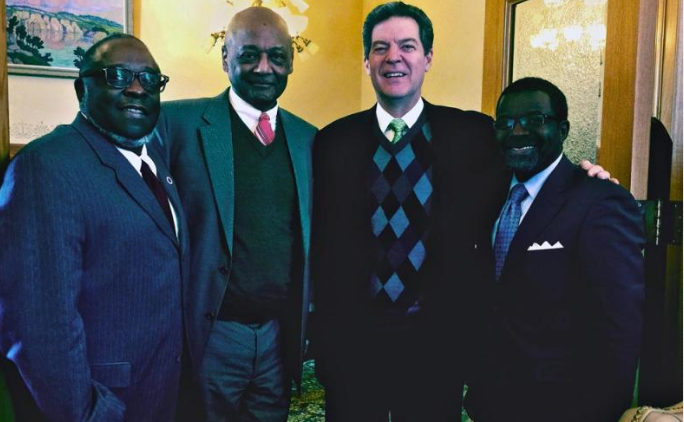
Photo by Kansas Department for Children and Families Gov. Sam Brownback, second from right, recently joined Center for Neighborhood Enterprise officials, from left, Charles Perry, Robert Woodson Sr. and Terence Mathis at the state’s announcement of a new initiative to address poverty-related community issues.
By DAVE RANNEY
Gov. Sam Brownback’s administration has awarded a one-year, $314,000 grant to a Washington, D.C.-based organization, the Center for Neighborhood Enterprise, to help low-income communities find ways to combat poverty, violence, substance abuse and absent fathers. “I’m excited to see this nationally recognized, successful initiative come to Kansas,” Brownback said in a recent Kansas Department for Children and Families news release of the national organization led by Robert L. Woodson Sr.
“Government doesn’t have the answers, our citizens know the problems plaguing their communities,” Brownback said, “and I look forward to working with Mr. Woodson to help our towns and neighborhoods grow at a grassroots level.” The Center for Neighborhood Enterprise is known for helping often-unrecognized leaders find ways to improve their communities without being overly dependent on government programs.
According to the grant, DCF and Center for Neighborhood Enterprise officials will recruit, train and assist 240 leaders from 17 cities: Dodge City, Fort Scott, Great Bend, Garden City, Hays, Hutchinson, Independence, Kansas City, Lawrence, Leavenworth, Liberal, Manhattan, Olathe, Pittsburg, Salina, Topeka and Wichita. Leaders in each community will be encouraged to “draft ideas” for addressing local needs.
Afterward, their proposals may be eligible for additional funding through public or private grant programs. The groups are expected to include people involved in law enforcement, child welfare, health care, mental health, social services, city government, credit counseling and the local faith community.
The initial meetings are expected to start in March. Theresa Freed, a DCF spokesperson, said the grant is underwritten with State General Fund monies in the department’s budget for the current fiscal year. The grant, awarded in November, was not subject to legislative approval.
The Center for Neighborhood Enterprise was founded in 1981 by Woodson, a former National Urban League administrator. According to the Center for Neighborhood Enterprise website, Woodson, now 77, “is the only person ever to have received both the liberal and conservative world’s most prestigious awards — the John D. and Catherine T. MacArthur ‘Genius’ Fellowship and the Lynde and Harry Bradley Foundation Prize, as well as the Presidential Citizens Medal.”
Woodson has agreed to spend up to 208 hours on the Kansas project. A Wall Street Journal article last year described Woodson as a “no-nonsense black conservative” who’s known for taking a market-driven — rather than government-dependent — approach to fighting poverty. In an interview Wednesday with KHI News Service, Woodson said most anti-poverty programs go into troubled communities “looking for deficiencies — families with kids who’ve dropped out of school, are in jail or on drugs.” The Center for Neighborhood Enterprise, he said, takes a different approach.
“When we go in, we look at the 30 percent of the homes without those deficiencies,” he said. “We identify their strengths, and then we look for what can be done to build on those strengths.” Oftentimes, he said, the strengths can be developed by using resources within the private sector rather than relying on government-funded support.
“The reason the word ‘enterprise’ is in our name is because we believe the principles that apply in a market economy also should apply in a social economy,” Woodson said. Barry Feaker, executive director at the Topeka Rescue Mission, said he’s not familiar with the Center for Neighborhood Enterprise. “What they’re wanting to do sounds like what we’re doing with Hi-Crest here in Topeka,”
Feaker said, referring to one of the most poverty-stricken neighborhoods in the nation. “It’s all about empowering people within their own neighborhoods.” Feaker said he’s been “more than encouraged” by the rescue mission’s successes in reaching out to Hi-Crest residents. “Crime is down,” he said.
“There’s a renewed interest in the community; residents have latched on to some hope in what they can do. City government is more involved, the private sector is more involved. There’s housing rehabilitation going on that wasn’t going on before. There’s a lot more interaction between the mental health and substance abuse programs. There’s been an explosion in interest from church groups. There’s significant momentum going forward.”
Feaker said he would welcome the Center for Neighborhood Enterprise effort in Topeka. “We don’t have all the answers,” he said. “If they can come in and generate some substantive ideas on where to go from here, I’m all for that. Time will tell, I guess.”
Dave Ranney is a reporter for Heartland Health Monitor, a news collaboration focusing on health issues and their impact in Missouri and Kansas.
Facebook users who don’t fit any of the 58 gender identity options offered by the social media giant are now being given a rather big 59th option: fill in the blank.
A Facebook announcement published online Thursday morning and shared in advance with The Associated Press tells users that if they do not identify with the pre-populated list of gender identities, they can add their own.
Facebook software engineer Ari Chivukula, who identifies as transgender and was part of the team that made the free-form option, says the change may lead to more widespread acceptance.
Last February, Facebook expanded gender identity from male and female to a list of dozens of options, including Androgyne, Gender Fluid and Transgender. Those choices will all still be available.
HUTCHINSON, Kan. (AP) — Kansas senators have expressed skepticism over the usefulness of Gov. Sam Brownback’s Rural Opportunity Zones program.
The Hutchinson News reports that the Republican and Democratic lawmakers are questioning whether the program, which is designed to pull people into the state’s rural areas, will actually bolster rural economies.
The program, which covers 77 counties that make up a large portion of western and southeastern Kansas, provides incentives like student loan forgiveness and waived income taxes to persuade people to move to rural areas.
The Department of Revenue estimates that 330 people will receive income tax waivers for 2014, which will cost the state about $800,000 in revenue.
Chris Harris of the Business and Community Development Division of the Kansas Department of Commerce said those individuals will have an economic impact of $44 million in the state.
ST. JOSEPH – Stefania Shtohryn, 88, passed away Tuesday, February 24, 2015 in a St. Joseph, health care center.
She was born October 8, 1926 in Kormaniche, Ukraine. She was a Homemaker, and a devoted member of the St. Joseph Ukrainian Catholic Church. She was also a member of the Kansas City Ukrainian Club.
Stefania was preceded in death by husband Jaroslaw “Russell” Shtohryn; two sons, Zenon “Jim” Shtohryn, and Peter Shtohryn; his mother, Maria Kurylo.
Survivors include son, Roman Shtohryn, (Cindy Portman) of St. Joseph; daughter, Mary Ann Heckelbeck of Kansas City, Mo.; a grandson, Paul (Angela) Shtohryn; four great-grandchildren, Alaina, Jace, Matthew, and Kessa; she also had two sisters in Ukraine, and one in Great Britain.
The Mass of Christian Burial will be celebrated on Friday, February 27 at 2 p.m., at the St. Joseph Ukrainian Catholic Church, Fr. Ivan Krotec, and Fr. Bohdan Kudleychuck and Con-Celebrant. The office of the dead will be prayed at 5 p.m., Thursday, and the family will receive friends until 7 p.m., on Thursday at the Rupp Funeral Home. The Interment will be at the Mount Olivet Cemetery. Memorials are requested to the St. Joseph Ukrianian Catholic Church. Online condolence and obituary at www.ruppfuneral.com
ST. JOSEPH – Dennis J. Donahue, 61, passed away Tuesday, February 24, 2015 in St. Joseph health care center.
He was born July 9, 1953 in Cameron, Mo., son of Mary and Hugh Donahue. He married Merrie Hines on November 15, 1969 and she survives of the home.
He was the owner operator of Hines Auto Service. He enjoyed working on cars, playing softball, but he most especially enjoyed watching his grandchildren playing sports.
Dennis was preceded in death by his parents; two daughters, Tina Marie and Cassandra Donahue.
Survivors include, wife, Merrie Donahue of the home; son, Scott Donahue and companion, Sandy of St. Joseph; two daughters, Shanin Donahue and Francine (Tito) Wilson of St. Joseph; “favorite granddaughter”, Mackenzie Donahue; grandsons, Ebon, Scotty, Brenten, Bryson, and Tryston; great-grandchildren, Taliyah and Jaseah; brother, Steve Donahue; two sisters, Linda (Gaylen) Caw, and Mary (Bob) Harless all of St. Joseph.
The family will receive friends from 6 to 8 p.m., on Friday at the Rupp Funeral Home. Memorials are requested to the Dennis Donahue memorial fund in care of the Rupp Funeral Home. Online condolence and obituary at www.ruppfuneral.com.
ST. JOSEPH – Timothy James Rice Sr., 72, passed away Wednesday, February 25, 2015 at Mosaic Life Care, St. Joseph.
He was born November 23, 1942 in Milwaukee, Ore., son of Hazel and William Rice Sr. He married Marie Youngs at St. James Catholic Church, Camp Douglas, Wi., on August 3, 1963.
He was a Welder and Maintenance Supervisor at several area waste management companies. He was a loving husband, father, and grandfather, and was very handy mechanically, as well as a skilled carpenter, you could always catch him working in his garage where he could fix anything. He was a member of St. James Catholic Church, St. Joseph.
He was preceded in death by his parents; and five brothers brothers, Robert, Bill, Jr, John, Don and Arthur.
Survivors include, wife, Marie Rice of the home; two sons, Timothy Rice Jr. (Becky), and Thaddeos (Tammy) Rice both of St. Joseph; six grandchildren, Trevor, Lena, Chris, Tamara, T.J., and Katie; and seven great-grandchildren; sister, Betty (Don) Eisel of Eugene, Ore.; mother-in-law, Margaret Youngs of Home; and several nieces and nephews.
Mass of Christian Burial will be celebrated on Tuesday at 10 a.m., at the St. James Catholic Church, Father Evan Harkins Celebrant, the Rosary will be Rosary will recited at 6:30 p.m., Monday, and the family will receive friends until 8 p.m., at the Rupp Funeral Home. The Interment will be at the Mount Olivet Cemetery. Memorials are requested to the St. James Catholic Church. Online condolence and obituary at www.ruppfuneral.com.
MIAMI (AP) — Looking for help for the stretch run, the Miami Heat turned to a familiar face.
Michael Beasley is with the Heat for a third time, signing a 10-day contract on Thursday with the team that drafted him with the No. 2 overall pick seven years ago.
He said returning to the Heat feels “like I never left, honestly.”
Beasley participated in an optional practice in New Orleans on Thursday, working on his shooting and adding a soaring one-handed dunk before walking off the court. He expects to be in uniform against the Pelicans on Friday night.
“I feel great,” Beasley said. “I’m definitely blessed and humbled for yet another opportunity and I’m ready to take it by storm.”
Beasley’s addition comes less than a week after the Heat learned they would lose All-Star forward Chris Bosh for the remainder of the season because of blood clots on a lung. Miami (25-31) entered Thursday in the No. 7 spot in the Eastern Conference standings.
Beasley spent this season in China, putting up monster numbers including a 59-point performance in his league’s All-Star game. He said he’s returned to the NBA a wiser, more patient player who has emphasized trying to “slow down, let the game come. I focus on trying to make the whole group better.”
“I’m still explosive. It’s just about when to use it and how to use it,” Beasley added. “I’ve just learned a lot about myself, learned a lot about my body and the most efficient ways I can move to help the team and I just want to show it.”
He has been working out in Miami for several days, even practicing in the team facility — a courtesy that the team extended to him, and a sign that yet another Beasley reunion could be looming.
Now it’s official, with Beasley wearing a team T-shirt as he signed his contract on Thursday.
Beasley spent his first two seasons in Miami, then was traded to Minnesota in the summer of 2010 as one in the series of moves that ultimately allowed the Heat to bring Bosh and LeBron James in to play alongside Dwyane Wade.
Beasley has been a proven scorer, and that’s something that Miami needs. The Heat rank 28th in scoring in the NBA this season, though their offensive pace has picked up since acquiring point guard Goran Dragic from Phoenix last week. Beasley said he expects he’ll have opportunities to be more aggressive than he was in his last stint with Miami because of LeBron James’ decision to return to Cleveland and Bosh being sidelined.
Beasley and Dragic were teammates in Phoenix two seasons ago. Beasley also played with Henry Walker at Kansas State.
Walker said he told Beasley: “You got to come back and remind people why you were the No. 2 pick.”
“He’s immensely talented,” Walker added. “He can do a lot of things and I think it’s going to be good for him.”
Beasley averaged 19.2 points in his first Minnesota season, then declined in his second year there and eventually ended up in Phoenix. He and the Suns parted ways after 75 games and the Heat brought him back last season.
Beasley appeared in 55 games for Miami in the 2013-14 season, averaging 7.9 points. He made four more appearances in the playoffs.
TOPEKA — A Johnson County senator backed legislation in a hearing Tuesday that would require postsecondary schools to produce a financial analysis of degree programs offered, costing institutions $6.6 million for the first year.
Senate Bill 193 would require 32 Kansas Board of Regents universities, community colleges and technical colleges to summarize information and statistics including expenses, salary percentages, average amount of time between graduation and full-time employment, and average amount of time to repay loans.
Sen. Jeff Melcher (R-Leawood) said the bill would provide prospective students and parents a tool to compare costs and information not compiled by a school’s marketing department.
“Across the board they can make a comparison that is considered to be non-biased in just factual information,” Melcher said.
No one testified against the bill, but Sen. Marci Francisco (D-Lawrence) and Sen. Laura Kelly (D-Topeka) wondered if presenting the total expenses and time to repay a loan might deter prospective students from considering certain institutions.
“That cost is still there whether you borrowed the money or whether you paid cash for it,” Melcher said.
In 2014, 43,394 degrees were awarded from state universities, Washburn University, community colleges and technical colleges. Andy Tompkins, president and chief executive officer of KBOR, said the bill would require a major investment of time to collect the information.
The fiscal impact totals an estimated $6.6 million. Of that, $2.3 million includes operating costs and additional staff needed to update the data each year. The other $4.3 million would come from institutions offering each graduate $100 as an incentive to provide information needed for the prospectus.
Data would also come straight from the institutions -such as calculated tuition, room and board, and books- and from KBOR research such as labor statistics.
Dave Trabert, president of the Kansas Policy Institute, a conservative think tank located in Wichita, said it is worth the investment because the documents would become useful tools for students and parents to determine what school fits their financial means.
“You can get the same degree from one university to another,” Trabert said. “One is going to cost you a great deal more.”
The bill requires the compiled information to be made readily available on the institution’s website homepage, titled “Degree Prospectus” and provided to each student who requests a electronic or hard copy.
No action was taken on the bill.
Amelia Arvesen is a University of Kansas senior from San Ramon, Calif. studying journalism.
WESTMORELAND, Kan. (AP) — A sheriff in northeastern Kansas’ Pottawatomie County says foul play isn’t suspected in the death of a 24-year-old jail inmate.
Sheriff Greg Riat says 25-year-old Andrew J. Brown of Wamego was pronounced dead at a hospital early Wednesday shortly after being found unresponsive in his cell by a jailer.
The Kansas Bureau of Investigation is handling the case.
Specifics about why Brown was jailed were not immediately disclosed.
TOPEKA, Kan. (AP) — The Kansas Senate has given first-round approval to a proposal described by supporters as refinancing part of the long-term debt facing the pension system for teachers and government workers.
The bill advanced Thursday would authorize $1 billion in bonds to shore up the financial health of the Kansas Public Employees Retirement System. Senators expected to take a final vote late in the day.
The pension system projects a $9.8 billion shortfall in funding for retirees’ benefits through June 2033. Lawmakers have moved in recent years to close the gap, but the bill would give KPERS an infusion of funds quickly.
The measure anticipates the state taking 10 years longer, until 2043, to close the shortfall while reducing the state’s annual costs. Critics questioned whether such a move is prudent.

 By Amelia Arvesen