TOPEKA, Kan. (AP) — For the second time in two days, a motorcyclist has died in an accident in Topeka.
Topeka police say the latest accident occurred Wednesday night when the motorcycle and another vehicle collided. The motorcycle driver was alive when emergency responders arrived but died later at a hospital.
The victim’s name and more information about the accident have not been released.
KSNT reports the accident occurred 24 hours after 53-year-old Michael Munoz of Topeka was killed when his motorcycle was hit from behind by a vehicle. The driver of the car was arrested and booked overnight on charges of manslaughter while driving under the influence, leaving the scene of an accident and several other charges.
KANSAS CITY, Mo. (AP) — A Kansas City officer has shot a man who police say held a CVS store employee hostage with a weapon.
Police say the suspect was transported to an area hospital in serious condition after the Wednesday night shooting. No other injuries were reported.
Capt. Tye Grant tells KCTV-TV the man was threatening the employee with a sharp object at the front of the store when officers arrived. Grant says the suspect lunged at the officer, who shot the man in the torso.
Police say the suspect was likely trying to rob the store. They haven’t released the identity of the officer.
GALLATIN- A Missouri man was injured in an accident just before 4 p.m. on Wednesday in Daviess County.
The Missouri State Highway Patrol reported a 2009 Kenworth semi driven by Herman O. Way, was making a left turn from MO 6 onto 239th Street one mile east of Gallatin.
A 2002 Buick LeSabre driven by James Roy, 71, Spickard, attempted to pass and hit the semi.
The Buick traveled off the north side of the highway, struck a sign and continued down an embankment.
Lifeflight transported Roy to Truman Medical Center. Way was not injured. The MSHP reported Roy was not wearing a seat belt.
KANSAS CITY (AP) – Kansas City authorities have arrested an armed robbery suspect after a 100 mph car chase that ended when the suspect’s vehicle caught on fire.
City police say the chase started Wednesday night after a person reported an armed robbery in a convenience store parking lot. Officers say the chase went through Platte and Buchanan counties and ended in Atchison county. Authorities used spike strips and the suspect’s vehicle eventually caught fire.
HATTON, Mo. (AP) — A Callaway County hog farm whose owners are seeking a state permit to significantly expand operations has reported a 10,000-gallon waste spill to state regulators.
The Columbia Daily Tribune (bit.ly/12dgVon ) reports the waste came from the Pork Master Inc. hog feeding facility and wound up in a tributary of Millers Creek in the Mark Twain National Forest. An owner of nearby property in central Missouri discovered the spill Monday.
Missouri Department of Natural Resources spokeswoman Gina Terlizzi says the spill could potentially violate the farm’s no-discharge permit, pending a state investigation.
The owners of Pork Master Inc. are seeking state approval for an adjacent breeding facility in western Callaway County that could house 10,000 pigs. More than 1,200 residents signed a petition opposing the plan.
Kansas State College of Education Dean Debbie Mercer
MANHATTAN, Kan. (AP) — A documentary about first-generation college students from across Kansas is premiering next month.
The premiere is planned for Nov. 4 at Kansas State University and will coincide with First-Generation College Student Awareness Week. “A Walk in My Shoes: First Generation College Students” also will be streamed live for those who can’t attend the premiere.
Experts say college can be overwhelming for first-generation students, filled with unfamiliar jargon and procedures. Frequently, parents who haven’t been through the experience themselves struggle to help their children.
Kansas State College of Education Dean Debbie Mercer commissioned the documentary to highlight the issue. About 40 percent of the university’s undergraduates are first-generation college students.
Several Kansas teachers and teachers-in-training are featured in the documentary.
JEFFERSON CITY (AP) – A conservative group has spent an estimated $670,000 so far on TV ads encouraging Missouri voters to back a proposed constitutional amendment limiting the governor’s budget-cutting powers.
The Missouri Club for Growth has been running ads criticizing Gov. Jay Nixon’s decisions to freeze or slow spending for public schools and other state budget items.
Proposed Constitutional Amendment 10 on the November ballot would allow Missouri lawmakers to overturn gubernatorial spending reductions by getting a two-thirds vote of the Legislature. That’s the same threshold already required to override vetoes.
The estimate of TV advertising spending comes from an analysis by the Center for Public Integrity of preliminary data produced by the media tracking service Kantar Media/CMAG.
Reps. Susan Concannon, R-Beloit, and David Crum, R-Augusta, served on the House Health and Human Services Committee.-Photo by Phil Cauthon
By Andy Marso
KHI News Service
TOPEKA — Medicaid expansion is more likely to be considered in the upcoming session of the Kansas Legislature if Rep. Susan Concannon is appointed to chair the House Health and Human Services Committee.
The panel is now chaired by Rep. David Crum, an Augusta Republican who has declined to hold hearings on the expansion issue for the past two sessions. But Crum is not running for a fifth term.
Concannon, a Beloit Republican and vice chair of the health committee, said she’s open to discussing expansion if the post-election political environment allows for it. She said she expects the Kansas Hospital Association to come forward with a plan.
“I do think there are some alternatives being looked at by the hospital association and I think that will come out a little more after the election,” said Concannon, whose husband is a doctor at Mitchell County Hospital Health Systems, a critical access hospital in Beloit.
Although he is more conservative than Concannon, Crum said “politics aside” she would be his choice to take over the committee.
“I just think she has the understanding of health care issues and has been very effective as the vice chairman of the committee,” Crum said.
Committee chairmanships are assigned by the House speaker and generally reflect the leadership’s political philosophies.
“I can’t get involved in all the politics of it,” Crum said, “and obviously I won’t be part of the politics of it.”
House Speaker Ray Merrick, in a statement released by his office, said committee assignments will not be discussed until December.
Concannon is unopposed in the general election. She said she has not spoken with Crum or Merrick about the health committee chairmanship but is interested in the post and would be disappointed if she’s not chosen.
Under the Affordable Care Act spearheaded by President Barack Obama, Medicaid coverage was to be extended to all families earning up to 138 percent of the poverty level, including an estimated 151,000 Kansans. The cost of the expansion would be borne entirely by the federal government through 2016 and then phase down to a 90 percent/10 percent federal-state partnership by 2020.
The state would continue to pay approximately 40 percent of the cost of covering Kansans previously eligible for Medicaid.
After a legal challenge to the law, the U.S. Supreme Court ruled that states could not be forced to expand Medicaid. About half the states, including Kansas, have chosen not to expand eligibility.
In Kansas, Medicaid expansion has been a political non-starter for conservatives who staunchly oppose the health reform law, also known as Obamacare, and have expressed doubt that the federal government will meet its funding obligation.
But the state’s hospitals stand to lose federal money for uncompensated care because the federal law assumed Medicaid expansion would reduce the state’s uninsured population.
Rep. Tom Moxley, a Republican from Council Grove, said the combination of not expanding Medicaid and losing uncompensated care funds could doom some small-town hospitals.
“Medicaid expansion seems to be extremely important to rural hospitals that are suffering through a real hardship period now, anyway,” Moxley said. “If they don’t get assistance, we’re going to lose some of them.”
Hospitals in urban settings that care for large numbers of uninsured Kansans also could be squeezed financially.
Moxley also pointed to low-income Kansans who would have been covered by the expansion but now find themselves in a coverage gap. They make too much to qualify for Medicaid but not enough to qualify for federal subsidies to buy private insurance on the online marketplace also established by the ACA.
Moxley, also unopposed in the upcoming election, said he hopes that the new health committee chair, whomever it turns out to be, will schedule hearings on the expansion issue.
Senate President Susan Wagle, a conservative Republican from Wichita, has expressed some openness to accepting federal money for Medicaid expansion under an alternative model, like one used successfully in Arkansas to give premium assistance to those buying private plans on the marketplace.
Concannon said she thinks the Kansas Hospital Association plans to propose something different than the Arkansas plan, “but it’s another way to get to the same result.”
“With my background coming from a family of providers and understanding the critical access hospitals, it would certainly be something we should look at,” Concannon said.
Concannon said she understands the struggles that small-town hospitals face.
In 2008 she started a foundation to aid the hospital where her husband works, which she calls one of the “anchors” of small-town life. A shrinking tax base made it a challenge to fund the hospital, she said.
One of her first projects involved raising funds to build an acute care wing.
“In our little town of 4,000 and the area around us, I raised $3.1 million over a five-year pledge period,” Concannon said.
The foundation also raised the money to purchase a 140-year-old limestone house next to the hospital. The lower level serves as the foundation’s offices, while bedrooms on the upper levels are reserved for out-of-town families with hospitalized loved ones.
“Kind of like a mini-Ronald McDonald house,” Concannon said.
Concannon still volunteers at the foundation, but she stepped down as executive director last year to focus on her legislative duties.
Andy Marso is a reporter for Heartland Health Monitor, a news collaboration focusing on health issues and their impact in Missouri and Kansas.
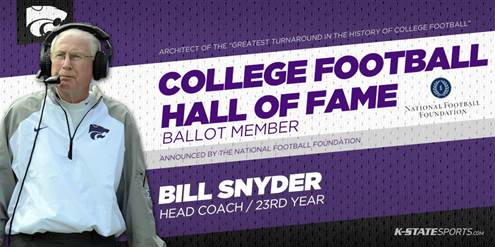
MANHATTAN, Kan. – The architect of the “greatest turnaround in the history of college football,” Kansas State head coach Bill Snyder was one of six coaches from the Football Bowl Subdivision (FBS) placed on the 2015 ballot for induction into the College Football Hall of Fame, the National Football Foundation (NFF) announced Wednesday.
A five-time National Coach of the Year honoree and seven-time conference coach of the year recipient, Snyder has compiled an amazing 183-91-1 record in his 22-plus years as the helm of the Wildcat program. He ranks 35th all-time in victories among FBS coaches and continues to climb the ladder with each win.
“Coach Snyder’s career as a leader, football coach and most importantly mentor to so many people is truly remarkable and inspirational,” Athletics Director John Currie said. “We are so fortunate to have one of the very best coaches in college football history leading our student-athletes, while his transformational impact has greatly benefited K-State and the Manhattan community. Being recognized as one of the top coaches of all-time by inclusion on this year’s hall of fame ballot is a testament to his hard work, dedication and the respect he has garnered from the college football community.”
Snyder is one of 193 total individuals on the ballot, which includes players and coaches from both the FBS and divisional ranks. The announcement of the 2015 class will be made Friday, January 9, 2015, at the media hotel for the College Football Playoff National Championship Game, which will be played at AT&T Stadium in Arlington, Texas.
To be eligible for the ballot, coaches must have coached a minimum of 10 years and 100 games as a head coach; won at least 60 percent of their games; and be retired from coaching for at least three years. However, if he is over the age of 75, he is eligible as an active coach, as is the case with Snyder.
The ballot was emailed Wednesday morning to more than 12,000 NFF members and current Hall of Famers whose votes will be tabulated and submitted to the NFF’s Honor Court, which deliberates and selects the class. Chaired by Gene Corrigan, a former ACC Commissioner and NCAA president, the 17-member NFF Honors Court includes an elite and geographically diverse pool of athletic administrators, Hall of Famers and members of the media.
“We are so proud of Coach Snyder,” said K-State President Kirk Schulz. “He has represented Kansas State University, the Manhattan community and college athletics with the utmost class and integrity. This is such a fitting honor for someone who has positively influenced the lives of countless student-athletes and the entire K-State family.”
Called the “coach of the century” by hall of fame coach Barry Switzer, Snyder’s accomplishments at K-State are nearly unthinkable considering what he inherited during his first tour of duty beginning in 1989. The Wildcat program was in the midst of an 0-26-1 run when he was hired and had been just one bowl game in its first 93 seasons. During a the span of 11-straight bowl seasons (1993-2003), Snyder’s Wildcats won nearly 80 percent of their games, chalking up 109 victories – a staggering 10 wins per season – and making K-State the nation’s second winningest program over that period. His first tenure included a Big 12 Championship in 2003 in a 35-7 win over No. 1 Oklahoma, while his 1998 team held a No. 1 ranking in the BCS Standings. Snyder retired from coaching prior to the last game of the 2005 season, and the Wildcats sent him out with a 36-28 come-from-behind home victory over Missouri in the first game of the newly renamed Bill Snyder Family Stadium.
Following a three-year hiatus, Snyder returned to the sidelines in 2009, and it has been more of the same as his teams have accumulated a 47-23 record through five-plus seasons. The Wildcats are in the midst of four straight bowl seasons, including a pair of 10-win campaigns in 2011 (10-3) and 2012 (11-2). The 2012 Wildcats captured the program’s second Big 12 Championship and held another No. 1 national ranking. After turning 75 years old two weeks ago on Oct. 7 – which qualified him to be included on this year’s ballot – Snyder’s team promptly traveled to No. 11 Oklahoma and pulled out a 31-30 victory to run its record to 5-1.
The new tradition of announcing the College Football Hall of Fame inductees on the Friday before the national title game will have no impact on the induction ceremonies, which will continue to take place during the NFF Annual Awards Dinner in New York City at the Waldorf Astoria, and the 2015 class will be inducted Dec. 8, 2015.
No. 11 Kansas State returns home this weekend to take on Texas in its annual Homecoming game at Bill Snyder Family Stadium. The game, which kicks off at 11 a.m., and will be televised by ESPN, will be the 18th-consecutive sellout, but standing-room only tickets remain available. Those tickets may be purchased by contacting the K-State Athletics Ticket office online at www.k-statesports.com/tickets, by phone at 1-800-221-CATS or in person at the main office inside Bramlage Coliseum.
INDEPENDENCE (AP) – The Jackson County Courthouse Annex in Independence will be undergoing a $6.8 million renovation and expansion.
The county Legislature this week approved a contract for the work at the annex, which will get five new courtrooms. The project is expected to be completed by late 2015.
The Independence Examiner reports because of population shifts the small annex could not handle the increased caseloads and some cases that normally would be heard in Independence have been sent to Kansas City.
County Executive Mike Sanders says the five new courtrooms should meet the county’s needs for at least 20 years.
The county created space for the changes in 2013 when renovations of the nearby Truman Courthouse allowed the county to move some offices there.

 TOPEKA, Kan. (AP) — For the second time in two days, a motorcyclist has died in an accident in Topeka.