RAYTOWN, Mo. (AP) – A jury has found a man guilty of second-degree murder in the shooting death of his longtime ex-lover’s new boyfriend.
Forty-three-year-old Falonzo Davis on Wednesday also was convicted of armed criminal action in the Feb. 20, 2014, death of Steven Jones outside a Raytown education facility. According to Davis’ defense attorney, the woman had called things off Davis three days before the shooting.
The Kansas City Star reports the incident prompted the evacuation of about 175 students from the Raytown Schools Education and Conference Center.
The jury recommended a sentence of life imprisonment for Davis on the murder conviction. It also recommended a 30-year prison sentence for the armed criminal action conviction.
A judge will issue a sentence for Davis at a later date.
ALTAMONT – Three people were injured in an accident just before 7:30 p.m. on Wednesday in Daviess County.
The Missouri State Highway Patrol reported a 2002 Dodge Neon driven by Paul M. Ferguson, 19, Independence, was eastbound on Mo. 6 one mile east of Altamont.
The vehicle crossed the centerline in an attempt to pass two vehicle in a curve.
A 2007 Buick Lucerne driven by Daniel T. Mattea, 59, Parkville, was westbound in the same curve.
The vehicles collided head-on.
Life Net Air transported Ferguson to Mosaic Life Care in serious condition.
Mattea was transported to Liberty Hospital.
A passenger in the Dodge Malia J. McFarland, 18, Independence, was transported to Cameron Regional Medical Center.
The MSHP reported all were properly restrained at the time of the accident.
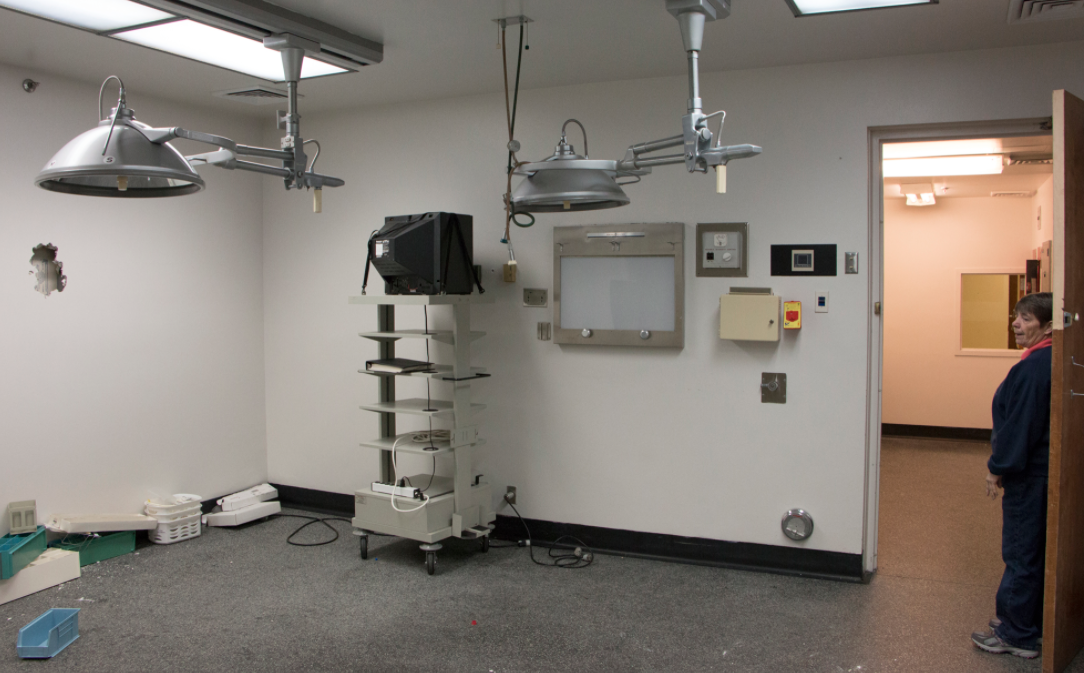
Connie Chapman, who worked at the Sac-Osage Hospital in Osceola, Mo.,for 40 years, looks over a nearly empty room in the hospital, which is slated for demolition on May 1. Credit Todd Feeback / Heartland Health Monitor
By ALEX SMITH
If you’re in the market for fluorescent light bulbs, you might talk to Chris Smiley. In the past few weeks, she’s been trying to sell off what’s left of Sac-Osage Hospital.
“Casework, lighting, plumping, sinks, toilets. Anything you want,” Smiley says.
That’s not in her job description. She’s actually the CEO of Sac-Osage, a hospital in Osceola, Mo., that closed in September.
“I have become an auctioneer,” Smiley says. “And I’ve learned more about asbestos and construction demolition than I ever wanted to know.”
The small, 45-year-old hospital shut down, Smiley explains, because of diminishing payments from Medicare as well as a heavy load of uninsured patients.
It’s a scenario more and more hospitals are facing – one that’s been especially hard on rural hospitals in states that have not expanded Medicaid.
Such hospitals are often the biggest employers in rural counties. But unless Medicaid eligibility is expanded to include more low-income people, as the Affordable Care Act envisions, officials at those hospitals say they may be forced to cut jobs – or even, like Sac-Osage, to close down.
The payment reductions that hospitals face came about in large part because of an agreement they made when the Affordable Care Act was crafted.
“It was a quid-pro-quo deal that the hospitals made,” says Timothy McBride, a health economist at Washington University in St. Louis.
Hospitals expected to see millions of newly insured customers thanks to federal subsidies enabling people to buy health insurance and the expansion of state Medicaid programs. In exchange, they agreed to accept reduced Medicare payments and a huge cut in Disproportionate Share Hospital, or DSH, funding, which the federal government pays to offset the costs of uncompensated care.
Federal law requires hospitals to treat all patients in emergency situations, regardless of ability to pay, and many hospitals provide a full range of services without reimbursement.
Quid pro quo
McBride says the American Hospital Association offered to forego more than $100 billion in federal payments. The thinking was that hospitals would be able to make up for the losses through the influx of newly insured patients.
But in 2012, when the Supreme Court ruled that the Affordable Care Act was constitutional, it also decided that individual states could not be required to expand their Medicaid programs. Many states, including Missouri and Kansas, chose not to do so.
That left many rural hospitals in an untenable situation.
“It’s been kind of a double-whammy, if you will. We’ve taken a cut in reimbursement and not received any additional patients with any type of coverage,” says Ronald Ott, CEO of Fitzgibbon Hospital in Marshall, Mo.
Last year, two of Missouri’s 74 rural hospitals (including psychiatric, rehabilitation and Veterans hospitals) shut down. Statewide, about 1,800 hospital employees lost their jobs, according to the Missouri Hospital Association.
All told, Missouri hospitals say they expect to lose nearly $3.5 billion by the end of 2019 because of Affordable Care Act cuts. Similarly, hospitals in neighboring Kansas and Nebraska anticipate major reductions of well over $1 billion each over the coming decade.
To avoid economic ruin, Missouri hospital leaders say the state needs to expand Medicaid eligibility to include people with incomes below 139 percent of the federal poverty level, as provided by the Affordable Care Act. That would add about 300,000 people to the Medicaid rolls in the state, an increase of nearly 40 percent.
Without expansion, the Missouri Hospital Association says, the state could lose 5,000 jobs in health care and other fields.
Holding fast
Ott shutters to think about what closing Fitzgibbon Hospital would mean for Marshall. The hospital employs 600 people in the largely rural community.
“It would be disaster,” he says. “I just can’t imagine how difficult it would be for the community.”
But conservatives in Missouri’s largely pro-business legislature remain unmoved.
“Now the hospitals have brought some of this on themselves,” says Republican Sen. Ed Emery from Lamar, Mo., “A lot of it was what we call in the rural areas ‘betting on the come’: If you’ll do this, then we’ll promise you this, and those promises were not fulfillable.”
Emery is among the majority of Missouri state senators who have held fast against Medicaid expansion because they say it will cost the state too much money and create too much reliance on government.
“Now they want my constituents and taxpayers to bail them out, and I just don’t think that’s the right thing to do,” he says.
The federal government has agreed to pay the entire cost of Medicaid expansion for states through 2016, phasing down eventually to 90 percent.
Studies conducted by the University of Missouri and the Missouri Budget Project show that once the federal funding level drops, expansion would call for hundreds of millions of dollars in state spending. But those costs would be offset or even exceeded by the economic boost provided by the federal funds.
The 2012 University of Missouri study forecast that the state would generate hundreds of millions of dollars in tax revenue and create tens of thousands of jobs in the next few years if it approved expansion.
The principal author of that study, MU professor and health economist Lanis Hicks, says that since the state has missed the first two years of federal expansion funding, the potential tax revenue is somewhat lower now than what her study initially predicted – though she maintains expansion at this point would still save the state money and produce jobs.
Republican Sen. David Pearce doesn’t buy it.
“The thought that, because you have federal dollars that that creates jobs – at the very end of the day we’re all paying for that,” Pearce says. “And so if it’s something you can’t afford, then it’s something you can’t afford.”
Pearce represents the state’s 21st district, where Fitzgibbon Hospital is located. He professes to be concerned about jobs there but insists the overall nature of health care is changing due to changing demographics and consolidation.
“As we all know, healthcare is extremely expensive, and so to be able to have a hospital in each county probably is not going to be a model we can sustain in the future,” Pearce says.
The end
It’s a future that has already come to Osceola.
In a town of around 900 people, Sac-Osage Hospital employed more than 100. Now, a few months after the hospital closed its doors, that workforce has dwindled to five.
The remaining employees include Carolyn Bruce and Connie Chapman, who worked at the hospital for a combined 75 years. In recent weeks, they’ve been digitally scanning the hospital’s decades of paper records and preparing the building for demolition on May 1.
Since the hospital closed, a few clinics have helped fill the health care gap, and most of the employees have been able to find work elsewhere. But the town is now without an emergency room or inpatient services. There’s not another full-service hospital for 30 miles in any direction.
And of course the town’s largest single employer is no more.
CEO Chris Smiley keeps a stiff upper lip as she talks about the end of the hospital. But after her remaining employees leave for the day, she admits the closure has been difficult.
“This is my last job, so I see it as a failure,” Smiley says. “I don’t know that I could’ve done anything different. I don’t think I could have saved the hospital. I hope that I have done everything that I could do to minimize the negative impact on my people and on the community.”
Alex Smith is a reporter for Heartland Health Monitor, a news collaboration focusing on health issues and their impact in Missouri and Kansas.
SPRINGFIELD (AP) – A 36-year-old Springfield man who impregnated a young relative has been sentenced to 11 years in prison.
The man, whom the Associated Press isn’t naming to protect the identity of the girl who had his baby, pleaded guilty last week to statutory rape, statutory sodomy and incest in a case that left the baby with a blood disease.
The Springfield News-Leader reports an officer was called to a Springfield hospital in August to help state child welfare workers investigate after a 2-month-old baby was diagnosed with a type of “blood cancer” that sometimes results from incest.
Police say the mother is now 17 but was 16 at the time she was impregnated. The man admitted to having sex with the girl, who police say has an IQ of 67.
HOLTS SUMMIT, Mo. (AP) – A central Missouri sheriff’s department is investigating the death of a 55-year-old man whose body was discovered in a lake.
Callaway County sheriff’s spokesman Lt. Clay Chism says the department got a call at 10:21 p.m. Tuesday about a suspicious vehicle on private property south of Holts Summit.
The Columbia Daily Tribune reports that soon after that call, a resident found the body of Mark Wenkel of Holts Summit in a nearby lake.
Chism says no foul play is suspected at this time.
Wenkel’s body was taken to the medical examiner’s office in Columbia for an autopsy that was scheduled to be done Wednesday.
Results of a toxicology screen aren’t expected for several weeks.
WASHINGTON D.C. – U.S. Senators Roy Blunt (Mo.) and Debbie Stabenow (Mich.) introduced the Empowering Jobs Act of 2015 recently, a bipartisan bill that will help spur economic growth and create job opportunities in 30 cities across the country by improving the Empowerment Zone program.
“Just as we’ve witnessed in St. Louis, these tax incentives will help encourage more private sector investment and create more economic opportunity for families and workers in Missouri and nationwide,” said Blunt. “I’m pleased to introduce this important bipartisan bill and I’ll keep working to encourage the creation of good-paying, full-time jobs for Missourians.”
The Empowering Jobs Act of 2015 will extend the Empowerment Zone program for two years and make the program more effective by expanding the way job creators and local governments can take advantage of their allocations of tax-exempt bonds. Specifically, the bill will ease the requirements for how these bonds can be used and encourage more job creators to invest in the nation’s hardest-hit communities. To read the legislation, click here.
Empowerment Zones were established by Congress in 1994 as a way to boost economic development in particularly struggling cities through tax incentives, grants, and tax-exempt financing. The Empowerment Zone bonds encourage the construction of economic development projects like commercial and manufacturing centers. The Empowering Jobs Act of 2015 will allow the 35 percent in-zone hiring requirement for the bonds to be met by hiring 35 percent of people from distressed Census tracts within the city in which the Empowerment Zone is located.
JEFFERSON CITY, Mo. (AP) — Missouri took a step toward joining 24 other states with right-to-work laws when its House voted to bar the collection of fees from workers who choose not to join a union.
The vote of 92 to 66 with two lawmakers voting present, marks an advance for supporters of right-to-work because a similar measure last year had failed to achieve a constitutional majority of 82 lawmakers in favor.
Republican Rep. Eric Burlison says right-to-work would make the state more competitive in attracting businesses, which would help workers find jobs.
Opponents say the measure would weaken labor unions and lower wages in the state.
The measure still faces a second House vote and would have to be approved by the Senate before going to Democratic Gov. Jay Nixon, who opposes right-to-work.
JEFFERSON CITY (AP) – The Missouri House is moving forward with a bill that bars construction workers from being required to pay union fees.
The House gave first-round approval Wednesday to the legislation sponsored by Democratic Rep. Courtney Curtis, of Berkeley. He says unions in the building trades have not done enough to ensure equal opportunity for minorities.
Curtis, who is black, says building trade unions will be weakened and have to fight for the support of minority workers if his right-to-work legislation passes. Another vote is needed in the House to send it to the Senate.
Democratic Rep. Karla May, of St. Louis, says the bill will not solve racism in Missouri but will negatively affect workers.
The House may also debate a separate right-to-work bill that would apply to all businesses.
ST. LOUIS (AP) — An immigrant couple from Bosnia has pleaded not guilty in St. Louis to federal charges of funneling money and military supplies to extremist groups in Iraq and Syria.
Attorneys for Ramiz and Sedina Hodzic of St. Louis County entered the pleas Wednesday during a brief hearing in U.S. District Court. Neither defendant spoke.
The couple is in federal custody. At the request of their attorneys, a federal magistrate judge postponed detention hearings for them until next week.
The Hodzics are among six Bosnian immigrants living in Missouri, Illinois and New York who were charged last week with conspiring to provide material support to groups the U.S. deems terrorist organizations, including Islamic State and Nusra Front, an al-Qaida-affiliated rebel group.
OLATHE, Kan. (AP) — A white supremacist accused of killing three people outside Jewish sites in Kansas has been assigned a new attorney in his capital murder case.
The Kansas City Star reports veteran death penalty defense lawyer Mark Manna of Topeka has been assigned to represent 74-year-old Frazier Glenn Miller Jr.
Miller’s previous attorney withdrew last week, citing a breakdown in communications with Miller.
Miller, of Aurora, Missouri, is accused of fatally shooting three people on April 13, 2014.
Prosecutors say he killed 69-year-old William Corporon and his 14-year-old grandson, Reat Griffin Underwood, outside the Jewish Community Center in Overland Park, then fatally shot 53-year-old Terri LaManno at the nearby Village Shalom care center.
Miller has said he wanted to kill Jews. None of his victims was Jewish.

 RAYTOWN, Mo. (AP) – A jury has found a man guilty of second-degree murder in the shooting death of his longtime ex-lover’s new boyfriend.