LAWRENCE, Kan. (AP) — One of four women who tried to steal 26 pairs of blue jeans worth thousands of dollars has been sentenced to prison.
Shaikeece Whisonant -photo Johnson County
25-year-old Shaikeece Whisonant, of Grandview, Missouri, was sentenced Tuesday to nearly two years in prison for robbery.
She was one of four women who tried to steal the jeans, worth more than $4,200, from The Buckle in downtown Lawrence. They dropped 22 pairs and ultimately stole only four pairs, valued at $805.
Prosecutors say one of the women maced a store employee and Whisonant punched an employee in the head.
Whisonant, who has three small children, is currently serving a prison sentence for a Johnson County theft conviction. Prosecutors say she 18 prior convictions, mostly misdemeanor theft and traffic cases.
Kansas, a state that went for President Donald Trump by 20 points two years ago, on Tuesday turned one of its four Republican seats in Congress to Democrat.
Democratic newcomer Sharice Davids topped incumbent Republican Kevin Yoder in his quest for a fifth term. She beat the Kansas City-area 3rd Congressional District by roughly 9 percentage points.
Another political newcomer, Steve Watkins, was elected to replace fellow Republican U.S. Rep. Lynn Jenkins in the 2nd Congressional District that covers most of the eastern third of the state. He edged out Democrat and former Kansas House leader Paul Davis.
In the Wichita area, incumbent Republican Rep. Ron Estes won re-election over attorney James Thompson, the same Democrat he beat in a special election last year.
And Republican U.S. Rep. Roger Marshall won another term in the sprawling western Kansas 1st Congressional District, again beating perennial opponent Democrat Alan LaPolice.
Davids became one of the few Native Americans, and perhaps the first American Indian woman, elected to Congress.
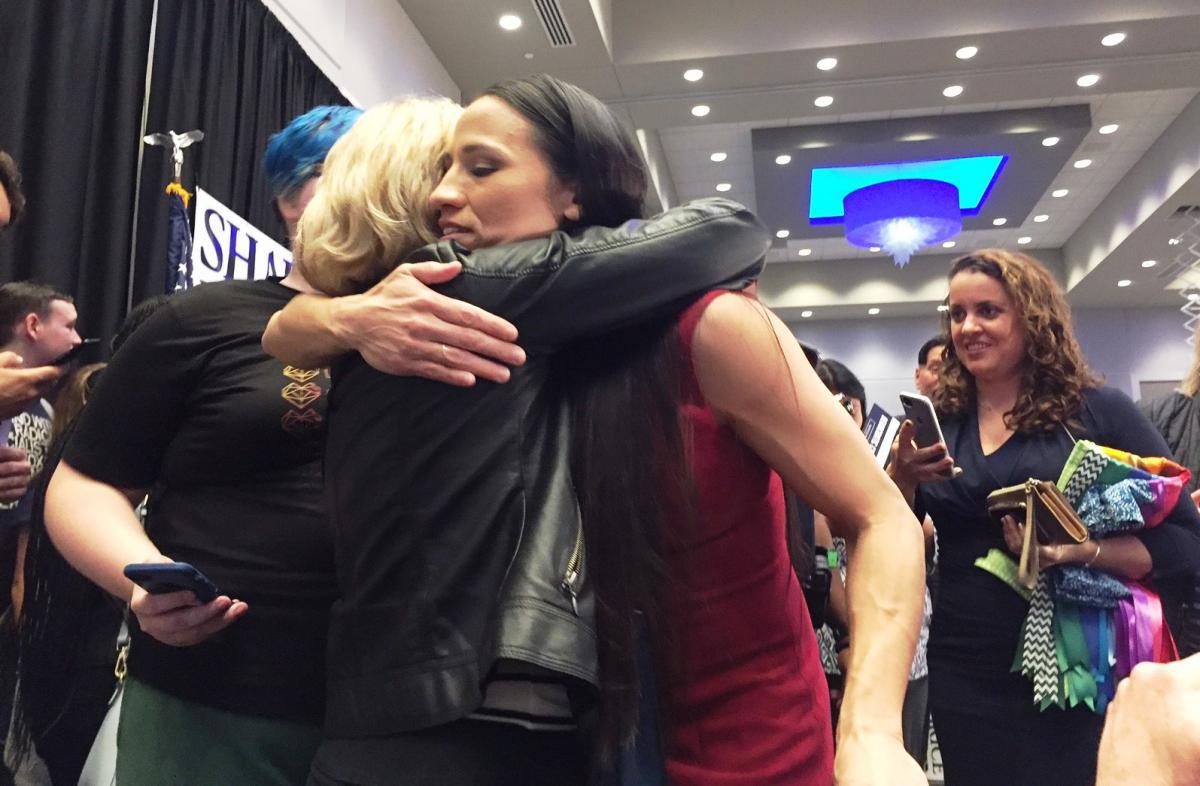
Sharice Davids got a hug from a supporter after winning election to the U.S. House on Tuesday
CREDIT SAM ZEFF / KCUR 89.3
3rd District
Davids and Yoder clashed over immigration, as much as anything .
Davids was criticized early in the contest for a podcast appearance where she seemed to call for the abolition of U.S. Immigration and Customs Enforcement. She later walked that back, insisting only that the agency needed reform.
Likewise, Yoder vastly overstated the number of immigrants filing false claims in seeking asylum. He also waffled at times on various immigration issues — at one point this year siding with Democrats on asylum issues, then later joining ranks with the Trump administration.
The two also differed sharply on health care issues. Yoder voted with other Republicans time and again in opposition to the Affordable Care Act, commonly known as Obamacare. For a time, that served him well in his Republican-leaning district. But after Trump took office, Obamacare became increasingly popular. Davids made it a centerpiece of her campaign.
At the Davids party, the room was boisterous when the cable networks began calling the race for her, another seat shifting to Democrats in their hopes of wresting control of the House from Republicans. They did.
“We have a chance to re-set expectations when people look at Kansas,” Davids said to a room full of cheering supporters. “I knew we could do better, and we just did.”
This Kansas district — a mix of largely white and wealthy Johnson County and more diverse and less prosperous Wyandotte County — sent a one-time mixed martial arts fighter and openly lesbian attorney to Washington.
“From the beginning,” Davids told supporters Tuesday night, “this campaign has been built on bringing new leaders to the table and new voices to the table.”
Across town, the Yoder party began to thin out early, many supporters uninspired by never-say-die backers of the incumbent and a band playing “Lukenbach, Texas.” Yoder had won the seat four times, always by fairly comfortable margins.
Yoder wished Davids good luck and called for unity but said the raise-money-and-run-again merry-go-round of American politics is a problem.
“This perpetual campaign cycle must close,” he said.
The district is again returning to Democratic hands. Dennis Moore served several terms before retiring amid mounting health problems and his wife later lost to Yoder.
2nd District
Watkins emerged from a crowded and bruising primary, where his opponents directed criticism at him that was uncharacteristic of attacks within a party.
But he brought an impressive resume to the race. Watkins is a West Point graduate and combat veteran of Iraq and Afghanistan. His campaign stumbled in the general election when reporters discovered that he exaggerated, or invented, business and philanthropic accomplishments.
Davis appeared to be a formidable opponent. While he’d lost a bid for governor in 2014, he won within the 2nd District. But that was a race for state office, where Kansans are far more willing to vote for Democrats. In federal races, Republicans tend to enjoy an advantage.
Watkins gave the usual round of thanks for family and campaign workers, but the congressman-elect also mentioned those he’d known in the military academy and in combat. They, he suggested, would appreciate another victory in life.
“I’ve lived to fight another day,” he said.
Davis said Tuesday’s loss marked the end of his political career. He chose to look at Kelly’s victory as the silver lining to his cloudy day.
Davis supporters after their candidate conceded the congressional race Tuesday night.
CREDIT STEPHEN KORANDA / KANSAS NEWS SERVICE
“We have something to celebrate tonight,” he said. “It’s time for me to turn a page in the next chapter of my life. But I’m not going to back away from the things that I believe in.”
Brian Grimmett, Stephen Koranda, Sam Zeff, Nomin Ujiyediin and Frank Morris contributed to this article.
Scott Canon is digital editor of the Kansas News Service. You can reach him on Twitter @ScottCanon.
JEFFERSON CITY, Mo. (AP) – About 58 percent of Missouri’s registered voters turned out to cast ballots in Tuesday’s elections.
The preliminary figures reported Wednesday by the secretary of state’s office would mark the highest turnout in a presidential midterm election since a 59 percent rate in 1994.
The top attraction was the U.S. Senate race in which Republican Attorney General Josh Hawley defeated Democratic incumbent Claire McCaskill. More than 2.4 million people cast votes, and Hawley won with more than 51 percent.
The next highest vote-getter was Constitutional Amendment 2, which legalizes medical marijuana.
ST. LOUIS (AP) – Missouri has joined the long list of states allowing medical marijuana, but it’ll likely be late next year at the earliest before people with cancer, HIV and other serious ailments will be able to obtain it.
Missouri became the 31st state to approve medical marijuana when voters on Tuesday approved Amendment 2 .
Amendment 2 requires the Missouri Department of Health and Senior Services to begin accepting applications from patients by early June. The department must begin accepting applications for dispensaries by early August, and accept or reject dispensary applications within 150 days of receiving them.
Potential growers and manufacturers also must apply to the state health department.
KANSAS CITY (AP) – Animal control workers who were called to an east Kansas City home encountered Catfish, a 6-foot alligator that its owner said is as “gentle as a kitten.”
photo courtesy City of Kansas City, Missouri
Eventually, a specialist was called to remove the 150-pound alligator. Two boa constrictors and a rabbit also were taken from the home.
The Kansas City Star reports the tenant, Sean Casey, said he owned the alligator for four years and called him “a big cuddly lizard.”
John Baccala, spokesman for the city’s Neighborhood and Housing Services department, says Kansas City does not allow homeowners to have alligators.
None of the four workers who removed the alligator was injured.
Catfish will be housed at the Monkey Island Rescue and Sanctuary in Greenwood for now. The boa and rabbit were taken to an animal shelter.
WASHINGTON (AP) —Attorney General Jeff Sessions has resigned as the country’s chief law enforcement officer.
Sessions announced his plan to resign in a letter to the White House on Wednesday.
We are pleased to announce that Matthew G. Whitaker, Chief of Staff to Attorney General Jeff Sessions at the Department of Justice, will become our new Acting Attorney General of the United States. He will serve our Country well….
President Donald Trump announced in a tweet that Sessions’ chief of staff Matt Whitaker would become the new acting attorney general.
The attorney general had endured more than a year of stinging and personal criticism from Trump over his recusal from the investigation into potential coordination between Russia and the Trump campaign.
Trump blamed the decision for opening the door to the appointment of special counsel Robert Mueller, who took over the Russia investigation and began examining whether Trump’s hectoring of Sessions was part of a broader effort to obstruct justice.
MANHATTAN, Kan. (AP) — Kansas State cornerback Duke Shelley was arrested this week for failure to appear and released after paying a $500 bond, though his status for this weekend’s game against Kansas remains in question.
Shelley -photo KSU Athletics
A school spokesman said any punishment will be handled internally.
The Wildcats’ best cornerback, Shelley had a warrant issued by Manhattan Municipal Court after he was cited for driving without proof of insurance and having expired tags. He was arrested Tuesday.
The senior from Georgia has 33 tackles and three interceptions this season, even though he has missed the past two games with a leg injury. Wildcats coach Bill Snyder expected him to return at some point this season, possibly in time for the Sunflower Showdown against the Jayhawks.
Patton – photo KSU Athletics
In October police arrested K-State football player Daquan Patton, 21, for failure to appear, according to the Riley County Police Department arrest report. He failed to pay an earlier speeding ticket, according to RCPD.
Patton is a red shirt junior linebacker from Cedar Park, Texas, according to the KSU football roster.
SPRINGFIELD, Mo. (AP) – Two men have been charged in the fatal shootings of two ex-roommates in a southwest Missouri home and one of the suspects also is charged with killing a woman one day later.
Perez -Greene Co.
Twenty-three-year-old Luis Perez was charged Tuesday with three counts of first-degree murder in the deaths of 38-year-old Steven Marler, 23-year-old Aaron Hampton and 21-year-old Sabrina Starr.
A second man, 19-year-old Aaron Anderson, is charged as an accomplice with murder in the men’s deaths. Starr was believed to be outside the home when the men were killed Thursday and was slain Friday.
They’re jailed without bond in Greene County. No attorneys are listed for them in online court records.
Charging documents say Perez had recently come to Springfield from New Jersey, where he had active warrants. Police say federal authorities believe he’s in the country illegally.
WICHITA, Kan. (AP) — A Kansas State University student has been convicted of killing his ex-girlfriend in Wichita.
Dane Owens -photo Sedgwick CountyRowena Irani-photo courtesy Downing&Lahey
Jurors found 29-year-old Dane Owens guilty Tuesday of first-degree felony murder and aggravated burglary in the October 2016 killing of 22-year-old Rowena Irani. She was studying psychology at Wichita State University.
Prosecutors say Owens parked his truck several houses away from her home, walked through an unlocked door and fired at her when she walked around a corner. He then left the home without helping her, throwing her cellphone in one pond and his gun in another
Her mother found her several hours later suffering from a gunshot wound to the head, and Irani died the next day. The defense said the shooting wasn’t intentional.
Owens was Sophomore social work major at Kansas State when the shooting happened.
Kansas Governor-elect Laura Kelly celebrates her victory over Kris Kobach on election night
Democrat Laura Kelly fended off perhaps the most energizing and divisive figure in Kansas politics on Tuesday to become the next governor of Kansas.
Kelly beat out self-described “full-throttled” conservative GOP nominee Kris Kobach, the secretary of state who’d forged a kinship with President Donald Trump while dabbling in anti-immigration and voter fraud crusades across the country.
He lost to a 68-year-old state senator from Topeka who ran as a moderate, banking on a reputation in the Legislature as someone willing to find compromise rather than as a charismatic force for change.
Instead, Kelly called for Kansas to roll back the clock a decade to when previous Democratic governors formed coalition governments by cobbling together support from party regulars and Republicans uncomfortable with its far-right factions. Kobach represented the most aggressive version of that conservative wing.
Kelly pledged to restore school spending and move past the tax-cutting, service-slicing ways of former Gov. Sam Brownback’s time in the office.
To win the overwhelmingly Republican state, she walked a delicate line of appealing to moderate GOP voters while trying to enthuse bleed-blue Democrats. She also championed the endorsements of several high-profile Republicans from an earlier era of Kansas politics.
Her campaign focused time and again on Brownback, arguing to voters that Kobach would return the state to the policies that carved away tax revenue and triggered cuts in a range of services.
“The people of Kansas spoke, and they spoke so loudly. They put partisanship aside,” she told supporters giddy over a Democratic win in the Republican-dominated state. “Kansans voted for change. … A change in tone in the state. That tone will come to Topeka now.”
In her victory speech, she congratulated Kobach and independent Greg Orman on their campaigns. An otherwise raucous crowd went quiet.
“No,” she chided her supporters gently, “we’re going to be civil.”
She said the election wasn’t so much a Democratic win as a “wave of bipartisanship. … Partisanship was put above all else and it tore our state apart,” Kelly said. “That ended today.”
Kobach spoke to supporters briefly, mostly thanking his family and campaign staff for weathering the grind of the campaign.
He said his loss resulted from political forces pushing against Republicans in the midterm election.
“Headwinds all the way,” Kobach said.
He said Kelly had too much money. Much of Kobach’s campaign was financed by running mate Wink Hartman whereas Kelly relied more on smaller donors. Other spending in the campaign came from independent groups, notably the Republican Governors Association.
Still, Kobach insisted Tuesday night that he couldn’t keep up in the money and advertising parts of the campaign.
“I wish campaigns were all about debates and every single voter watched the debate and that would be different,” he said. “But spending money on campaigns matters.”
Orman, who made a close run for the U.S. Senate four years ago, turned out not to be a factor in the race. Kelly supporters had pressured him to drop out, fearing he would capture the votes of moderate Republicans who would otherwise opt for the Democrat.
In the end, Orman pulled about 6 percent of the vote. Kobach would have needed nearly every one of those votes to overcome Kelly. At the most, Orman’s candidacy might have denied her a clear majority — not of the plurality that swept her into office.
In other statewide races, Republicans maintained their grip on races farther down the ballot. In the race for secretary of state, State Rep. Scott Schwab beat former Google executive Brian McClendon. Attorney General Derek Schmidt bested a candidate the Democratic Party had abandoned. Vicki Schmidt ran away with the insurance commissioner’s race. Jake LaTurner will remain treasurer.
The governor’s race
When Kelly begins her term in January, it will be the first time since 2011 that Republicans haven’t controlled the governor’s office, the Kansas House and the Kansas Senate.
Kelly’s election revives the prospect that Kansas could expand Medicaid coverage. After moderates made sweeping wins in the 2016 election, the Legislature voted for the expansion in 2017 but failed to overcome a veto by then-Gov. Sam Brownback.
Kelly has made clear her support for Medicaid expansion, which represents an embrace of the Affordable Care Act, commonly known as Obamacare. Lawmakers might now rally behind expansion.
Her victory likely will mean an end to tax cuts, and the possibility of tax increases to pay for greater state aid to local school districts and an array of social programs. Those were virtually impossible under Brownback and his successor, Jeff Colyer.
Young supporters at Kelly’s Topeka election party said they were inspired by her positions on immigration and education — issues where she differed sharply from Kobach.
“She’s been so active with college students,” said Alyssa Evans of Russell. “I just wanted to show her that we’ve been paying attention and we do care that she’s been coming to different universities.”
Brecken Shimel of Hutchinson pointed to the differing personas of the top candidates — Kelly’s mild-mannered ways versus what he called Kobach’s delight in “intellectual combat.”
“She’s not as hateful as Kobach when it comes to, well, mostly everything,” Shimel said.
In 2014, fewer than 870,000 people voted in the governor’s race and Brownback beat Democrat Paul Davis by about 3.5 percentage points — despite a steady string of polls suggesting Davis was leading in the days running up to the actual voting.
This year, more than 1 million Kansans voted in the governor’s race. Kelly got about 48 percent, Kobach 43 percent and Orman roughly 6 percent.
The election returns showed a split in Kansas mirroring that in the country. In places where people live close together — the Kansas City suburbs, Wichita, Topeka, college towns — the Democrat won. Where they live far apart, the Republican piled up votes.
Even as statistically sound polls continued to suggest Orman was doomed to fall far behind the main contenders, he stayed in the race. His campaign treasurer quit a week before the election and endorsed Kelly, saying Orman had promised to drop out of the race if his stock hadn’t risen beyond spoiler status a month before the election.
Some supporters remained convinced even early Tuesday evening that Orman could pull off a shocker. Sean Reilly, a retired school teacher, hung his hopes on an unscientific poll of self-selected voters that suggested he might win with a plurality just shy of 40 percent.
“Over 7,000 people on the poll,” Reilly said. “They don’t have a dog in the hunt.”
And, it turned out, they weren’t representative of the electorate.
In the end, he may have denied Kelly a clear majority but not a win. Orman promised to advocate for those independents who voted for him and challenged the coming Kelly administration to avoid partisanship.
“Despite the fear, the anger and the hate that both parties threw at them,” Orman said, voters “still stood up and voted for me. I am so very grateful.”
Secretary of state
In the secretary of state’s race, conservative state Rep. Scott Schwab continued Republicans’ hold on the office by beating out former Google executive Brian McClendon. While one Democrat was appointed to briefly serve in the office in recent years, only Republicans have won election to the post since the middle of the 20th century.
Kobach elevated the job’s profile, using the force of his personality and headline-grabbing claims about immigration and claims of widespread voter fraud to catapult himself to national prominence as a Fox News regular and a sometimes-confidant to President Trump.
Schwab promised voters a less controversial tenure, although he’d been a key player in the Legislature backing Kobach’s wide-ranging efforts. Schwab said he at least wouldn’t oppose efforts to strip the secretary of state of one-of-a-kind powers to directly prosecute voter fraud cases granted during the Kobach years.
McClendon promised an aggressive re-make of the office aimed at making voting easier and using his Silicon Valley know-how to tailor the job’s record-keeping chores to business needs.
Schwab pledged Tuesday night to help county clerks navigate Kansas statutes and avoid conflicts with the American Civil Liberties Union, which was often at odds — and campaigned against — Kobach.
“We’re gonna make sure you get the understanding of what the legislature wanted so you will be able to execute on elections in a way that you don’t have to worry about the ACLU trying to kick down your door anymore,” Schwab said.
Madeline Fox, Nomin Ujiyediin, Brian Grimmett and Amy Jeffries contributed to this report.
Scott Canon is digital editor of the Kansas News Service. You can reach him on Twitter @ScottCanon.
————-
TOPEKA, Kan. (AP) — Democrat Laura Kelly won the Kansas governor’s race Tuesday, prevailing over Republican Kris Kobach after promising to slam the door on conservative budget and tax-cutting policies that were followed by persistent budget problems.
Kelly, a veteran state senator from Topeka, defeated Kobach, the Kansas secretary of state, even though Kobach is President Donald Trump’s closest ally in a state that Trump won handily in 2016. Independent candidate and Kansas City-area businessman Greg Orman trailed far behind.
The Democratic governor-elect made former Republican Gov. Sam Brownback and his ill-fated 2012-13 experiment in slashing state income taxes — not Trump — a key issue in her red state. Budget woes made Kansas a cautionary example of how not to do trickle-down economics, and Kelly was visible in the successful and bipartisan effort in 2017 that reversed most of the cuts.
“They spoke with a single thunderous voice,” Kelly said of voters in her victory speech at a Topeka hotel. “Kansans voted for change, a change not only in the direction of our state but a change in the tone in our state.”
Kelly wooed GOP moderates and independent voters upset with Brownback’s tax-cutting experiment. She said her victory signaled greater bipartisanship.
Kelly’s message resonated with even Republican voters such as Kimberli Evans, a 43-year-old federal employee from Topeka, who voted for the Democratic nominee. She said fair funding for public schools is one of her big concerns.
“I believe that the Brownback experiment did not work and needs to be reversed,” Evans said after casting her ballot.
Kobach had criticized the $600 million-a-year income tax increase and campaigned on shrinking government so that the state could resume cutting taxes.
Kobach brought some celebrity to the race, having built a national profile as an advocate of tough immigration policies and strict voter identification laws. He has advised Trump and served as vice chairman of Trump’s since-disbanded commission on voter fraud.
He narrowly ousted Gov. Jeff Colyer in the GOP primary in August after Trump defied a split among his advisers and tweeted an endorsement of Kobach. Trump carried the state easily in the 2016 presidential race and had a rally to help Kobach’s campaign in October. Donald Trump Jr. had two fundraising events for him.
“We fought the good fight,” Kobach told his supporters at another Topeka hotel. “This one just wasn’t God’s will.”
The contrast between Kobach and Kelly was stark because Kelly not only portrayed Kansas as in financial recovery but also had a list of places where she’d like to bolster spending, including higher education, early childhood education and mental health services.
Kansas is considered a deep red state with party registration 44 percent Republican and 25 percent Democratic. But its dominant Republican Party sometimes splits between moderates and conservatives, leaving an opening for a Democrat to peel off disaffected GOP voters. In recent decades the state has alternated between Republican and Democratic governors.
Kobach cited that historical trend in telling supporters that the race came with, “headwinds all the way for our team.”
That GOP rift emerged this year with the nomination of Kobach, who concentrated on motivating his conservative base rather than wooing moderate voters. Kobach said that if elected he would encourage immigrants living in the state illegally to leave Kansas.
Kelly said Kobach’s immigration policies would hurt the state’s economy, particularly in western Kansas, which depends on immigrant workers for the meatpacking industry.
Ellie Smith, a 24-year-old Democrat, stay-at-home mom and musician from Topeka, said Kobach’s positions on immigration “hurts my heart.”
“I believe that everybody belongs here,” she said.