We have a brand new updated website! Click here to check it out!

Missouri museum honoring Churchill gets 1 of his paintings

FULTON, Mo. (AP) – The latest addition to the National Churchill Museum in Missouri is a testament to the longtime British prime minister’s artistic, rather than political, skills.

The former Monsanto Co. on Friday donated a painting by Churchill to the museum at Westminster College in Fulton, where Churchill delivered his famous “Iron Curtain” speech in 1946.

Photo courtesy national Churchill Museum

The work, “Lake Scene at Norfolk” from around 1935, shows a tranquil scene of a tree-lined lake. Its value was not disclosed.

Churchill was 40 when he began painting to escape the pressures of politics. The painting was acquired in 1993 by St. Louis-based Monsanto. German pharmaceutical company Bayer AG on Thursday completed its purchase of Monsanto.

The painting is among four of Churchill’s that will be on permanent display at the museum.


Planned road work for northwest Missouri, June 11 – 17

ST. JOSEPH, Mo. – The following is a listing of general highway maintenance and construction work in the Northwest Missouri region planned for the week of June 11 – 17 from the Missouri Department of Transportation.

In addition to the work listed below, there may be pothole patching, mowing, shoulder work, bridge maintenance, striping, brush cutting, guardrail repairs, litter pick up and other road work conducted throughout the region. Many of these will be moving operations and could include lane closures with delays. All scheduled maintenance and construction projects are subject to change.

MoDOT reminds the public to stay alert, watch for road work, buckle up, slow down, and drive with extreme caution through work zones and in changing weather conditions.

For more information about a project, please contact MoDOT at 1-888-ASK-MoDOT (888-275-6636) or visit modot.org/northwest. You can also follow MoDOT’s Northwest Missouri District on Twitter @ModotNorthwest and on Facebook.

Andrew County

  • Interstate 29 – Bridge deck replacement project at the Nodaway River Bridge. Traffic is head-to-head in the northbound lanes. This traffic pattern will be in place through August and includes a 13-foot width restriction.
  • U.S. Route 71 – Resurfacing project from Route 48 to Route A (Nodaway County), June 11 – 15

Atchison County

  • I-29 – Pavement repair from mile marker 124 near the Iowa state line to mile marker 111 near Route 111, June 11 – 15
  • Route E – Driveway tube replacement at Route U, June 12
  • Route D – Shoulder work near the railroad crossing south of Watson, June 13 – 15
  • U.S. Route 275 – Resurfacing project from the Iowa state line to U.S. Route 136, June 14 – 15

Buchanan County

  • Route 759 – Pavement repair of railroad crossing southbound from Hickory Street to Florence Road, June 11 – 13. This includes overnight lane closures.
  • Route V – Pothole patching, June 11 – 13
  • Route K – Pothole patching, June 13 – 15
  • Route 759 – Pavement repair of railroad crossing northbound from Hickory Street to Florence Road, June 13 – 15. This includes overnight lane closures.

Caldwell County

  • Route D – Pothole patching from U.S. Route 36 to Route HH, June 11 – 15

U.S. Route 36 – Bridge maintenance on the Brushy Creek Bridge, June 11 – 17. This includes overnight lane closures.

Carroll County

  • U.S. Route 65 – Sealing and resurfacing project from the Missouri River to the Iowa state line, June 11 – 16. This project includes a 12-foot width restriction.
  • Route E – Sealing from Ely Street in Carrollton to Route D, June 13 – 15

Chariton County

  • Route JJ – Chip seal from Route E to the Linn County line, June 11
  • Route F – Chip seal from Route E to U.S. Route 24, June 12 – 13

Clinton County

  • Route 116 – CLOSED for a bridge replacement project at the McGuire Creek Bridge. The road will be closed through July. A signed detour is in place.

Daviess County

  • Route 13 – CLOSED for a bridge replacement project at the Honey Creek Bridge. The road will be closed through September. A signed detour is in place.

DeKalb County

  • U.S. Route 36 – Pavement resurfacing and realignment project at the Route 33 North/Route M junction. Traffic is head to head in the eastbound lanes. This traffic pattern will be in place through July 3 and includes a 14-foot width restriction.

Grundy County

  • U.S. Route 65 – Sealing project from the north city limits of Chillicothe to the Iowa state line, June 11 – 16. This includes a 12-foot width restriction.

Harrison County

  • Route AA/H – CLOSED for a bridge deck replacement at the I-35 overpass. The bridge will be closed through July. One lane of I-35 may be closed in each direction during the project.
  • I-35 – Resurfacing project from the Iowa state line to Route N at Eagleville, June 11 – 16. This includes a 16-foot width restriction.
  • Route M – CLOSED for a resurfacing project from Route D to Route EE, June 12 – 13, 7 a.m. to 3 p.m. daily

Holt County

  • I-29 – Bridge deck replacement at the Nodaway River Bridge. Traffic is head to head in the northbound lanes. This traffic pattern will be in place through August and includes a 13-foot width restriction.
  • I-29 – Resurfacing project from Route W to Route 118, June 11 – 15

Linn County

  • Route JJ – Chip seal from the Chariton County line to the city limits of Marceline, June 11

U.S. Route 36 – Shoulder improvements from just east of Route 11 to Route 5, June 11 – 15. This project includes a 16-foot width restriction.

Livingston County

  • U.S. Route 65 – Pavement repair from Route K to the Grundy County line, June 11 – 12
  • U.S. Route 65 – Sealing and resurfacing project from the north city limits of Chillicothe to the Iowa state line, June 11 – 16. This includes a 12-foot width restriction.

Mercer County

  • U.S. Route 65 – Sealing project from the north city limits of Chillicothe to the Iowa state line, June 11 – 16. This includes a 12-foot width restriction.

Nodaway County

  • Route MM – CLOSED for a culvert replacement from U.S. Route 136 to 280th Street, June 11, 8 a.m. to 3 p.m.
  • Route M – Pothole patching, June 11
  • U.S. Route 71 – Resurfacing project from Route A to just north of Route 48 (Andrew County), June 11 – 16
  • Route 246 – Pothole patching from U.S. Route 148 to Route E, June 12
  • Route PP – Pothole patching, June 13
  • U.S. Route 136 – Shoulder improvements from east of the city limits of Maryville to Route 46 in Ravenwood, June 13 – 15
  • Route 46 – Pothole patching, June 15

Putnam County

  • Route W – Pothole patching from U.S. Route 136 to Route 149, June 15

Worth County

  • Route 46 – Pothole patching from U.S. Route 246 to Route W, June 11 – 12
  • Route M – CLOSED for resurfacing project from Route EE to Route C, June 14 – 15, 7 a.m. to 3 p.m. daily

Gilman City teen seriously injured in rollover crash

A Gilman City teenager was seriously injured in a rollover crash Saturday morning near Melbourne.

According to the Missouri State Highway Patrol, at 10:44 a.m. Saturday, 16-year-old Quentin D. Hughs was driving a Ford Focus east on MO 146 when the vehicle crossed the center line and Hughs overcorrected. The vehicle went off the south side of the road and overturned twice before coming to rest on its wheels. Hughs was transported by Grundy County ambulance to Wright Memorial Hospital for treatment of serious injuries.

According to the crash report, Hughs was wearing a seat belt.

Man convicted of Missouri murder in 1997 freed

McKim -photo Mo. Dept. of Corrections

COLUMBIA, Mo. (AP) – A Missouri man who served 20 years in prison is enjoying his freedom after he had his sentence commuted by outgoing Gov. Eric Greitens.

The Columbia Daily Tribune reports that 52-year-old Jessie McKim had been serving a life sentence for first-degree murder in the 1997 death of Wendy Wagnon of Kirksville.

Evidence of an inaccurate ruling on the part of a medical examiner, prosecutorial misconduct and witness credibility were all said to be reasons for a new trial. But they were all denied by appeals courts.

In a release Greitens said “six experts have concluded that the cause of death identified at the time was completely wrong” in McKim’s case.

Richard Hicks, the prosecutor in the case, maintains that McKim is guilty and says he’s concerned the former governor’s office never spoke with him about the case.

Woman sues NASA in Kansas over moon dust possession

KANSAS CITY, Kan. (AP) — A Tennessee woman is suing NASA in Kansas to affirm her ownership of lunar dust she says astronaut Neil Armstrong gifted to her.

Image courtesy U.S. District Court-Cicco v. National Aeronautics and Space Administration

Laura Murray Cicco filed the federal lawsuit Wednesday seeking to establish her moon dust ownership under the Declaratory Judgment Act of the United States Code.

Cicco was 10 when her mother gave her a vial of dust with a note appearing to be from Armstrong, the first man to set foot on the moon and a friend Cicco’s father.

“To Laura Ann Murray — Best of luck — Neil Armstrong Apollo 11,” the note read.

NASA has not tried to claim ownership of the dust, but Cicco filed the lawsuit proactively because the agency’s position is that all lunar material belongs to the nation.

“Laura was rightfully given this stuff by Neil Armstrong, so it’s hers and we just want to establish that legally,” said Chris McHugh, her attorney.

Cicco lives in Tennessee but filed her lawsuit in Kansas because of a 2016 case in Wichita where a federal judge ruled in favor of a collector who bought a space bag with moon dust that was mistakenly placed in an online government auction. The bag sold at auction last year for $1.8 million. McHugh also represented the collector.

Cicco’s family moved to Cincinnati in 1969 or 1970, where her father Tom Murray became close enough friends with Armstrong that the former astronaut signed his note to Cicco on the back of one of Murray’s business cards. The signature has been authenticated by an expert as Armstrong’s, according to the lawsuit.

Miss South Central crowned 2018 Miss Kansas

PRATT — Hannah Klaassen was crowned the new Miss Kansas

Saturday night during pageant festivities at Pratt Community College.

Courtesy Miss Kansas Pageant

Klaassen is a Tabor college student from Arkansas City. Her platform, “The Mind Matters.”

She will represent Kansas in the Miss America pageant in September.

Northwest president to participate in national summit

Northwest Missouri State University President Dr. John Jasinski. Photo courtesy Northwest.

Maryville, Mo. – Northwest Missouri State University President Dr. John Jasinski is among a select group of leaders chosen to participate in the Age of Agility Summit.

The Age of Agility Summit is a gathering of business leaders, education experts and policymakers engaging in solution-oriented discussion about restructuring how education is delivered. The nationally touring event stops June 14 at the Westin Kansas City at Crown Center.

According to a press release, Jasinski will join other education leaders as a member of a panel sharing education success stories. The panel, moderated by the Kauffman Foundation, begins at 11 a.m. and will feature each panelist delivering a TED-style presentation; the panelists will then participate in a discussion and Q&A with audience members.

Hosted by America Succeeds, the U.S. Chamber of Commerce Foundation and the American Enterprise Institute, among others, the Age of Agility Summit is part of a multi-city national tour designed to generate actionable strategies and tactics to improve and modernize education, training, and workforce preparedness in each state. The event will be recorded and portions will be accessible in the Age of Agility Resource Bank at ageofagility.org.

America Succeeds’ mission is to elevate and expand the business voice for the dramatic and continuous improvement of public education. In 2017, the organization released “The Age of Agility: Education Pathways for the Future of Work,” which provides stories and data about the rapidly changing workplace.

Individuals interested in attending The Age of Agility Summit may RSVP online at rsvpkansascity.ageofagility.org.

Kansas Medicaid woes prolong wait for autistic kids needing therapy

Five-year-old Ridley Fitzmorris works with therapist Ashley Estrada in his backyard. In Kansas, some children with autism end up on long waitlists for therapy. (Photos by Celia Llopis-Jepsen/Kansas News Service)

Five-year-old Ridley Fitzmorris sits at a picnic table in his backyard in Lawrence, one leg dangling and the other tucked beneath him. His eyes are focused on a row of Hot Wheels that his therapist asked him to count.

“One, two, three,” he says in a whisper, his finger hovering over each toy car until he reaches the last one. Turning to an iPad that he uses to communicate, he clicks an icon. “Eight,” the computerized voice announces.

“Good job!” cooes therapist Ashley Estrada, a specialist in treatment for children with autism. “You did it by yourself.”

Then Ridley’s favorite part — the part his therapist recently realized sends him into reliable fits of giggles. With a few clicks on his iPad, he lets her know which car he wants: the green one.

Vvvvvvvvvvvvvvvvvv. It’s coming, it’s getting you,” Estrada teases.

The boy squirms delightedly as she rolls the toy car across the table. Up his right arm. Over his head — prompting more giggles — and plop, she slides it into the left pocket of his blue cotton baseball tee.

The pair then practice saying the word “pocket” a few times.

Therapist Ashley Estrada mixes plenty of play and light moments into her work with five-year-old Ridley Fitzmorris.
 Autism looks very different in different people. But for those who struggle to communicate or interact with others, psychologists often point families to the kind of one-on-one treatment that Ridley receives — applied behavior analysis, or ABA.

In Kansas, though, parents face long waitlists and shortages of providers. So a decade into statewide insurance reforms, more Kansans have coverage for this therapy, but that doesn’t mean kids get it.

The situation is worst for children with Medicaid as their primary or secondary insurance, and those in rural areas.

The lack of therapy could be holding kids back, with consequences for their education and career prospects, personal relationships and adult independence.

“I’m just very thankful Ridley was able to get it,” said Jillian Fitzmorris, his mother.

The Fitzmorris family got access to ABA when they had private insurance.

Jillian runs an autism support group and encounters plenty of families navigating the insurance maze and waitlists that can make seeking care complex and time consuming. “I try to share everything we know.”

Where to turn?

Based on statistics from the Centers for Disease Control and Prevention, somewhere around 650 children born in Kansas this year will likely develop autism. Signs can appear within the first two years.

Often intensive therapy is recommended. Many psychologists and other experts favor applied behavior analysis — though the topic is not without debate — as the most researched and evidence-based method to help autistic children develop life skills that may not come easy. The treatment is often recommended for the early years of childhood and brain development.

Ridley has severe autism and gets upward of 25 hours a week of behavior analysis with specialists like Estrada, who uses an iPad to meticulously note his progress on a wide range of skills.

His mother believes the sheer number of hours has made a difference, so her son can tell her things like what he wants to eat or do. He loves playing puzzles and is learning to type.

“ABA therapy,” Fitzmorris said, “has been huge in helping unlock that.”

But behavior analysts in Kansas can’t keep up with demand. A big reason, they say, is the state’s privatized Medicaid program, KanCare. Reimbursements are too slow — and too low.

One well-established mental health center recently decided to add ABA therapy to its services, but for now, at least, won’t be accepting Medicaid for that program.

“The state of Kansas’ hourly reimbursement rate doesn’t even cover the time and costs,” said a spokeswoman for the Family Service and Guidance Center in Topeka. “The KanCare rate pays about 50 percent.”

Katrina Ostmeyer is the associate executive director of IBT Inc., a provider of therapy for children with autism.

Even the process of getting credentials from KanCare’s three contractors can take months for each therapist. In the meantime, applicants for those jobs sometimes disappear.

“We have about 75 employees in our agency at any one time,” said Katrina Ostmeyer, associate executive director at Integrated Behavioral Technologies. “Ideally, if we’re fully staffed, we should have about 120.”

IBT, which serves large parts of Kansas, currently serves about 60 children. It has about 150 on its waitlist for behavior analysis. Most are enrolled in KanCare, which insures children based on family income and level of need.

It can take a long time for slots to open up because therapy for a single child can take multiple years.

A sense of urgency

Special education professor Tamara Marder at Johns Hopkins University says behavior analysis helps especially with communication and social skills — things like playing alongside other children at preschool.

“Other children will approach them to play,” Marder said. “But if they don’t have the skills to reciprocate, then they won’t approach them eventually. Then the issue becomes, that child becomes more isolated in that school setting.”

Children learn not just from adults but from interacting with one another — just one reason that preventing isolation matters.

Jon Hamdorf, a former researcher at the University of Kansas School of Medicine, became Kansas’ Medicaid director in January amid the gradual transition from the Brownback administration to the Colyer administration.

Hamdorf acknowledges some of the problems raised by IBT and others — including that reimbursement rates are too low and credentialing is, in his words, “onerous.”

“I’ve probably had at least a dozen conversations with IBT directly,” he said.

The three contractors that run KanCare didn’t comment, but Hamdorf said the companies are now engaged in weekly conversations with IBT over unpaid claims.

Some delays can have an explanation, he said, because so many of the children receiving services have a combination of private health insurance and KanCare coverage. That requires sending the bills to both — private plan first. But, he said, that’s not a blanket excuse.

“They’re responsible,” he said of Amerigroup, Sunflower and UnitedHealthcare, “to make sure services are delivered to the individuals and that they’re paying claims in a timely manner. And I will hold them to that.”

Hamdorf is also talking to state lawmakers about the Medicaid reimbursement rates.

The state is trying to streamline credentialing, too, and help providers recoup some costs in the meantime.

“There’s a short-term solution where we’re trying to work with the providers to make sure they’re getting reimbursed something,” Hamdorf said. “But we need to fix the process itself.”

IBT confirmed it’s in regular contact now with the KanCare contractors. Ostmeyer estimates she spends around four hours a week on the phone with them, trying to resolve claims.

Her frustration is that the delays — some payments, she says, can take months — contribute to a vicious cycle. IBT frequently takes loans to make payroll while significant chunks of its revenue lay tangled in paperwork.

At one crisis point last summer, Ostmeyer says the disputed backlog totaled a few hundred thousand dollars. Though things have improved, enough problems remain that the agency hasn’t taken new Medicaid clients for nearly a year and may not be able to start again for fear of going under.

“It’s absolutely devastating,” she said. “Because it’s so hard to tell a family. I know this is a time-limited service.”

Even families with private health insurance face obstacles to behavior analysis, despite statutory reforms to increase access.

Among them, provider shortages outside the state’s two largest metros. Advocates argue higher Medicaid reimbursement rates might help attract more ABA providers to more rural areas, too.

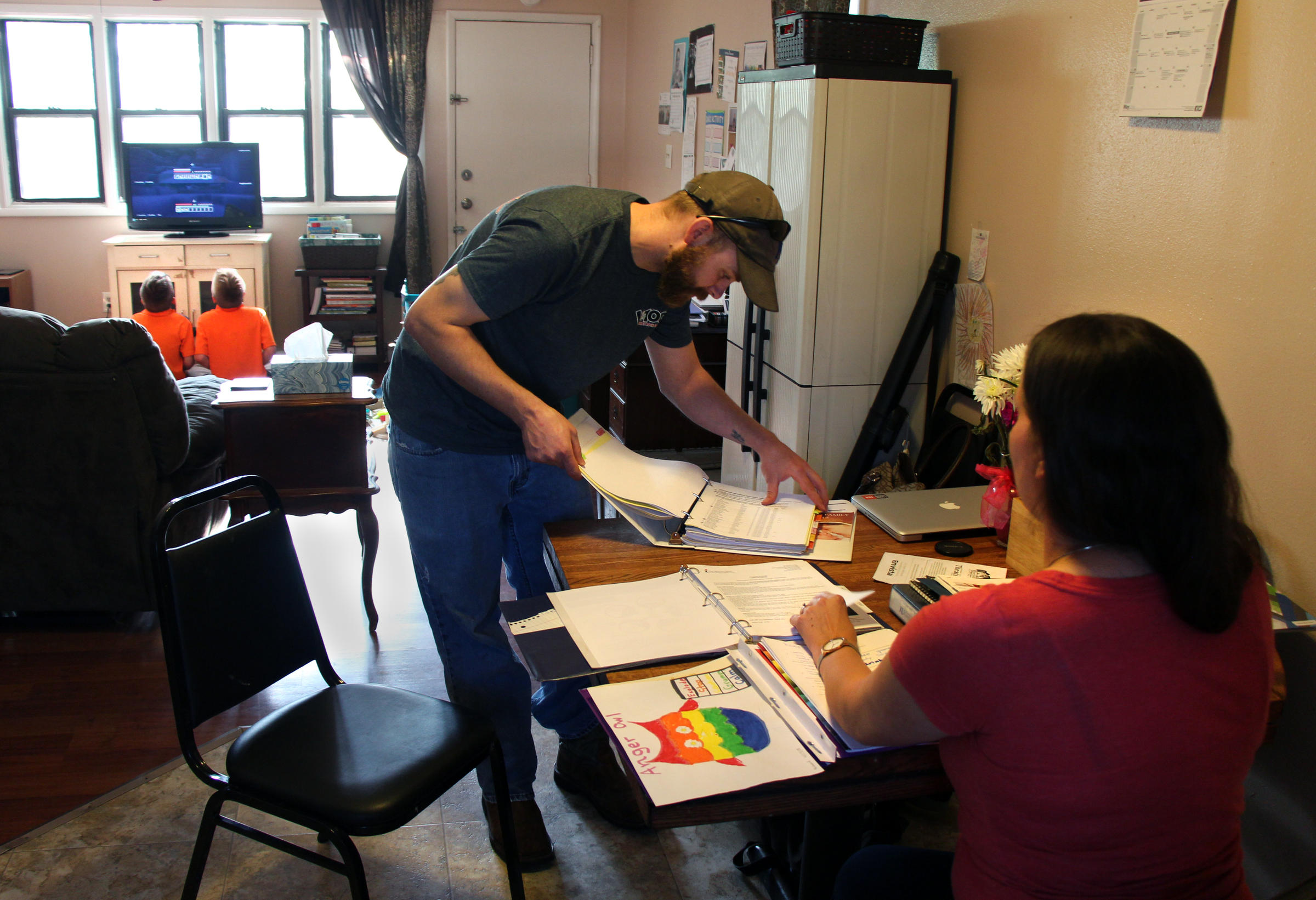
Samantha and Andrew Morrison show some of the binders full of materials that they have amassed over the years while learning about autism. Their sons Richard and James play a video game in the background.

Daily challengesSamantha and Andrew Morrison have loads of reading materials about autism in their Topeka home. Books and pamphlets from psychologists and pediatricians, personal stories written by people with autism and by parents.

They’ve become skilled at scouring for tips to help their nine-year-old son, Richard, because they haven’t had access to ABA therapy for most of his life.

“You’re just trying to make it so that they have an easier way to do things in life without feeling so stressed,” Andrew Morrison said. “Because little things can stress out kids on the spectrum really quickly.”

The Morrisons moved home to Kansas last year from Colorado, where they say behavior analysts helped Richard with his sensitivity to everyday variations in life that could trigger explosive outbursts.

Switching between two activities at home or in school could be difficult for him. Taking a different route to the grocery store or receiving a plate of spaghetti on a different dish than usual — things that any parents might do without much thought — could inadvertently cause intense distress and flailing, and leave the Morrisons struggling with guilt.

One time, they say, he plunged his feet through a van window from his spot in the backseat, shattering the glass.

“He hadn’t cut himself, but it scared him pretty good,” Samantha Morrison recalled. “He had no idea he had even done it. He was just so pent up and angry and upset.”

After the Morrisons arrived in Topeka they sought more behavior analysis. But when they called around, they say, providers told them they would have to wait.

It’s a situation those providers aren’t happy with either. Sandy Crawford, vice president of pediatric services at Easterseals Capper Foundation in the state capital says her team encourages families to get on as many waitlists as they can. The foundation has 90 kids on its own list.

“Some of these kids have been on the waitlist, two, three, four years,” Crawford said. “A four-year-old plus four years on the waitlist — that’s an eight-year-old. You’re losing time.”

Celia Llopis-Jepsen is a reporter for the Kansas News Service, a collaboration of KCUR, Kansas Public Radio, KMUW and High Plains Public Radio covering health, education and politics. You can reach her on Twitter @Celia_LJ.


Public comment period opens on Statewide Transportation Improvement Program

WEST PLAINS, Mo. – A draft 2019-2023 Statewide Transportation Improvement Program (STIP) that builds on the Missouri Department of Transportation’s long-range transportation plan, financial forecast, asset management plan and the prioritization of project needs at the local level by planning partners was presented this week to the Missouri Highways and Transportation Commission.

Transportation Planning Director Machelle Watkins told commissioners the draft STIP includes 1,319 projects, which for the most part will maintain the system in the condition it is in today. On average, this STIP annually invests in 586 lane miles of interstate pavements, 1,065 miles of major route pavements, 2,754 miles of minor route pavements and 172 bridges.

Missouri has the nation’s seventh largest state highway system with 33,856 miles of roadways and 10,403 bridges but ranks 46th nationally in revenue per mile.

The STIP details an annual construction program of $900 million per year for the five-year period, up from $850 million in Fiscal Year 2018. But it is still insufficient to meet the state’s unfunded high-priority transportation needs that are estimated in MoDOT’s “Citizen’s Guide to Transportation Funding” at an additional $825 million per year.

“Community input is critically important to the process of prioritizing local needs and putting the STIP together,” MoDOT Director Patrick McKenna said. “The STIP represents our commitment to Missourians of the projects that will be developed and delivered over the next five years.”

The STIP also takes into account commission action from January that increases cost-share funding to $30 million for 2021, $35 million for 2022, $40 million for 2023, and $45 million for 2024 and thereafter. The purpose of the cost-share program is to build partnerships with local entities to pool efforts and resources in order to deliver state highway and bridge projects.

“We know from discussions our districts have been having with our planning partners that there is a healthy appetite out there for locally important projects that can be expedited by this increase in cost-share funding,” Watkins said.

In January, the Commission also updated the distribution method for safety funds. Some $35 million is available each year for safety funding, with $3 million dedicated to statewide initiatives. Beginning in 2021, the remaining $32 million will be distributed to MoDOT’s seven districts based on a three-year average of the number of fatalities and serious injuries on the state highway system. Currently, district safety funds are distributed based on a three-year crash average that includes fatal, injury and property damage-only crashes. Watkins said focusing MoDOT’s efforts on areas with high fatalities and serious injuries is a key strategy for reducing the number of deaths on the Missouri transportation system. That is in keeping with “Missouri’s Blueprint – A Partnership Toward Zero Deaths” which is an ongoing strategic plan to assist in continuing efforts to reduce the number of people killed and injured as the result of motor vehicle crashes on the state’s roadways.

For the second straight year, the draft STIP includes more detailed project information for non-highway modes of transportation than in the past, and also includes a section detailing the planned operations and maintenance activities for the next two years, alongside expenditures for those same activities in the prior year. This additional information is provided to allow Missourians to more easily see how their transportation funding is invested.

The draft 2019-2023 Statewide Transportation Improvement Program lists transportation projects planned by state and regional planning agencies for fiscal years 2019 through 2023 (July 1, 2018 through June 30, 2023). The proposed program is available for public review. Those interested in seeing the program or offering comments can contact MoDOT by email to STIPcomments@modot.mo.gov, by calling customer service at 1-888-ASK-MoDOT (275-6636), or by mail to Transportation Planning, Program Comments, P.O. Box 270, Jefferson City, MO 65102. The program is also available on MoDOT’s website, www.modot.org/plansandprojects/construction_program/DRAFT_STIP2019-2023/index.htm, and at MoDOT district and regional offices around the state. The formal comment period ends July 6, 2018.

Following the public review period, the comments will be presented to the Missouri Highways and Transportation Commission. The Commission will review the comments and the final transportation program before considering it for approval at its July 11 meeting in Springfield.

Also at the meeting, the Commission approved an update of MoDOT’s 2014 Long-Range Transportation Plan. The update took place over the past year in accordance with new federal laws and regulations that require additional content, including safety performance measures and targets.

In the previous effort, four goal areas were established:

  • Take care of the transportation system and services we enjoy today;
  • Keep all travelers safe, no matter the mode of transportation;
  • Invest in projects that spur economic growth and create jobs; and
  • Give Missourians better transportation choices.

MoDOT sought public input in fall 2017 to determine if those goals were still valid, or if priorities had changed. Nearly 8,000 people participated in the online survey and submitted about 5,400 comments. Based on that feedback, the four goals above were validated and the updated plan adds a fifth goal:

  • Improve reliability and reduce congestion on Missouri’s transportation system.

For the first time, the plan also examines how Missouri should prepare for autonomous and connected vehicles.

– MoDOT Press Release –


Arrest made in killing of man whose body was found on Mo. road

SPRINGFIELD, Mo. (AP) – Authorities say an arrest has been made in the killing of a man whose body was found near a road north of Springfield.

Phillips photo Greene Co.

The Greene County Sherriff’s Office says 23-year-old Adam Phillips, of Springfield, was arrested Friday night. Investigators say Phillips is suspected in the shooting death of 48-year-old Shone Swearingin, of Strafford.

Swearingin’s body was round around 3:30 a.m. Friday near WW Highway, just east of Missouri 13.

Sheriff Jim Arnott had said Friday that Swearingin was last seen Thursday night in Springfield by an officer. Arnott did not detail the nature of the officer’s contact with Swearingin.

Copyright Eagle Radio | FCC Public Files | EEO Public File