LAWRENCE, Kan. (AP) — A fraternity at the University of Kansas has been closed because of several health and safety violations and a failure to meet its national organization’s guidelines.
The national Sigma Alpha Epsilon organization announced Thursday that the Kansas chapter will close after 115 years at the university. The national organization didn’t elaborate on what led to the closing. All Kansas members have been suspended indefinitely.
The chapter will remain closed for no less than four years or until the last current members have graduated or left the university.
The Lawrence Journal-World reports that the university had placed the fraternity on probation for two years after violations of the students’ code of conduct.
Two other Kansas fraternities, Delta Upsilon and Sigma Phi Epsilon, have been suspended this year.
KANSAS CITY, Mo. (AP) – Kansas City police say a 26-year-old man has been charged in the shooting death of a woman on her front porch.
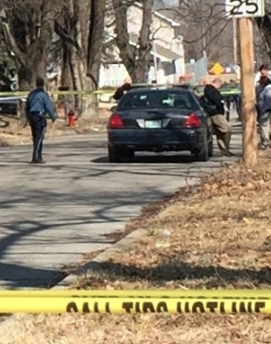
Investigators on the scene of Friday’s fatal shooting -photo courtesy KMBC
Police say Dimitri Tinsley has been charged with second-degree murder, armed criminal action, endangering the welfare of a child and a weapons count for the fatal shooting Friday morning of 25-year-old old Ashley Roberts. Police say the shooting happened across the street from Cleveland Park near the Oak Park Southeast neighborhood.
Police say neighbors reported that Tinsley left the home in a car with the couple’s 3-year-old and 8-year-old children after the shooting. He was arrested a short time later.
Police say the children were taken into protective custody.
Court records say Tinsley told police he accidentally shot Roberts after taking a gun from her while they were arguing.
Students in Kansas are bearing more than two-thirds of the cost of their education at public universities in the state.
That’s a sharp increase over the last 16 years. In 2001, revenue from tuition was little more than a third of the cost of education — about 35 percent. Today it’s just over 71 percent.
The main reason students — rather than the state — are paying a majority of the cost is years of state funding cuts. Funding for
higher education has faced multiple cuts over the past decade. Adjusted for inflation, Kansas universities lost more than a quarter of their state funding since 2001.
That has caused universities to turn to tuition hikes. Since 2001, revenue from tuition for state universities increased more than 2.5 times (also adjusted for inflation).
“This, of course, doesn’t take into account expenses that they have for books or student fees,” said Elaine Frisbie, the vice president for finance and administration for the Kansas Board of Regents.
Those fees have also jumped, at least in part as a reaction to lower state funding.
CREDIT STEPHAN BISAHA / SOURCE: KANSAS BOARD OF REGENTS
The future of state funding and tuition is uncertain. While the Kansas Board of Regents is pushing the Legislature to restore $24 million from recent cuts, lawmakers have hinted at the possibility of more cuts to pay for K-12 funding.
Frisbie says the Board of Regents will review possible tuition increases for 2019 this summer, though she suspects the board is concerned about how tuition increases would further block Kansans’ access to higher education.
“Whether they are willing and interested in having the universities continue to increase tuition is going to be an interesting discussion,” Frisbie said.
There’s a third factor that goes into the cost of tuition: the actual cost of education. And that cost has grown over the last 16 years, outpacing inflation.
Some of the rise in education spending is out of the universities’ hands. State university faculty, for example, have a state employee health plan. As premiums go up, so does the cost of education.
“We are looking at ways of how do we reduce our costs and be more efficient,” said Ethan Erickson, the assistant vice president for budget planning at Kansas State University.
“But, at the end of the day, there are going to be some areas where if we want to continue to maintain and provide an excellent educational opportunity we have to able to increase and adjust for those operational costs,” he said.
Despite the increases to tuition, Erickson argues that K-State is worth the cost.
“Kansas State University is an exceptional bargain for our citizens,” he said. “We still provide a great value for our customers.”
Stephan Bisaha is an education reporter for the Kansas News Service. Follow him on Twitter @SteveBisaha.
JEFFERSON CITY, Mo. (AP) — Missouri lawmakers are threatening to make “painful cuts” to a state department’s funding for refusing to release information about a virus that killed a state employee last year.
Republican Rep. Justin Alferman
Republican Rep. Justin Alferman first proposed Wednesday at a House budget committee hearing a 10 percent budget reduction for administrative staff at the Missouri Department of Health and Senior Services. Republican Rep. Scott Fitzpatrick then threatened even deeper cuts if the committee doesn’t get answers, the Washington Missourian reported .
“The cuts are nothing that will hurt anyone receiving services or benefits from the DHSS,” Alferman said. “But they are going to hurt the administration and bureaucracy continuing to obstruct information.”
Meramec State Park Assistant Superintendent Tamela Wilson died last summer from complications of the rare Bourbon virus after being bitten by an infected tick. Lawmakers wanted to know whether others have tested positive for the virus, concerned that others could contract the disease at state parks. But the department said releasing such information would violate patient privacy laws like the Health Insurance Portability and Accountability Act, or HIPAA.
“I want to be perfectly clear, this is not a veiled threat, this is a promise,” Alferman said. “Just from the department not releasing any information makes me suspicious. Let’s not negate the fact we had a state employee pass away from this disease. I think they (DHSS) are hiding behind an interpretation.”
On Thursday, Alferman and state Rep. Nate Tate of St. Clair had a closed door meeting in Jefferson City with two staff members from the governor’s office. The staff members brought an email dated March 8 from the Centers for Disease Control to Ken Palermo, the administrator of the state agency’s disease prevention section.
The email said only staff who worked or volunteered at the park were eligible to participate in the investigation. It said since a limited number of staff were part of the investigation, information to identify the individuals is not being disclosed.
Tate said he and Alferman aren’t satisfied and expect to receive more information from the governor’s office next week.
KANSAS CITY, Kan. (AP) — An expert on voter fraud says voter confusion and clerical errors likely led to a “handful” of noncitizens successfully registering to vote Kansas.
Lorraine Minnite, a professor of political science at Rutgers University
Lorraine Minnite, a professor of political science at Rutgers University, testified Friday in the trial for a lawsuit brought by the American Civil Liberties Union challenging a law requiring people to provide documents verifying citizenship when registering.
Minnite believes voter fraud is rare in the United States. She said her research on the subject didn’t support Kansas Secretary of State Kris Kobach’s public assertions that noncitizens registering to vote is a pervasive problem in the country.
Earlier Friday, Brian Caskey, director of elections in Kobach’s office, testified that he wasn’t sure if the office had notified all suspended voters that they could vote in elections.
The Polsinelli law firm said this week it will work with immigration lawyer Rekha Sharma-Crawford to secure the release of Syed Ahmed Jamal, who was arrested in January and nearly deported after living in Kansas more than 30 years. He lived with his wife and three children in Lawrence.
Jamal remains jailed in Platte County, Missouri. He was returned there nearly a month ago after attorneys secured a court order to remove him from a plane in Hawaii that was flying him back to Bangladesh.
An attorney at Polsinelli’s, Alan Anderson, is Jamal’s neighbor.
Jamal’s case is being reviewed by the U.S. Board of Immigration Appeals and federal courts in Washington, D.C.
SHAWNEE COUNTY — A Kansas man died in an accident Saturday morning in Shawnee County.
Just before 10:30 a.m., the Shawnee County Sheriff’s Office, Soldier Township Fire and AMR responded to the scene of a farm implement related accident at 1800 block of NW 38th Street, according to Sheriff Herman Jones. Upon arrival a farm tractor was discovered to be on fire.
The operator of the tractor was deceased upon arrival of emergency personal. The Sheriff did not release the name of the victim.
SPRINGFIELD, Mo. – A Mexican national was sentenced in federal court Thursday for his role in a drug-trafficking conspiracy that resulted in the murder of a co-conspirator, according to Timothy A. Garrison, United States Attorney for the Western District of Missouri.
Yovanny Aroldo Mendivil-Balderama, 23, a Mexican national, was sentenced by U.S. District Judge Roseann Ketchmark to 50 years in federal prison without parole.
On Oct. 16, 2017, Mendivil-Balderama pleaded guilty to participating in a conspiracy to distribute methamphetamine in Greene County, Dallas County, Webster County and Christian County, Mo., from April 28, 2015, to April 26, 2016. He also pleaded guilty to using a firearm in furtherance of a drug-trafficking crime, resulting in the murder of Oscar Adan Martinez-Gaxiola on April 25, 2016, in Webster County.
According to court documents, Mendivil-Balderama and Martinez-Gaxiola obtained large amounts of methamphetamine from either Arizona or Mexico and transported it to Missouri. They supplied methamphetamine to co-defendant Brooke Danielle Beckley, 21, of Nixa, for distribution in the Springfield area. Beckley, who pleaded guilty to the same charges, was sentenced on Feb. 26, 2018, to 40 years in federal prison without parole.
Beckley met Mendivil-Balderama and Martinez-Gaxiola in January 2016, and Beckley and Mendivil-Balderama started a sexual relationship shortly afterwards.
On April 6, 2016, law enforcement officers seized from Beckley’s hotel room approximately 1.9 kilograms of methamphetamine, a loaded 20-gauge shotgun with a sawed off barrel and stock, four rounds of additional shotgun ammunition, a .22-caliber pistol, a drug ledger and $3,662.
The loss of the 1.9 kilograms of methamphetamine created a $44,000 debt that Beckley owed to both Mendivil-Balderama and Martinez-Gaxiola. According to court documents, text messages between Mendivil-Balderama and Beckley revealed they both wanted to kill Martinez-Gaxiola as a way to reduce, or extend, the debt and to prevent Martinez-Gaxiola from possibly killing Beckley. Mendivil-Balderama suggested in a text to Beckley that he had “an idea of how we can do so you do not have to pay me everything.” Beckley, in a text on April 21, 2016, asked what he needed her to do. Mendivil-Balderama responded, “I just need someone to help me get rid of someone I need gone like now.” Subsequent text messages suggested that the person that needed to be “gone” was Martinez-Gaxiola.
Beckley then recruited co-defendant Anthony Edward Donovan, 21, of Springfield, Mo., to assist in killing Martinez-Gaxiola, and offered to pay him $6,000. Donovan recruited co-defendant Nathaniel Austin Lee, 20, of Seymour, Mo., to assist in the murder and allow for the use of Lee’s property in rural Webster County, Mo., in exchange for part of the $6,000. Lee then recruited Joshua Applegate (who was a minor under federal law at the time of the offense, and therefore charged as an adult in state court rather than in the federal indictment).
On April 24, 2016, Beckley, Donovan and Lee practiced for the murder of Martinez-Gaxiola by discharging various firearms at the Lee residence. On April 25, 2016, Mendivil-Balderama traveled with Martinez-Gaxiola to the Lee residence on the pretext that Beckley would pay the drug debt. Beckley, Donovan, Lee and Applegate were waiting at the residence; Donovan and Lee were armed with handguns. Upon arrival, Mendivil-Balderama got out of the vehicle first. When Martinez-Gaxiola exited the vehicle, Donovan and Applegate opened fire and Martinez-Gaxiola fell to the ground. Eventually, Donovan went up to where Martinez-Gaxiola lay and shot him once in the head. Martinez-Gaxiola was armed with a handgun but did not discharge it during his murder.
Lee’s neighbors reported the shots fired at the residence (it is estimated that the co-conspirators expended 30 to 60 rounds of ammunition during the murder). Webster County deputies responded to the location. Hearing the emergency sirens, the co-conspirators attempted to conceal Martinez-Gaxiola under a piece of tin siding, and then fled area. When the deputies arrived, they found Martinez-Gaxiola, who was still alive but critically hurt and who died before transportation to the hospital. Law enforcement officers captured all the co-conspirators by the end of the day on April 25, 2016.
Donovan and Lee have pleaded guilty to the same charges and await sentencing. Co-defendant Jourdan Ashley McGinnis, 29, of Nixa, pleaded guilty to his role in the drug-trafficking conspiracy. McGinnis was sentenced on Dec. 18, 2017, to seven years and 10 months in federal prison without parole.
ST. JOSEPH, Mo. – Motorists on Interstate 229 will encounter single-lane traffic in various locations next week.
Contractors working with the Missouri Department of Transportation plan to close one lane in order to safely work on sections of guardrail both on the roadside and in the median between I-29 and Route 371 (22nd Street) beginning Monday, March 12th. They plan to work from approximately 6 a.m. to 6 p.m. each day, Monday through Friday.
This guardrail work will continue through April.
During the work motorists may experience delays. The project is weather dependent and could be rescheduled.
FARGO, N.D. (AP) — Agricultural Secretary Sonny Perdue said Friday that while he’s as anxious as farmers are about President Donald Trump’s new tariffs, the move doesn’t look as bad as he originally thought.
Perdue-courtesy photo
Perdue said during a trip to meet with representatives of North Dakota’s agricultural sector that Trump’s decision to enact a 25 percent tariff on imported steel and a 10 percent levy on aluminum looks better in the final version than it did when first announced. He joked with farmers in Iowa earlier this week that one option for farmers who fear a trade war may be to pray.
“I was very concerned last week with the surprise announcement on the steel and aluminum tariffs, as most people in the White House were,” Perdue said during a press conference at North Dakota State University. “But we hope to turn it into a positive. This president has the unique ability to turn some things that we think are initially negative into positives.”
Perdue says the final version looked much better because Canada and Mexico were excluded, which he believes could spark discussions on improving the North American Free Trade Agreement. He said he will be on edge until NAFTA is recertified and reauthorized and the U.S. addresses trade issues with its key importers.
Agriculture producers receive 20 cents out of every dollar from exports. Perdue heard from about 20 farm representatives Friday, most of whom didn’t pass the microphone until saying something about trade. Mark Martinson, a durum wheat farmer in northeastern North Dakota, said the U.S cannot risk losing “China, Indonesia, all those markets.”
In addition to Trump backing off on Canada and Mexico, Perdue was relieved the president indicated he was willing to work with Europe and other U.S. allies on improving trade. Canada and Mexico are two of the largest suppliers of agricultural products to the United States, according to Commerce Department figures. In 2016, the U.S. imported $22 billion in ag products from Canada and exported $23 billion; the U.S imported $23 billion from Mexico and exported $18 billion.
The European Union, meanwhile, said it is putting together a list of agricultural products it plans to target for tariffs as retaliation to the U.S.
“This is a president who is willing to change his mind over issues,” Perdue said. “He came out of the campaign literally believing that everybody in the United States hated NAFTA. And we had to walk in and show him that many of his supporters and voters benefited from NAFTA.”
North Dakota U.S. Sens. John Hoeven and Heidi Heitkamp said Perdue has been willing to stand up to the president on the importance of trade to agriculture.
“Secretary Perdue has been a very strong advocate for the farmer on trade,” Hoeven said. “No question about it. Right from the start with NAFTA, now with the tariffs, he’s been very vocal with the administration on the importance of trade to agriculture.”
Heitkamp said the first thing Perdue said to her in their first face-to-face meeting was “trade, trade, trade” and is happy he is pushing back against trade policies that will hurt farmers.