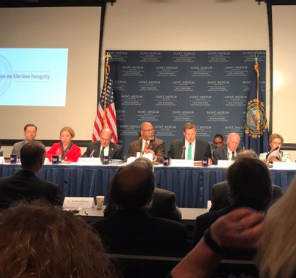
Republicans in the Kansas House on Tuesday unveiled a plan they say will make schools safer.
Kansas House Speaker Ron Ryckman, in the center at the microphones, and other Republicans want to spend $5 million on a yet-to-be-developed plan to improve school security. JIM MCLEAN / KANSAS NEWS SERVICE
Really more of a plan to get a plan, it calls for the Kansas State Department of Education and state emergency response and law enforcement agencies to develop statewide standards for “safe and secure school buildings.”
The standards would provide districts with best-practice guidelines for securing buildings and training staff and students how to respond in emergencies. The education department would provide districts with technical assistance. Financial assistance would come from a new $5 million state grant program.
“We know this will make a difference,” said House Speaker Ron Ryckman, flanked by several Republican lawmakers. No Democrats attended their hastily called news conference.
The GOP plan, developed in the aftermath of the Feb. 14 Florida school shooting that left 17 dead, would encourage Kansas school administrators to use a program developed by the NRA to educate students about firearm safety. But unlike a previous bill, it wouldn’t preclude the use of other gun safety curricula.
“It’s not a mandate,” Ryckman said. “It’s a suggestion.”
Rep. Brenda Dietrich, a former Topeka school superintendent, backed the plan but said care should be taken not to turn schools into fortresses.
“Our buildings need to be safe and secure without a doubt,” she said. “They also need to be warm and nurturing and welcoming.”
Ryckman, an Olathe Republican, brushed aside questions about the future of other measures intended to reduce gun deaths. He said GOP lawmakers were united on the school security plan. They’re still split on other proposals, including one that would allow guns to be temporarily confiscated from people seen as immediate suicide risks or domestic violence threats.
Senate leaders have pledged to give that bill a hearing but it hasn’t been scheduled. Sen. Barbara Bollier, a Mission Hills Republican and sponsor of that “red flag” bill, has said if necessary she will attempt to force a vote on it.
Two House-passed gun bills cleared a Senate committee earlier this week. One would expand the list of people prohibited from owning firearms to include those convicted of domestic violence and those subject to restraining orders to keep them from stalking or harassing others. The other would allow people with permits from other states to also carry concealed firearms in Kansas.
Jim McLean is managing director of the Kansas News Service. You can reach him on Twitter @jmcleanks
PHOENIX (AP) – Federal prosecutors say two Arizona men have been sentenced to long prison terms for a telemarketing scheme that victimized about 4,000 people including nearly 100 Missouri residents.
They say 48-year-old Michael McNeill received a 10-year prison sentence while Joshua Flynn was given a seven-year term.
Both men must pay restitution to the mostly elderly victims.
McNeill, of Phoenix, pleaded guilty last November to one count of wire fraud in connection with telemarketing and one count of conspiracy to commit money laundering.
Flynn, of Chandler, pleaded guilty to the same charges.
The men were accused of selling fictitious business opportunities as part of a scheme that reached across the United States and Canada and generated more than $20 million in fraudulent sales.
The Phoenix-based telemarketing enterprise operated under multiple business names.
KANSAS CITY, MO. —(AP) – Friends and family are rallying in support of a Kansas City bar manager who was deported amid a legal effort to keep her in the U.S.
Dozens showed up Wednesday in front of the bar where Leticia Stegall worked. Her husband, Steve Stegall, said it’s a “travesty” that she was flown to Mexico on Friday.
Leticia Stegall’s troubles stem from a driving while intoxicated arrest six years ago. She was arrested last week as part of a four-day enforcement operation in the Kansas City metro area. U.S. Immigration and Customs Enforcement said the operation targeted people in the country illegally who had prior criminal histories.
KSHB-TV reports that a judge ordered a hearing next week in the case. But ICE said Stegall already was in Mexico.
OLATHE, Kan. (AP) — A man charged with fatally shooting an Indian immigrant last year at a suburban Kansas City bar pleaded guilty Tuesday to murder in the slaying that fanned fears of anti-immigrant violence following President Donald Trump’s election.
Witnesses said Adam Purinton, who is white, yelled “Get out of my country!” before firing at two men who had stopped for an after-work drink at Austin’s Bar and Grill in Olathe, Kansas.
Srinivas Kuchibhotla was killed in the Feb. 22, 2017, attack. His friend Alok Madasani was wounded. The men, both 32, had come from India to the U.S. as students and worked as engineers at nearby GPS-maker Garmin.
Another man, Ian Grillot, was wounded when he tried to intervene.
Purinton faces life in prison with no chance of parole for 50 years when he is sentenced May 4 for premeditated first-degree murder.
At the time of the shooting, officials in India expressed concern about their citizens’ safety in the United States.
Kuchibhotla’s widow, who was not present at the hearing, issued a statement saying she hoped the guilty plea would “send a strong message that hate is never acceptable.”
“We must understand and love one another,” Sunayana Dumala said.
According to court documents, Purinton was asked to leave the bar when he made derogatory comments. He returned a short time later with a gun.
Madasani told detectives that the gunman asked the men if their “status was legal” before he opened fire, according to an affidavit released last year.
After the shooting, Purinton drove 70 miles (110 kilometers) east to Clinton, Missouri, and stopped at a restaurant, where he allegedly confessed to the killings to a bartender, who called police.
Purinton, a 52-year-old Navy veteran, was a regular customer at Austin’s. Neighbors in the Olathe cul-de-sac where he lived told The Associated Press after the shooting that he became “a drunken mess” following his father’s death about two years before the shooting and had physically and mentally deteriorated.
He still faces federal hate crime charges in the slaying. Federal prosecutors have not determined whether they will seek the death penalty.
Mike Wolfe, Frank Fritz and their team are excited to return to Kansas. They plan to film episodes of the hit series “American Pickers” throughout the area this May.
“American Pickers” is a documentary series that explores the fascinating world of antique “picking” on history. The hit show follows Mike and Frank, two of the most skilled pickers in the business, as they hunt for America’s most valuable antiques. They are always excited to find sizable, unique collections or accumulations and learn the interesting stories behind them.
As they hit the back roads from coast to coast, Mike and Frank are on a mission to recycle and rescue forgotten relics. Along the way, the Pickers want to meet characters with remarkable and exceptional items. The pair hopes to give historically significant objects a new lease on life, while learning a thing or two about America’s past along the way.
Mike and Frank have seen a lot of rusty gold over the years and are always looking to discover something they’ve never seen before. They are ready to find extraordinary items and hear fascinating tales about them.
“American Pickers” is looking for leads and would love to explore your hidden treasure. If you or someone you know has a large, private collection or accumulation of antiques that the Pickers can spend the better part of the day looking through, send us your name, phone number, location and description of the collection with photos to americanpickers@cineflix.com or call 855-OLD-RUST.
With the 10th season of St. Joseph Mustangs baseball approaching, a special logo has been unveiled to commemorate the occasion.
According to a press release, Mustangs General Manager Ky Turner said the organization has more planned to celebrate a decade of Mustangs baseball in St. Joseph.
“We’re excited to kick off our 10th season at Phil Welch Stadium,” Turner said. “This logo is just the start of many exciting things that we have ahead of us for this upcoming season. You will see this logo included on a lot of special merchandise and giveaways that we have planned.”
More announcements regarding the celebration of the 2018 season will be released soon. Mustangs will kick off their 10th season in St. Joseph on Wednesday, May 30th against the Midwest A’s.
JEFFERSON CITY, Mo. (AP) – The Missouri Supreme Court has upheld the conviction and death sentence for a southwest Missouri man who admitted raping and killing a 9-year-old girl.
Judges ruled unanimously Tuesday to reject arguments that Christopher Collings’ previous attorneys were not effective in defending him over the November 2007 death of Rowan Ford.
The girl was taken from her Stella home and found a week later in a sinkhole. Her stepfather, David Spears, was also charged with murder and rape but pleaded guilty to reduced charges of child endangerment and hindering prosecution.
Collings’ new lawyers argued that his previous attorneys didn’t call enough expert witnesses and didn’t challenge DNA evidence, among other things. But judges ruled the trial attorneys made reasonable decisions and that Collings’ didn’t prove the case would have ended differently.
COLUMBIA, Mo. (AP) – The University of Missouri is facing a $60 million budget shortfall on its Columbia campus under a worst-case scenario for state support and enrollment.
The Columbia Daily Tribune reports that Chancellor Alexander Cartwright held a campus faculty meeting Monday to discuss a report recommending the campus close nearly 30 graduate programs. The meeting also included discussing the financial straits the university faces in the coming year.
The university released in January the report by the Task Force on Academic Program Analysis, Enhancement and Opportunities that cited low numbers of applicants, graduates, academic output or grant production as reasons for shuttering 27 programs.
Faculty passed a resolution Monday asking Cartwright to create a formal process for addressing the recommendations. Cartwright says he’ll decide on the recommendations by the end of spring
A Kansas law that blocked tens of thousands of voter registrations goes on trial this week in federal court — testing whether fraud is common enough to warrant tougher registration rules.
Tougher voter registration rules championed by Kansas Secretary of State Kris Kobach go on trial this week. FILE PHOTO / KANSAS NEWS SERVICE
Kansas Secretary of State Kris Kobach wants to prove his oft-made and much-challenged assertions that voter fraud isn’t just a risk, but a real and widespread problem.
If he fails in court, the state will no longer be able to block voter registrations at driver’s license offices for failing to show such things as birth certificates or passports to prove citizenship.
Rick Hasen, a professor of law and political science at UC Irvine, says a Kobach win would allow other Republican-controlled states to impose their own stricter voter registration laws.
The case will also draw attention because of Kobach’s national role in promoting the idea that immigrants game the American electoral system.
“Here’s a case where that very issue is going to be put on trial,” Hasen said.
Kobach’s statements have made national headlines, especially after he began talking to President Donald Trump about overhauling federal election law and backed his assertion that millions of illegal voters may have cost him the popular vote to Hillary Clinton.
Claims by Kansas Secretary of State Kris Kobach that voter fraud is rampant and warrants tough registration standards is on trial in federal court this week. CREDIT NADYA FAULX / KANSAS NEWS SERVICE
Though Politifact dubbed that idea “Pants on Fire” false, Kobach argues that Democrats turn a blind eye to the problem of noncitizens casting ballots.
“It does seem that many in the Democrat party — hopefully not all — seem to think that it’s OK if aliens vote,” Kobach told Fox News ahead of this week’s trial. “Heck, it helps the Democrat party.”
Now comes the trial in Kansas City. It could last more than a week and is one of several legal challenges that have tied up Kobach’s Secure and Fair Elections, or SAFE, law in state and federal courts.
Since 2013, that law has required Kansans who want to vote to back up their assertion of American citizenship with papers.
Opponents of Kobach’s law say it disenfranchises people who lack such documents — especially the elderly, people living in poverty and younger voters, such as college students who are far from home without their birth certificates.
The American Civil Liberties Union represents the League of Women Voters — a nonpartisan, progressive civic engagement group that Kobach has called communist— and several Kansans who were blocked from voting. They took Kobach to court.
ACLU lawyers say some of the plaintiffs didn’t have documents showing citizenship and some did, but were still blocked despite having shown these at the DMV.
Dale Ho, who’s litigating the Kansas case for the ACLU, says Kobach’s law allowed him to hold back tens of thousands of voter registration applications without good reason.
“He’s been talking for years about supposed hordes of non-citizen immigrants registering to vote and corrupting American elections,” Ho said, “but he hasn’t been able to show an iota of evidence.”
The would-be registrants tended to be young and politically unaffiliated, compared to the general electorate.
This week’s trial gives ACLU a chance to scale back Kobach’s law by leaning on the 1993 National Voter Registration Act — often called the Motor Voter Act. That law says swearing your citizenship under penalty of perjury is sufficient for registration. Liars risk prison, fines and deportation.
If the organization succeeds, Judge Julie Robinson of the US District Court for the District of Kansas will block the Kansas law when it comes to anyone registering through the DMV process created by that 1993 law.
That motor-voter process, which boosted voter registration nationally, allows streamlined registration while getting or renewing a driver’s license. One-third of Americans who register to vote use the DMV process. In Kansas, the ACLU says, that figure tops 40 percent.
Kobach already faces other roadblocks to implementing his SAFE law in full.
Pending Robinson’s decision, he is barred from requiring birth certificates or other such documents from DMV voters. Kobach is already blocked by a separate federal lawsuit — from making that demand of voters who register using a federal paper application.
As many two in five Kansans register to vote when they get a driver’s license. CREDIT CELIA LLOPIS-JEPSEN / KANSAS NEWS SERVICE
A state court ruling, meanwhile, has stopped Kobach from circumventing this by allowing people who register through the DMV or federal form to vote just in federal elections and not state or local elections.
Kobach’s office didn’t respond to repeated requests for an interview for this story.
In court filings, he argues the motor-voter process isn’t rigorous and lets non-citizens slip through.
“The SAFE Act was what finally provided a tool to prevent non-citizens from registering to vote,” he wrote.
Under a higher court’s decision that laid out what Kobach needs to prove in order to win this week’s trial, he has to show more evidence of non-citizens gaming the system. Judges have made clear his evidence so far doesn’t cut it.
Kobach’s briefs indicate at least 43 suspected non-citizens registered in Kansas since 2000, and 11 voted. Kansas has about 1.8 million people on its voter rolls.
In this round of the fight, Kobach will present statistical estimates and other research that he argues point to much higher rates of fraud existing without being detected. The ACLU will challenge his numbers as junk science.
If Kobach convinces Robinson with his evidence, he will then also have to prove that the only way to prevent the illegal voting is by requiring more documents from people — instead of, for example, working to make sure the DMV doesn’t mistakenly offer foreigners voter registration.
Wendy Weiser, director of the democracy program at New York University’s Brennan Center for Justice, doubts Kobach has the proof he needs.
“Voting by non-citizens turns out to be incredibly rare,” she said, “because there are real strong safeguards in place.”
By contrast, she said, a study by the center concluded 7 percent of Americans don’t have easy access to the type of documents Kobach is seeking from voters. That rate is higher among the poor.
The Brennan Center represents the plaintiffs in a separate lawsuit that currently prevents Kansas from applying its SAFE law to people who register with a federal paper form.
Whatever the outcome following this week’s trial, it could feed into court challenges elsewhere or clear the way for more states to mimic what Kobach has done in Kansas.
Arizona, Georgia and Alabama have laws similar to the one in Kansas, though the latter two aren’t currently implementing theirs.
Hasen, the law professor, says the narrow victory by George W. Bush over Al Gore in the 2000 presidential race underscored for Republicans and Democrats that “the rules of the game matter.”
“We’ve seen the emergence of what I call red state election law and blue state election law,” he said. “States with Republican legislatures and governors have been passing laws that make it harder to register and vote. States with Democratic governors and legislatures have been passing laws that make it easier to register and vote.”
Why? Hasen says the theory, at least, is that the people hindered or helped by these laws are likely to vote Democrat.
KANSAS CITY, Kan. (AP) — A conservative official’s claim that scores of noncitizens are voting in Kansas will be put on trial Tuesday in a legal challenge to a law requiring people to show proof of citizenship to register to vote in the state.
Kansas Sec. of State Kobach at meeting of President Donald Trump’s commission on election fraud
At issue in the bench trial unfolding in federal court in Kansas City, Kansas, is the fate of a law championed by Republican Kansas Secretary of State Kris Kobach requiring people to provide citizenship documents such as a birth certificate, naturalization papers or passport when they register.
U.S. District Judge Julie Robinson must decide whether Kobach has legal authority to demand such paperwork for people who register at motor vehicle offices. If he’s to win, Kobach will need to show that Kansas has a significant problem of noncitizens registering to vote.
Kobach, the vice chairman of President Donald Trump’s recently disbanded commission on election fraud, argues the law is necessary to prevent voter fraud and says even a small number of noncitizens voting could sway a close election. Critics say incidents of noncitizens registering to vote are extremely rare and argue that such Republican-backed laws hurt voter registration efforts and disenfranchise minorities and college students who may not have the documentation readily available.
Kansas has about 1.8 million registered voters. Kobach has told the court he has been able to document a total of 127 noncitizens who at least tried to register to vote since 2000. Forty-three of them were successful in registering, he says, and 11 voted.
The law in question went into effect in 2013. In its first three years, about one in seven voter registration applications in Kansas were blocked for lack of proof of citizenship — with nearly half for people under the age of 30, according to court filings.
Robinson in May 2016 temporarily blocked the law’s implementation for people who register at driver licensing offices, a ruling that was upheld by the 10th Circuit Court of Appeals.
SPRINGFIELD, Mo. (AP) – A man who was shot and wounded after pointing a gun at Springfield police officers has been sentenced to four years in prison.
The Springfield News-Leader reports that 44-year-old Jerry Beasley was sentenced Monday for assault and unlawful use of a weapon. Police say a suicidal Beasley told a 911 dispatcher he would shoot officers and there was “fixing to be a shootout” before police arrived at his northwest Springfield home on Aug. 12.
After negotiation attempts failed, Beasley came out of his house and pointed a rifle at officers. A Springfield police officer then shot Beasley, whose rifle wasn’t loaded.


 With the 10th season of St. Joseph Mustangs baseball approaching, a special logo has been unveiled to commemorate the occasion.