SIKESTON, Mo. (AP) – A Missouri state lawmaker is sharing her story of being sexually abused by her grandfather when she was a girl to help other victims.
Rep. Holly Rehder tells the St. Louis Post-Dispatch that she was 11 when her grandfather crawled into her bed with her and started touching her.
Rehder says she didn’t feel safe after the incident, but the next day when she went to her great aunt’s house, she told her great aunt and her mom and neighbors.
The 48-year-old Republican from Sikeston, Missouri, says she told others because she wanted to stop the abuse from happening again.
Rehder’s grandfather wasn’t charged with a crime but he later sought treatment. He is deceased.
The 43rd Annual Yuletide Feaste held at the Ballroom of the J.W. Jones Student Union Dec. 8, 2016. (Photo by Todd Weddle | Northwest Missouri State University)
Northwest Missouri State University’s Madraliers will host their 44th annual Yuletide Feaste in December.
The event includes a banquet with performances by Recorder Consort, the Royale Brass Quintet and The Royal Theatrical Players.
“The annual tradition of the Yuletide Feaste is a tremendous opportunity for the students, faculty and citizens of the surrounding community to come together and celebrate the holiday season,” Dr. Brian Lanier, the Madraliers conductor and a Northwest professor of music, said. “The student performers are able to sing, act and play for the audience in a beautiful setting reminiscent of a banquet hall from the Renaissance.”
At the Yuletide Feaste, guests celebrate and rediscover Christmas through the evening’s programs and festivities, highly stylized after old England. The menu, performances and decorations are reminiscent of 16th century Tudor England.
The Feaste will take place at 6:30 p.m. Friday, Dec. 8, and Saturday, Dec. 9, in the J.W. Jones Student Union Ballroom.
Tickets are $31.50 and may be purchased by check or cash in Room 101 of the Olive DeLuce Fine Arts Building. Credit card orders may be placed online at www.nwmissouri.edu/finearts/music/yuletide.htm.
Attendance is limited to 320 guests each evening, and all tickets are reserved. No tickets will be sold at the door.
For more information about the Yuletide Feaste, contact the Department of Fine and Performing Arts at (660) 562-1326.
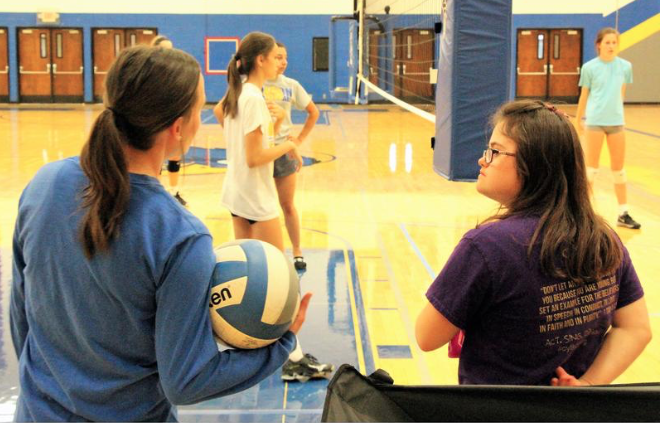
A Kansas education policy has raised concerns among advocacy groups who say it may exclude thousands of students in academic achievement gaps. That includes students with disabilities, like Rachel Mast, right, a senior at Olathe South High School. CELIA LLOPIS-JEPSEN / KANSAS NEWS SERVICE
ByCELIA LLOPIS-JEPSEN
Kansas’ approach to implementing a federal law on equity in education would fail to promote achievement for thousands of students the law was meant to protect, civil rights advocates say.
But state education officials counter that there are good reasons for their strategy designed to ensure that Kansas schools are evaluated fairly.
At issue is Kansas’ blueprint for complying with federal requirements meant to close academic achievement gaps among students in traditionally disadvantaged and underserved demographic groups.
Those include racial and ethnic minorities and students from low-income families, who have disabilities or are learning English as a second language.
National advocacy groups — ranging from the NAACP and American Civil Liberties Union to the National Down Syndrome Congress and League of United Latin American Citizens — have urged states to set a high bar for implementing the federal requirements.
“There’s still a high percentage of kids not getting diplomas that we know can perform better,” said Ricki Sabia, a senior policy adviser for the National Down Syndrome Congress. “Sometimes the only way to see what works, what doesn’t work is to have accountability.”
Kansas is one of eight states taking a more limited approach to the federal law than the rest of the country by making fewer schools fully accountable to it.
The National Down Syndrome Congress believes this will have “a devastating impact” for monitoring how well schools serve children with disabilities.
Kansas education officials disagree.
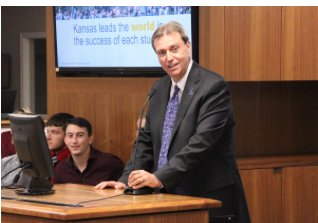
Education Commissioner Randy Watson said the state’s K-12 accreditation system and support systems for schools extend far beyond its efforts to meet federal requirements — with goals for boosting the academic success of every child.
“We try to take a much broader approach,” Watson said, “and say, ‘How do we serve every kid in Kansas?”
The Achievement Gap
Click to expand
Nationally and in Kansas, academic achievement gaps persist, leaving millions of children without the high school diplomas and postsecondary education that open doors to self-reliance and economic stability in adulthood.
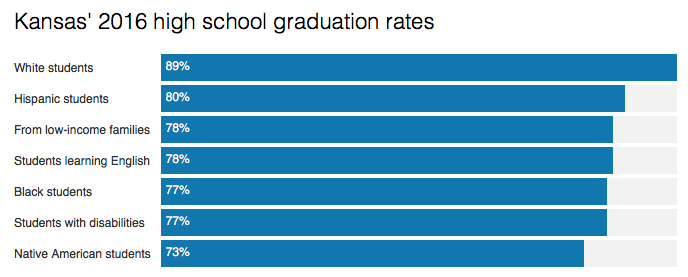
White students are more likely to be proficient in math and reading — as measured by standardized tests — and graduate from high school than their black, Hispanic and Native American peers. The gaps are evident, too, for students who don’t speak English at home, have disabilities or come from low-income families.
“These are the categories around which educational opportunity has historically been denied,” said Liz King, director of education policy for the Leadership Conference on Civil and Human Rights in Washington, D.C. “We need to know whether or not schools are removing barriers.”
King’s organization is one of more than 20 advocacy groups that sent letters to Watson and other state education chiefs urging them to apply the federal law rigorously and maximize accountability.
“The value for children in this,” King said, “is action to improve their quality of education.”
What groups like the Leadership Conference are unhappy about is Kansas’ decision regarding a key statistical threshold central to implementing the 2015 Every Student Succeeds Act, or ESSA.
The act requires states to monitor progress of underserved student groups and identify schools struggling to close achievement gaps. States must target resources and interventions to help those schools, and they receive federal dollars to do so.
Each state was allowed to hammer out the logistics on its own. Kansas submitted its proposal to the U.S. Department of Education in September, with a goal of eliminating achievement gaps statewide by 2030. It is awaiting federal approval.
The statistical threshold in question is known to education wonks as the “N-size.” It’s the number of students in any given demographic category that a school must serve before being held accountable for the achievement of that group.
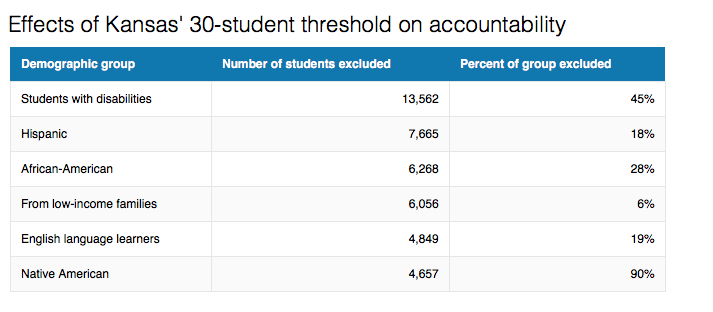
Kansas set the bar at 30. A Kansas public school with at least 30 black students will fall under the ESSA accountability system for that category. A school with 29 or fewer won’t. The same goes for each of the other student groups.
At that threshold, nearly 30 percent of black students will be excluded from the accountability monitoring. Ninety percent of Native Americans and nearly a fifth of Hispanic students and English language learners will be in the same boat.
But in sheer numbers, no group is affected more than students with disabilities. Nearly half of them will be excluded — more than 13,500 children and teens.
The statistical debate
Source: Kansas State Department of Education draft analysis -click to expand
This won’t be new for Kansas, because the state used the same threshold under ESSA’s predecessor, the 2001 No Child Left Behind law.
But under ESSA — a law that many educators view as less punitive than No Child Left Behind — states were asked to revisit their thresholds, and some lowered them so they could monitor the progress of more students.
That means Kansas is now at the high end of the spectrum — one of eight states opting for a threshold of 30. Most set the bar at 10 or 20 students. The Leadership Conference recommends 10.
Brad Neuenswander, Kansas deputy education commissioner, said the state’s goal is statistical validity. Thresholds that are too small run the risk of producing average graduation rates and math and reading test scores that don’t really reflect efforts.
“There’s more accuracy in the larger numbers,” Neuenswander said. “If you’re going to make a claim about whether or not a district is providing the services, we want it to be statistically accurate.
“When you get down really low, it’s very likely you’re going to identify a building based off a very easily identifiable family. Or a family moves in, and all of a sudden something happens because of that group. Not really anything the district did.”
Civil rights groups agree the threshold needs to be high enough to provide quality data and respect student privacy, but they argue 30 is excessive.
There’s no consensus among academics on where the sweet spot is — the number that would hold schools as fully accountable as possible without homing in on groups of students that are too small to measure soundly.
“There’s clearly no magic number for what the right N-size threshold should be,” said Dan Goldhaber, vice president of the American Institutes for Research and an expert in education data. “It’s a trade-off.”
A lower threshold helps ensure schools where children are struggling don’t get overlooked, he said, but a higher threshold increases confidence that the data from each school truly reflects meaningful differences in student outcomes among schools.
Jerry Meier, a retired principal who steered a large Topeka middle school through the rise of standardized testing and federal accountability, sees advantages and disadvantages on both sides.
“I don’t believe there is an easy answer,” he said. “I think it’s hard on the state.”
He’s skeptical of states that picked numbers as small as 10, which he says could be particularly problematic for measuring the academic progress of children receiving special education services because disabilities vary greatly.
But he also finds it somewhat troubling that nearly half of students with disabilities are excluded under the Kansas ESSA plan.
“I truly understand the parents who say, ‘We need to make (the threshold) a smaller one, because I want my child to be counted in the accountability. That way I know the school is held under the gun, so to speak,’” he said.
Public input
Jawanda Mast is one of those parent advocates.
Her daughter, Olathe South High School senior Rachel Mast, is graduating in May and plans to attend college next year.
Rachel, who has Down syndrome, is manager of the school’s volleyball team and takes a full slate of core academic classes alongside her peers without disabilities — opportunities that her mother believes have helped prepare her for life after high school.
Mast said federal laws have, for decades, pushed schools to better serve children who face developmental, learning or behavioral challenges. ESSA, the latest iteration of federal education legislation that arose out of the civil rights movement of the mid-20th century, is no exception.
“Probably you’re going to have to have some oversight to get people to do the right thing,” she said. “I hate to say that, but I think that’s just the reality. And I think if you’re getting federal funding, I think you should be accountable to the federal government for what you’re doing.”
A Kansas News Service article earlier this fall included Mast’s concern that Kansas made little effort to communicate with the public about its ESSA plan and seek broad feedback before finalizing it.
In part, Mast wanted a public discussion of Kansas’ 30-student threshold, and access to information about how many more children would be included if Kansas chose a smaller number.
Federal law required states to engage parents, teachers and other groups in choosing that number. But Kansas, unlike some states, didn’t release information to the public about the threshold and the number of students it would exclude from the monitoring system.
Nor did education officials share the figures with the advisory council of about 40 educators and advocates that they convened for the purpose of providing input on Kansas’ ESSA plan.
“I don’t know how that’s possible without giving them data on the exclusion rates,” she said.
Neuenswander says Kansas’ engagement with stakeholders on accountability thresholds took place over several years, prior to ESSA.
“We had already had all those discussions over the last five — four to six — years,” he said. “We had those conversations with … our special education advisory council and across the field.”
And since then, he said, the education and advocacy groups that his department communicates with regularly through various advisory councils haven’t pushed for any changes.
“I’ve yet to have one person say, ‘I’d like to have a conversation about N-size,’” he said.
Education Commissioner Randy Watson and other Kansas officials say the state monitors and accredits schools through its own school quality checks, independent of the federal government. CREDIT FILE PHOTO / KANSAS NEWS SERVICE
Representatives for two key school administration groups in Kansas said they have not heard interest from their members in rethinking the state’s threshold from what it was under No Child Left Behind.
“Kansas administrators are very comfortable with that N-size,” said G.A. Buie, executive director of United School Administrators of Kansas, an umbrella group that includes associations of principals, special education administrators and other school leaders.
“It’s not really been something we’ve looked at or hear about,” said Mark Tallman, a lobbyist for the Kansas Association of School Boards.
Both said school leaders are busy monitoring student outcomes independently, regardless of the federal system.
“We’re looking at individual students,” Buie said. “We’re concerned with each individual student.”
And Watson and Neuenswander said there is plenty of incentive to make sure teachers and principals do their best for those students, even if their schools fall short of Kansas’ ESSA threshold.
The state monitors and accredits schools through its own school quality checks, independent of the federal government.
It also publishes academic outcomes and demographic breakdowns for many schools that don’t fully factor into Kansas’ federal accountability plan, as well as statewide aggregated data on outcomes by demographic group, so the public can still view that data.
“We have multiple accountability systems through the state system that goes way beyond any federal requirement,” Neuenswander said.
Celia Llopis-Jepsen is a reporter for the Kansas News Service. You can reach her on Twitter @Celia_LJ.
A “Howliday” shopping event on Sunday will raise funds for the Friends of the St. Joseph Animal Shelter.
Kappy Hodges with the Friends of the Animal Shelter said the 6th Annual Howliday Shopping Event includes pet-themed vendors along with other vendors such as Mary Kay, Pampered Chef and more displaying their holiday gifts.
“What I like about the Howliday Shopping Event is they make the cute little Friends of the Animal Shelter t-shirts where they have Santa hats on the logo animals,” Hodges said. “I think this year there’s reindeer antlers on the dog and holly wrapped around the cat so you can buy one of those shirts and that’s really fun.”
The Howliday Shopping Event takes place from 10 a.m. to 3 p.m. on Sunday, November 12th, at the Green Acres Building in St. Joseph.
For more information, visit the Friends of the St. Joseph Animal Shelter Facebook page.
BLUE SPRINGS, Mo. (AP) — A Missouri man is charged with second-degree murder in the death of a Kansas man outside a restaurant.
Jackson County prosecutors charged 24-year-old John Dewayne Jeffries of Raytown on Thursday in the death of Clinton Peckman, of Paola, Kansas, who had gone to the area to work.
Investigators say Peckman was shot while he was inside a work van parked near the Bethlehem Cafe in Blue Springs.
Jeffries also is charged with first-degree robbery and two counts of armed criminal action. He allegedly tried to carjack a vehicle from another couple before he was found and arrested.
Kansas Senate President Susan Wagle photo by Stephen Koranda
TOPEKA, Kan. (AP) — The leader of the Kansas Senate says the state Supreme Court timed a recent decision on school finance to help Democrats elect a governor.
Republican Susan Wagle on Friday denounced the court’s October ruling that found the state’s school funding formula is unconstitutional. The justices ordered the Legislature to show how it plans to respond by April 30.
Wagle says the justices want to elect a Democratic governor in order to have more Democrats appointed to the court.
Wagle also says Kansas is headed toward a constitutional crisis over education funding. She suggested considering an amendment to the Kansas Constitution to remove a requirement that the Legislature provide “suitable” provision for school funding.
A court spokeswoman said justices don’t comment on pending cases.
The Missouri Department of Transportation reminds motorists to move over for any vehicle with flashing lights on the highway during Traffic Incident Response Awareness Week.
Every minute of every day emergency responders across Missouri work tirelessly to help save lives at the scene of traffic incidents. Across the country every year hundreds of emergency responders representing fire, law enforcement, emergency medical services, towing and transportation agencies are struck and either injured or killed while responding.
According to a press release, the Federal Highway Administration has declared Nov. 13-19, 2017, as the second annual national Traffic Incident Response Awareness Week.
MoDOT’s emergency response crews work to keep our state’s transportation system moving every day. In an average month, MoDOT emergency crews respond to 5,000 traffic incidents.
“MoDOT and its partners in law enforcement, fire, EMS and the tow industry work together to clear incidents but we need the help of motorists,” said MoDOT Chief Engineer Ed Hassinger. “Move over when you see responders on the road and give them extra space to work. Please respect the lives of responders who safeguard you when you are in a crash.”
Missouri’s Move Over law requires drivers to change lanes when approaching MoDOT vehicles, law enforcement vehicles and any other emergency vehicle with lights flashing. If drivers can’t change lanes safely, they must slow down as they pass the emergency vehicles.
The National Highway Traffic Safety Administration (NHTSA) reported a 7.2% increase in roadway fatalities in 2015 over the previous year. In 2016, another 6% jump was reported. Traffic incidents are the number one cause of death for police officers and EMS responders nationwide.
For more information on the Traffic Incident Response Awareness Week, please visit the national website or visit MoDOT’s website at modot.org.
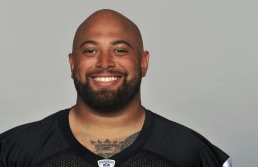
JACKSONVILLE, Fla. (AP) — Jail records show that Kansas City Chiefs defensive tackle Roy Miller has been arrested in Florida on a domestic battery charge.
The records show Miller was jailed shortly before 5 a.m. Saturday by the Jacksonville Sheriff’s Office. There are no details immediately available about the alleged battery or who was involved. The records do show that it involved a minor injury.
Court records show Miller has an initial appearance before a judge later Saturday. The records do not show whether he has a lawyer.
Miller, 30, played for the Jacksonville Jaguars from 2013 to 2017, when he signed with the Chiefs. The 6-foot-1, 320-pound lineman was originally drafted by the Tampa Bay Buccaneers in 2009 out of the University of Texas.
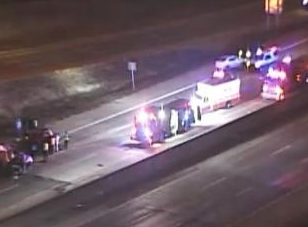
KANSAS CITY (AP) – Kansas City police say two people were killed and another was injured in a wrong-way collision on an interstate in Kansas City.
Police say the accident happened early Saturday when a car was driving south in the northbound lanes of interstate 49. The car collided head-on with a Jeep.
The driver and a passenger in the Jeep died. The driver of the car is hospitalized in critical condition.
The two people in the Jeep were a 31-year-old man and a 29-year-old woman, both from Kansas City.
COLUMBIA, Mo. (AP) – Conservationists and lawmakers dissatisfied with Missouri’s anti-poaching laws believe the current fines and penalties do little to prevent the act.
The Columbia Missourian reports that Missouri’s fines cover a range of wildlife code violations, from importing a live prohibited species into the state to taking a deer from a public roadway. No fines exceed $300 plus court costs, a factor that supporters of stiffer penalties believe leads to a large number of poaching cases.
Conservation agents have detected a total of nearly 74,000 wildlife code violations over the last three years while on patrol. Agents say that of those violations, they’ve taken action on less than 22,000.
Some lawmakers have tried passing legislation to increase poaching fines but failed. One lawmaker says he plans to re-file a bill in January.



 A “Howliday” shopping event on Sunday will raise funds for the Friends of the St. Joseph Animal Shelter.



 The Missouri Department of Transportation reminds motorists to move over for any vehicle with flashing lights on the highway during Traffic Incident Response Awareness Week.