WASHINGTON (AP) — The Obama administration says it’s making progress trying to correct a tax-form error that affected 820,000 customers of HealthCare.gov.
Administration officials said Friday that 740,000 corrected forms have gone out, and another 80,000 will be mailed next week.
The issue involves a new government form called a 1095-A.
It’s like a W-2 form for health care for people who got subsidized private insurance under President Barack Obama’s law. Consumers who got health insurance tax credits need the information on the 1095-A to file their taxes.
Last month, federal officials said more than 800,000 consumers had gotten the wrong details on premiums.
HealthCare.gov CEO Kevin Counihan says some customers may still have other errors on their forms, like the wrong coverage dates. He’s urging them to call
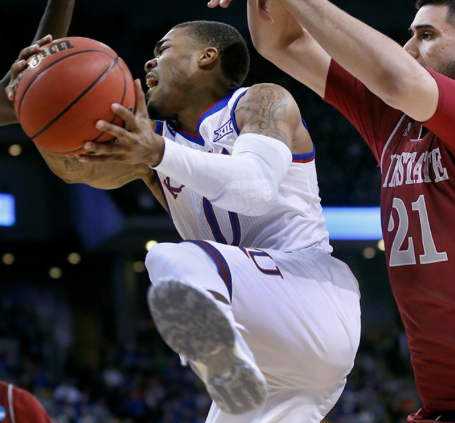
Frank Mason led the Jayhawks with 17 points- Univ. of Kan. Athletics
University of Kansas Athletics
OMAHA, Neb. — Jamari Traylor’s breakaway dunk made for a memorable moment, but the biggest statement came from behind the arc. No. 2-seed Kansas unleashed the three-point brigade to defeat No. 15-seed New Mexico State, 75-56, in the NCAA Tournament Second Round Friday morning inside CenturyLink Center Omaha.
Kansas (27-8, 13-5 Big 12) met with a New Mexico (23-11, 13-1 WAC) squad that did not reflect a traditional 15 seed. In fact, it was the lowest seeding for NMSU in school history, the previous low (No. 14) coming in 1999. The Aggies were making their fourth-straight NCAA Tournament appearance after four-straight Western Athletic Conference (WAC) tournament titles. A senior-laden lineup, the Aggies came in on a 13-game winning streak and were completely comfortable in the Big Dance environment.
So, the Jayhawks made them uncomfortable – specifically the sharpshooters. Kansas made a name for itself as the Big 12 Conference’s best three-point shooting team earlier this season, but fell into a lull in recent weeks. On Friday, sophomores Frank Mason III and Brannen Greene and freshmen Kelly Oubre, Jr. and Devonte’ Graham all connected on multiple threes, landing Kansas at 69.2 percent (9-for-13) for the game, the best since Nov. 27, 1996 (71.4 percent vs. Virginia).
Kansas picked apart the Aggie zone. When attacking the basket caused the defense to close in, the Jayhawks kicked the ball out for long jump shots instead. The combination was lethal. The Jayhawks put together numerous scoring runs on the offensive end and forced scoring droughts on the defensive side to finish shooting 54.0 percent (27-of-50) compared to NMSU’s 35.7 percent (20-of-56). In KU’s 26-year streak of NCAA Tournament appearances, that marks the 17th time the Jayhawks have shot 50 percent or better in its opening-round contest.
Making their first NCAA Tournament starts, Mason led the floor with 17 points while sophomore forward Landen Lucas pulled down a game-high nine rebounds. Junior forward Perry Ellis hung up nine points, while the three-point patrol – Greene, Graham and Oubre – each tallied eight points. Together, Graham and Mason’s eight combined assists totaled the assist output of the Aggies. Traylor completed his well-rounded performance with eight points, five rebounds, two assists, a block and a steal.
Seniors led the charge for the veteran Aggies. DK Eldridge led the team with 11 points, while fellow seniors Remi Barry and Tshilidzi Nephawe posted 10 points apiece in their last game together. WAC Freshman of the Year Pascal Siakam recorded eight points, eight rebounds and a game-high two blocks.
NMSU’s size played a role early. Ellis chalked up KU’s first bucket, but the Aggie big men pestered the Jayhawks down low. They altered close-range attempts, forcing Ellis and Lucas to miss under the basket. Lucas took the cue, moved a few steps back and drained a jumper to spark a 7-0 run. Just five minutes in, Kansas climbed to an 11-4 edge.
New Mexico State’s zone provided several opportunities of the like. Mason and Oubre each connected from behind the arc to build the lead. With the tone set, the Jayhawks returned to working the ball inside. Ellis and sophomore guard Wayne Selden, Jr. were game, finishing lobs from Traylor and Graham for back-to-back dunks. A three from Ellis put Kansas up by double-figures, 22-12, a trend the Jayhawks would stick with for the remainder of the day.
Graham used the zone defense as a dare, just asking him to test his three-point shot. He accepted. The first was a result of a broken play, which Lucas’ offensive rebound kept alive. The second, Graham just flat-out nailed from the top of the key. While New Mexico State suffered through seven-straight misses, Kansas piled on for its largest lead of the half, 34-16. Though another three from Barry snapped NMSU’s drought, the Jayhawks took a 36-23 margin to halftime.
Winners of 13-straight, New Mexico State wasn’t ready for its season to end. Both sides turned up the intensity: the Aggies on the press and the Jayhawks on the attack. Selden’s dunk got it started, but Traylor’s crowd-pleasing slam brought back the KU’s edge.
When NMSU drew in to protect the lane, Mason found his shooters. Selden knocked down and long two and Oubre pulled up for his second three-pointer of the game. Desperate to stop momentum, New Mexico State called a timeout down, 49-32.
When looking for an answer, a seven-footer is a good place to start. Freshman Tanveer Bhullar, a 7-3 center, checked in for four quick points to help his team chip away at the deficit. Yet, Lucas continued to step up in big spots, this time with an offensive board and the put back to reignite KU’s point production.
It worked.
Mason sank a jump shot and Greene caught fire. The sophomore shooting specialist delivered all of his eight points in a four-minute window, including a pair of three-pointers to put his team up 20, 63-43. As the five-minute mark neared, Mason let another three fly to lock up the game.
WAC Coach of the Year Marvin Menzies checked his seniors and starters out of the game one-by-one, hugging each. On the other bench, AP Big 12 Coach of the Year Bill Self subbed in his walk-off reserves, leading to the first-career points for freshman Josh Pollard and KU’s last of the game. Kansas advanced with the 75-56 win.
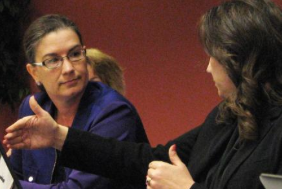
Photo by Dave Ranney Kari Bruffett, secretary of the Kansas Department for Aging and Disability Services, discusses potential changes to state regulation of prescription mental health drugs. At right is Amy Campbell, director of the Kansas Mental Health Coalition. –
By Dave Ranney
TOPEKA – State officials say they’ve reached an agreement with mental health providers for regulating Medicaid patients’ access to antipsychotic medications. “We are all working toward a common goal: Providing safe access to mental health drugs for those who need them,” Kansas Department of Health and Environment Secretary Susan Mosier said in a prepared statement Wednesday.
Kansas Department for Aging and Disability Services Secretary Kari Bruffett and Kyle Kessler, executive director for the Association of Community Mental Health Centers of Kansas, expressed similar support for the measure.
“I think this is a positive step forward in improving and expanding upon sound mental health drug prescribing practices,” Kessler said.
Under the agreement, a nine-member panel of hands-on mental health practitioners – psychiatrists and pharmacists, primarily — will be charged with developing evidence-based guidelines for prescribing antipsychotic medications. The advisory committee will spell out the circumstances under which KDHE, the state’s Medicaid agency, and the Drug Utilization Review Board can intervene in prescribing decisions.
Currently, Kansas law guarantees Medicaid patients ready access to whatever mental health drugs their physicians or psychiatrists see fit to prescribe.
Kessler and several mental health center directors last month testified against a KDHE-introduced measure, Senate Bill 123, that would have repealed the guarantee. Opponents of the bill said delaying or depriving patients’ access to medications could put them and others in their communities at risk.
KDHE and KDADS insisted the repeal would reduce the risk to patients, children in particular. They cited reports that documented instances of providers prescribing adult antipsychotics to children. The agencies said tighter regulation of behavioral health drugs could also save KanCare – the state’s Medicaid program — more than $7 million.
The Senate Public Health and Welfare Committee endorsed the bill but it stalled in the full Senate. The committee revived the bill on Wednesday using a complicated set of procedural maneuvers. The compromise language and parts of the original bill are now folded into a new bill, – Senate Substitute for House Bill 2149.
The full Senate is expected to vote on the compromise proposal next week, after which, assuming it passes, it will be sent to the House. Compromise a surprise to some The Wednesday vote caught many mental health advocates off-guard. “We were surprised that statutory language got dropped into committee yesterday,” said Amy Campbell, executive director for the Kansas Mental Health Coalition.
Even so, Campbell said, the coalition is cautiously supportive of the compromise. “We feel like what’s being proposed is an improvement over the original (SB) 123,” Campbell said. “But we continue to communicate with the agencies (KDADS and KDHE) to get some questions answered.
There are some things we’d like to see formalized.” Under the compromise, patients whose drug regimens are currently considered effective will not be altered. The advisory committee will be chaired by the KDHE secretary or a designee.
Its membership will include two psychiatrists nominated by the Kansas Psychiatric Society, two psychiatrists nominated by the association of community mental health centers of Kansas, two pharmacists nominated by the Kansas Pharmacy Association; one physician nominated by the Kansas Medical Society; and one advanced practice registered nurse nominated by the Kansas State Nurses Association.
The nominee will be selected by the KDHE secretary. At least one of the psychiatrists must specialize in treating children; another in caring for the elderly.
“The hope now is that this committee’s representation will be broad enough to cover the concern of all our constituencies and patients.” said Dr. Eric Atwood, a psychiatrist and medical director at Family Service & Guidance Center, Topeka. If KDHE and KDADS “are approaching this in good faith and if the spirit of this is to ensure safety, I think this can be a workable process,” Atwood said.
The compromise bill requires that the advisory committee meet at least four times a year. Consumer representation absent from committee Rick Cagan, executive director for the Kansas chapter of the National Alliance on Mental Illness, said his consumer constituents are noticeably absent from the proposed advisory committee. “No one consulted us,” Cagan said. “At this point, it looks as though there won’t be a consumer on the committee.
That’s a disappointment, but there don’t appear to be any representatives from the managed care companies on there either.”
Three private managed care companies operate the KanCare program for the state. Cagan said he remains troubled by KDADS and KDHE’s assertion that regulating access to mental health drugs will save millions of dollars. “They say that,” he said, “but that’s not been substantiated and I don’t see it happening.”
Dave Ranney is a reporter for Heartland Health Monitor, a news collaboration focusing on health issues and their impact in Missouri and Kansas.
TOPEKA, Kan. (AP) — A Kansas House committee has rejected a proposed ban on using multistate Common Core academic standards in the state’s public schools.
The Education Committee on Friday voted 10-7 against a bill preventing any school district or official from giving “any measure of control” over academic standards to any group outside Kansas.
Common Core foes split Friday over whether to pursue softer language for the bill to help it advance.
The State Board of Education in 2010 adopted Common Core standards for reading and math developed by the National Governors Association and education associations. Supporters see them as rigorous standards emphasizing critical thinking.
The standards have been strongly criticized over changes in how material is taught, but opponents haven’t been able to get a ban through the Legislature.
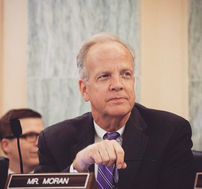
WASHINGTON – On Thursday, U.S. Senators Jerry Moran (R-Kan.), Joe Manchin (D-W.Va.) and Shelley Moore Capito (R-W.Va.) introduced The Financial Institutions Examination Fairness and Reform Act (S. 774). The bipartisan legislation would reform the examination process for financial institutions by requiring regulatory agencies to issue examination determinations promptly, as well as give banks and other supervised financial institutions the right to have those determinations reviewed.
“I am proud to introduce the bipartisan Financial Institutions Examination Fairness Reform Act to provide much-needed changes to the financial institution examination process,” Sen. Moran said. “The legislation allows for independent review and promotes greater uniformity among the various regulators. By improving the examination process, banks and credit unions can better serve their local customers and contribute to economic growth in their communities.”
“An effective and fair examination process of financial institutions is vital to the health of our banking system and is beneficial to the consumers it serves,” Sen. Manchin said. “This commonsense legislation would make sure that any bank or financial institution that undergoes a supervisory exam is allowed to have an impartial third party also review the exam findings before agencies can take action against that company. This independent review would not only strengthen transparency and openness during the review process, but it would also promote greater uniformity among the various regulatory agencies and impose much-needed accountability on those agencies.”
“By creating a reasonable process for financial institutions to appeal examination reports, our community banks and credit unions will have the clarity they need to provide small businesses with loans, spur investment and create jobs. Our economy needs certainty and confidence, and this bipartisan legislation puts us on the right track to achieve those goals,” said Sen. Capito.
Specifically, S. 774 would:
Impose reasonable limits on examiners to provide their conclusions to the institutions they examine and to make available upon request the information relied upon for those determinations;
Establish an independent examination review director. This individual would be retained by the Federal Financial Examinations Institution Council and would be authorized to address examination complaints and review examination procedures; and
Provide financial institutions with the right to seek review of supervisory determinations with the Independent Examination Review Director. The legislation authorizes the director to review the examination record and – at the institution’s request – direct an evidentiary hearing to enable the director to decide whether the agency’s examination determination shall be upheld.
The Financial Institutions Examination Fairness and Reform Act also incorporates important safeguards to ensure that financial institutions will not abuse the review process to delay or evade appropriate supervisory action. An institution can seek review of an agency determination only if the determination is significant – such as a rating downgrade, imposition of a “matter requiring attention,” or suspension of the institution’s ability to open new bank branches or engage in other significant transactions. The review process also incorporates strict time limits. Finally, S. 774 will not prevent a regulatory agency from imposing supervisory restrictions on an institution or pursuing administrative enforcement of agency rules and regulations.
The bill is also cosponsored by U.S. Senators Rob Portman (R-Ohio), Kelly Ayotte (R-N.H.) and Steve Daines (R-Mont.). The bill is supported by the American Bankers Association (ABA), Credit Union National Association (CUNA), National Association of Federal Credit Unions (NAFCU), and the Independent Community Bankers of America (ICBA).
KANSAS CITY- A Kansas man was injured in an accident just before 8:30 a.m. on Friday in Wyandotte County.
The Kansas Highway Patrol reported a 2008 Yamaha motorcycle driven by Garet A. Kraft, 22, Leavenworth, was southbound in the number 1 lane on U.S.73. just north of Polfer Road in Kansas City.
The driver realized he was not going to get stopped in time and laid the bike onto its side.
According to the KHP Kraft was transported to St. Johns and was not wearing a safety device.
Hugo UmphreyAn endangered person alert for a Cameron man has been cancelled. The Cameron Police Department says 76-year-old Hugo Umphrey has been located safely in Michigan.
On Tuesday, Mr Umphrey was expected to drive from Michigan to Cameron, but never showed up. A Silver Alert was issued, warning that the man had no GPS or cell phone and was believed to be off his medications for Alzheimer’s and Diabetes.
Authorities canceled the alert Thursday night after Umphrey was found safe in Michigan.
TOPEKA, Kan. (AP) — School districts suing Kansas over education funding are asking the Kansas Supreme Court to keep their entire lawsuit before a lower court.
Attorneys for the four districts asked the Supreme Court on Thursday to reject the state’s appeal of a recent decision from a three-judge Shawnee County District Court panel.
The panel ruled in December that the state must boost its annual spending on public schools by at least $548 million.
Attorney General Derek Schmidt asked the panel to reconsider, but it refused on March 11. Schmidt notified the panel that he would appeal.
The lower-court panel still is considering whether the state distributes its aid fairly among districts.
The aggrieved districts said the Supreme Court should have the lower-court panel finish with the entire case before considering any appeals.
TOPEKA, Kan. (AP) — Kansas universities would be required to publicize information on their graduates’ average salaries, student loan debt and employment under a bill passed by the Senate.
The bill passed the chamber on a 27-11 vote Thursday.
Supporters say the measure would help prospective students make informed decisions on which university and major to choose by requiring institutions to provide them a “prospectus.” The information would compare the average economic outcomes of their graduates from each degree track.
Republican Sen. Julia Lynn from Olathe said graduates today face higher education costs and a tougher job market and not all incoming students are aware of the realities.
But other senators balked at the potential cost of up to $5.5 million annually and said broader research on such subjects is already available.
TOPEKA, Kan. (AP) — Kansas has ordered drilling operations in two counties to cut back on a practice that may be causing earthquakes.
The Kansas Corporation Commission issued the order Thursday. It requires drillers in five areas in Harper and Sumner counties in south-central Kansas to reduce the amount of water they inject into underground wells as a part of their businesses.
The process is commonly part of the hydraulic fracking technique used to reach previously inaccessible oil and gas deposits.
More than 200 earthquakes have been recorded in Kansas since 2013 in an unprecedented spike in seismic activity. Many have been in the two counties.
Interim Director Rex Buchanan of the Kansas Geological Survey has said there is a strong correlation between the injection-well process and the dramatic increase in earthquakes.

 WASHINGTON (AP) — The Obama administration says it’s making progress trying to correct a tax-form error that affected 820,000 customers of HealthCare.gov.