TOPEKA, Kan. (AP) — A Kansas House committee has tabled a bill that would end a tuition break at state colleges for some young immigrants living in the state illegally.
The Education Committee’s 10-8 vote Thursday showed that Republicans who control the panel are split on immigration issues. The bill appears unlikely to advance this year.
A 2004 law allows high school graduates who came to the U.S. illegally to pay the lower tuition rates at state universities, community colleges and technical colleges normally reserved for legal residents.
About 650 higher education students enrolled in fall 2014 under the law. Committee members amended the bill to apply starting with 2018 high school graduates.
Supporters of the law say the young students are an asset. Critics of the law say it encourages illegal immigration.
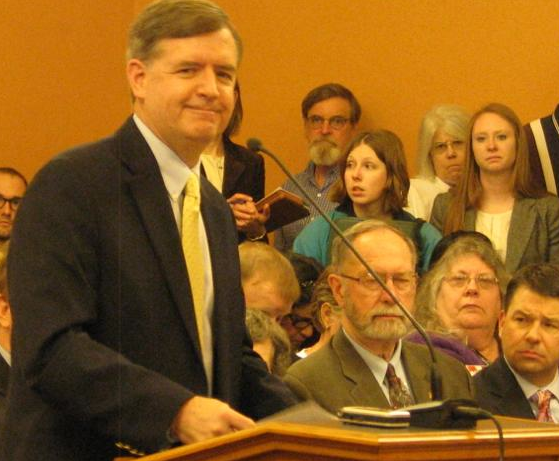
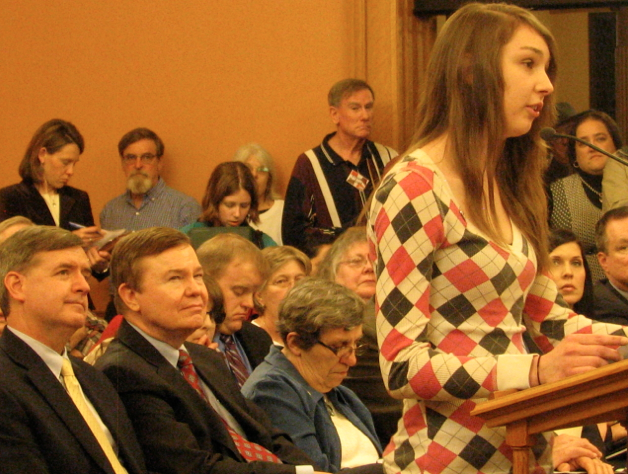
Photo by Dave Ranney Robert Moser, former secretary of the Kansas Department of Health and Environment, testifies for Medicaid expansion Wednesday.
By ANDY MARSO
Robert Moser, who until December was the secretary of the Kansas Department of Health and Environment, headlined a long list of Kansans asking legislators Wednesday to expand Medicaid.
In a long-awaited and much-anticipated hearing in the House Health and Human Services Committee, Moser urged legislators to look past dissatisfaction with the federal Affordable Care Act (ACA) and consider the practical implications of continuing to refuse expansion and the federal dollars that come with it.
“Expansion is critical for Kansas,” Moser said. “Our providers need it. Our people need it.” Wednesday’s hearing concerned House Bill 2319, which would compel Gov.
Sam Brownback and KDHE to develop an expansion plan and negotiate with federal officials for its approval. Proponents of the bill testified Wednesday and opponents were scheduled to testify Thursday.
Wednesday’s hearing brought a standing-room only crowd that spilled out to the hallway of the Statehouse’s fifth floor, where custodial staff brought in extra chairs to accommodate the overflow.
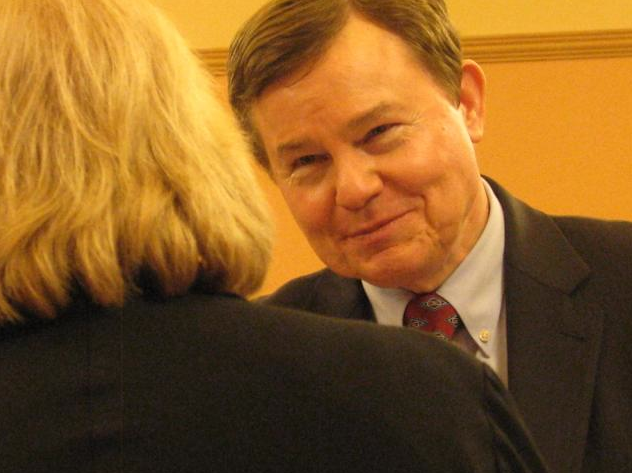
Photo by Dave Ranney Steve Kelly, president and CEO of Newton Medical Center, talks with Concannon after Wednesday’s hearing. –
Testimony in favor of expansion came from more than 150 health care providers, business organizations, religious leaders and activists like Finn Bullers, a Prairie Village man with muscular dystrophy , and Marcillene Dover, a Wichita State University student recently diagnosed with multiple sclerosis.
Dover said there was a delay in getting her symptoms diagnosed correctly because she did not have insurance and could not afford an MRI. “I thought ‘No way, not me, I don’t have a disease. I’m 21, in the prime of my life,’” Dover said. “I didn’t have insurance.
Just to get diagnosed would be extremely expensive.” Dover gets her expensive medications and neurological treatments through a patchwork of charity and public health groups.
She asked the committee to think about others who are uninsured and don’t have those connections. “No one should have to go through receiving a devastating diagnosis and then feel further devastation having to figure out how they’re going to pay for the health care they need,” Dover said.
A binder with hundreds of pages of written testimony was compiled by the Kansas Hospital Association, the organization that has taken a leading role in pushing for expansion because of its financial benefits to the state’s hospitals.
The ACA cut Medicare payments to hospitals on the assumption that expansion of Medicaid would make up the lost revenue. But the 2012 U.S. Supreme Court decision upholding the ACA also said that states could opt out of expansion, and about half the states — all controlled by Republican legislatures — have done so. Kansas’ privatized Medicaid program, KanCare, covers about 425,000 children and low-income, disabled and elderly adults.
But that number includes relatively few non-disabled adults. Adults with dependent children can participate in KanCare, but only if they have incomes below 33 percent of the federal poverty level, or a little more than $8,000 annually for a family of four.
Adults without children aren’t eligible for coverage no matter how poor they are. Expansion would make all Kansans with incomes up to 138 percent of poverty eligible for KanCare. The eligibility cap would be set at annual income of $16,105 for an individual and $32,913 for a family of four. Estimates vary, but it’s thought Medicaid expansion would extend coverage to between 140,000 and 170,000 Kansans.
“With one stroke, you could reduce the number of uninsured in this state almost by half,” Jerry Slaughter, executive director of the Kansas Medical Society, told legislators.
Recently, some Republican governors have negotiated with the federal government for expansion plans intended to allay conservatives’ concerns about cost and government growth.
Tom Bell, president and CEO of the Kansas Hospital Association, said HB2319 gave the Brownback administration the opportunity to do the same. “This is a way to build on the current privatized Medicaid program in a way that supports the economy, in a way that’s fiscally responsible, in a way that promotes personal responsibility and in a way that provides person-centered care for thousands of people who do not have it,” Bell said.
The hospital association released a study in 2013 that found accepting expansion and its federal dollars would spur $3 billion in economic growth and 4,000 new jobs by 2020. Rep. Jim Kelly, a conservative Republican from Independence, said Medicaid expansion was not “high on his list” of things to do, until he started hearing from hospitals in his mostly rural district that are struggling mightily.
“We have one very stressed hospital,” Kelly said. “We have another that’s probably not at the same level but certainly not good.” Kelly said he’s concerned about facilities closing in part because of the failure to expand Medicaid.
Photo by Dave Ranney Steve Kelly, president and CEO of Newton Medical Center, talks with Concannon after Wednesday’s hearing.
Brownback and legislative leadership have thus far made no move to expand Medicaid, but Moser said Wednesday that now is the time. Moser, a physician, now heads a heart attack and stroke unit at the University of Kansas Hospital. He said the hospital had lost about $10 million in Medicare reimbursements per year since the ACA passed and is now absorbing about $60 million per year in uncompensated care.
“Not all of that is charity care, but with the KanCare expansion model being proposed, we believe we can cut charity care costs by 30 percent,” Moser said.
Moser said that while he was speaking on behalf of KU Hospital, his support for expansion “goes beyond hospital interests.” As one of the architects of KanCare, Moser said the program was increasing primary care for those on Medicaid, keeping them out of emergency rooms and improving their health at lower costs. He emphasized that expansion would help Kansas’ working poor.
“The vast majority of those in the expansion population are hard-working people, some working multiple jobs,” Moser said. “The trouble is, they are not benefits-eligible at any of those jobs.”
Andy Marso is a reporter for Heartland Health Monitor, a news collaboration focusing on health issues and their impact in Missouri and Kansas.
TOPEKA, Kan. (AP) — A Kansas House panel has approved a process for establishing a greenhouse gas reduction plan.
The House Energy and Environment Committee approved the measure Thursday.
The Environmental Protection Agency has directed all states to develop stricter emissions standards by June 2016. States without a suitable plan will have federal regulations imposed upon them.
The EPA estimates Kansas would have to cut emissions 23 percent from 2012 levels by 2030.
The Kansas Department of Health and Environment would have the power to develop an emissions plan under the bill and the Legislature’s energy committees would be required to approve or reject it.
Environmental advocacy lobbyist Rabbi Moti Rieber said he generally supports the measure because alternative proposals might have caused Kansas to miss the deadline and face a federal plan.
TOPEKA, Kan. (AP) — A Kansas Senate committee has approved a proposed $15.5 billion state budget that would not balance without tax increases.
The Ways and Means Committee’s 9-2 vote Thursday was part of a crowded legislative agenda. The Senate Commerce Committee also approved a bill limiting collective bargaining between state agencies and public employee unions.
The budget plan and the bargaining bill go next to the Senate.
Lawmakers must close a projected budget shortfall of nearly $600 million for the fiscal year beginning July 1 that arose after they cut personal income taxes in 2012 and 2013 at Republican Gov. Sam Brownback’s urging to stimulate the economy.
The proposed budget trims overall spending slightly for the fiscal year beginning July 1 but still would require tax increases of more than $200 million.
The NCAA is going all in on high-def video reviews during March Madness.
For the men’s and women’s basketball tournaments that begin this week, the NCAA for the first time will use a replay system that captures live high-definition video from multiple angles for immediate review. That means officials will be able to see much more quickly some of the same replays everyone is seeing on TV — and just maybe some of those delays to get a call right won’t be so long.
Kim Jackson is director of basketball operations for DVSport, the system’s developer. He says the goal is to avoid changing the momentum of the game.
With the DVSport system already used by several leagues during the season, game officials generally have instant access to the main TV feed and three other angles.
KANSAS CITY, Kan. (AP) — KANSAS CITY, Kan. (AP) — A Lawrence, Kansas, contractor and five other people have been indicted in connection with an alleged scheme to unlawfully pay drywall workers who are illegal immigrants.
U.S. Attorney Barry Grissom announced the indictments during a news conference Thursday in Kansas City, Kansas.
The indictment alleges that as part of the scheme, more than $13 million in payroll checks was converted into cash to pay crews.
TOPEKA, Kan. (AP) — A Kansas Senate committee has approved a bill to limit bargaining between state agencies and public employee unions and to prevent such unions from collecting dues through paycheck deductions.
The bill endorsed by the Commerce Committee on a voice vote Thursday also would keep state and local agencies and school districts from making many other paycheck deductions. The list includes contributions to charities such as the United Way.
The proposal originally would have barred only deductions for union dues, but committee members said it’s fairer not to single out unions.
The bill would limit collective bargaining between state agencies and employees to minimum wages.
Supporters say the bill protects taxpayers. Critics see it as an attack on unions.
TOPEKA, Kan. (AP) — A Kansas House panel has endorsed a resolution that would begin a process for amending the U.S. Constitution.
The House Federal and State Affairs Committee approved the resolution Thursday. It calls on the U.S. Congress to organize a convention of states that would consider amendments to the U.S. Constitution. Thirty-three other state legislatures would have to pass similar legislation for Congress to act.
The resolution says it aims to restrict federal fiscal policy, limit the federal government’s powers and shorten terms of office for federal officials. It must be passed by a two-thirds majority in each chamber of the state legislature.
Republican Rep. Stephanie Clayton from Overland Park said she is interested in requiring the federal government to pass balanced budgets but worries that the movement could lose focus.
HUTCHINSON, Kan. (AP) — A controversial plan to divert Missouri River water from northeast Kansas to western Kansas is unlikely to happen.
Tracy Streeter, executive director of the Kansas Water Office, says the proposed aqueduct from Doniphan County to Utica in western Kansas isn’t feasible because of the estimated $18 billion cost to build it and another $1 billion to operate it every year. Streeter told The Hutchinson News Monday that the water office has no plans to take the proposal further.
The proposal met strong resistance from northeast Kansas and Missouri officials.
However, aqueduct supporters in water-starved southwest Kansas aren’t giving up on some type of water transfer. The Southwest Kansas Groundwater Management District No. 3 has commissioned a $20,000 study of the economic impact if the aqueduct isn’t built.
A bill that would change the Saint Joseph School Board has cleared the state legislature. House Bill 63 would reduce board terms to 3 years from the current 6, and would reduce the number of signatures required to run for school board from 750 to 0. It would also prevent the superintendent of schools from running for the board of that district.
State Representative Delus Johnson of Saint Joseph presented the bill, which has passed both the House and Senate and now goes to the Governor. It contains an emergency clause so it would go into effect immediately when the Governor signs it.

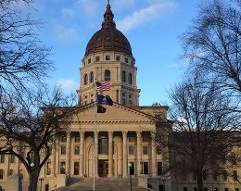 TOPEKA, Kan. (AP) — A Kansas House committee has tabled a bill that would end a tuition break at state colleges for some young immigrants living in the state illegally.