We have a brand new updated website! Click here to check it out!

Kan. Senate continues discussion of concealed handguns without a permit

conceal and carry 2By Amelia Arvesen
KU Statehouse Wire Service

TOPEKA — It is a constitutional right for people to carry a concealed handgun without a permit, urged gun right activists Thursday when they testified in a hearing on Senate Bill 45 before legislators.

Sen. Majority Leader Terry Bruce (R-Hutchinson) the chief sponsor among 25 co-sponsors of 40 Senators, said the bill upholds the Second Amendment right to keep and bear arms.

“There truly is not a reason why you need the government’s permission to protect you or defend your family,” Bruce said.

Legislators decided last year to allow citizens to carry an open or unconcealed firearm without a permit. Bruce said passing the bill would give Kansans the freedom to carry a handgun under their clothing or in their purse if they choose.

Sen. Tom Holland (D-Baldwin City) a gun rights supporter, and David Nichols, a member of the NRA, expressed concerns with the removal of formal training administered through the current conceal-and-carry permit system.

“I don’t relish the idea of someone carrying a concealed handgun for self defense, that has as much potential of inflicting deadly force on an innocent bystander as the assailant does,” Nichols said.

John Commerford, a state liaison with the National Rifle Association, said interest in education would increase, and access to training programs in Kansas wouldn’t change.

“We try to do our best to get the word out and make access as easy as possible for people so they can acquire training if they feel they need it,” Commerford said.

Since 2007, Kansas has issued permits for concealed carry. Permits cost $132.50 and a renewal application is $25.There are approximately 75,1000 permit holders in Kansas, said Joe Neville, political director for the National Association for Gun Rights.

Bill supporters also addressed concerns of increased criminal activity. Patricia Stoneking, president of the Kansas State Rifle Association, said the government should trust citizens unless they’ve provided a reason not to be trusted.

“Every law abiding citizen has a right and there’s no prohibitive law of any kind that you can ever pass that is going to prevent a criminal from doing something criminal,” Stoneking said.

Open carry and concealed carry is legal in Arizona, Alaska, Vermont and Wyoming.

Members of the Senate’s Federal and State Affairs Committee will deliberate the bill before it moves to the Senate floor.

Amelia Arvesen is a University of Kansas senior from San Ramon, Calif., majoring in journalism.

Kansas Senate panel approves bill to ban abortion method

abortionTOPEKA, Kan. (AP) — A Kansas Senate committee has approved a proposed ban on a procedure used in 8 percent of the abortions performed in the state.

The Public Health and Welfare Committee’s voice vote Thursday sends the measure to the Senate for debate. The bill was drafted by abortion opponents who describe the targeted procedure as dismembering a fetus.

The bill would prohibit a procedure known as dilation and evacuation and designate it in state law as a “dismemberment abortion.” Doctors would not be allowed to use forceps, clamps or other similar instruments to cut up a fetus and remove it from the womb in pieces.

Abortion rights advocates say the procedure is sometimes the safest way to terminate a pregnancy and also is sometimes used during the first trimester.

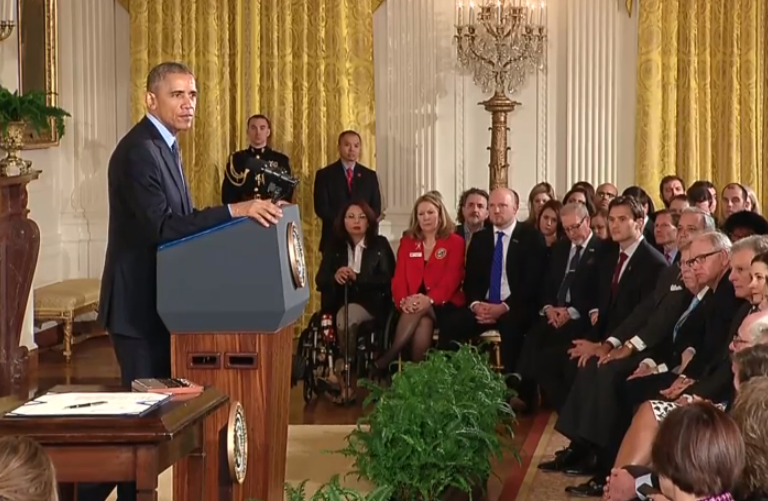
Huelskamp Joins Pres. Obama for Signing of Veterans Bill

Thursday's White House ceremony- courtesy photo
Thursday’s White House ceremony- courtesy photo

WASHINGTON – Congressman Tim Huelskamp (KS-01) will join President Barack Obama and other members of Congress at the White house for the signing ceremony of The Clay Hunt Suicide Prevention for American Veterans Act. The bill was passed by the House and the Senate without a single nay vote. A replay of the Thursday afternoon signing can be seen here (advance the video to the 18:20 mark)

“We all agree our Veterans deserve our support. Without a single nay vote, Congress and the White House have approved of a measure to address the staggering 22 veteran suicides per day. War often inflicts unseen battle scars our brave men and women then carry home with them and without professional help, these injuries often tear apart marriages and families. I am honored to join my colleagues today to commit to providing better mental health care to our Veterans when they return from the battlefield.

“I would take this opportunity to stress the need for continued accountability for those in management roles in the VA. We must improve the VA as a whole, while striving to increase Veterans’ choices for where and how they access the mental health care they

$1M winning Powerball ticket sold in Kansas

powerballTOPEKA, Kan. (AP) — A Powerball ticket sold in northeast Kansas is worth $1 million.

The Kansas Lottery said in a news release that the ticket matched all five white-ball numbers — 11, 13, 25, 39 and 54 — in Wednesday’s drawing but not the Powerball of 19.

Another ticket, sold in southwest Kansas, matched four of the first five numbers, plus the Powerball, to win a $10,000 prize.

Tickets in North Carolina, Puerto Rico and Texas matched all six numbers to split a $564.1 million jackpot. The jackpot goes back to $40 million for the next drawing, on Saturday.

Kansas senate bill would move local elections

voteBy Alyssa Scott

KU Statehouse Wire Service

TOPEKA – Traditionally, voter turnout is substantially lower during off-cycle spring elections than regular fall elections. The result is fewer people vote on city and school board issues than during presidential or mid-term elections.

According to Secretary of State Kris Kobach, between 2008-2013, local spring election voter turnout ranged from a low of 6.2 percent in Sedgwick County to a high of 56 percent in Sherman County. In comparison, fall election turnout during that same time period ranged from 37.3 percent to 85.8 percent. According to the Sedgwick County Election Office, about 67 percent of registered voters participated in fall 2012 elections.

Supporters of Senate Bill 171 said moving municipal elections to the fall of even-numbered years and making them partisan would increase voter turnout and make it more convenient for voters. Under the bill, primary party elections would occur in August prior to a November general election.

During the Senate Ethics and Elections Committee hearing Wednesday, seven bill proponents testified for more than 50 minutes as two opponents were allowed to testify in the final 15 minutes of the meeting. Committee chair Sen. Mitch Holmes (R-St. John) said additional opponent testimony will be allowed Thursday.

Clay Barker, executive director of the Kansas Republican Party, said he supports SB 171 because it is a way to encourage more people to vote in city and school board elections.

“There is a lack of citizen participation, and it’s an amazingly large amount of money to spend with very few voters’ input into it, whether it’s cities or school districts,” Barker said. “What we would like to see in this bill is aligning the spring and fall elections so all the voters turn out and they get to vote on all the positions.”

Joy Eakins, a Wichita Public Schools Board of Education member, testified on behalf of the bill, saying research shows that simply moving elections from April to November raises the participation rate by 8 to 9 percent. She said while it is important to increase voter turnout there are other parts of SB 171 she wants changed.

In addition to making municipal elections partisan and holding them in the fall, SB 171 would allow county election officers to require school districts to schedule an in-service day so that school buildings are available as polling locations during elections. Eakins said she did not support that part of the bill because taking time from schools is detrimental to students and teachers.

“You’re asking a person who has no accountability to the community (county election officer) for the education of their students or for what happens in a school day to be able to commandeer buildings that belong to students, buildings that were built by the taxpayers of our communities to educate their students,” Eakins said. “They do a great job, but they shouldn’t have a say over when school’s in session.”

Mark Tallman, associate executive director for advocacy at the Kansas Association of School Boards, opposes the bill and expressed concerns with adding partisanship into municipal elections.

“Our members have repeatedly voted that they do not favor a change in law for several reasons,” Tallman said. “We hear from local boards, and they believe we are better served by keeping education somewhat nonpartisan, even though in many cases people do know that parties can get involved.”

In a news release last week, committee chair Holmes said SB 171 would help reduce the influence teachers unions have in local elections. He said based on research, teachers unions have a majority in the current off-cycle elections because they’re able to organize while overall voter turnout is low.

“The information that we have showed that the timing of the election is the single biggest variable that affects voter turnout,” Holmes said. “There are other peripheral things that can be done, but that one by itself is the most effective.”

However, Eakins said it makes sense for teachers to be highly involved in the municipal elections.

“I can’t say to what extent they control the elections, but certainly teachers would be interested in voting because it’s something they’re passionate about, and that’s not necessarily a bad thing,” Eakins said. “It’s just who they are.”

The Senate Ethics and Elections Committee will hear from opponents of the bill when it convenes at 9:30 a.m. Thursday.

Alyssa Scott is a University of Kansas junior from Wichita majoring in journalism and French.

Home schooled St Joe student wins regional Poetry Out Loud competition

L to R: Max Schieber, Alden Willdermood and Alex Hall
Allied Arts Council announces the regional winner of the 2015 Poetry Out Loud competition.

Three students from Northwest Missouri including Alex Hall, home school, Max Schieber, Bishop LeBlond High School and Alden Willdermood from Lathrop R-II competed in the 2015 Poetry Out Loud Northwest Regional Finals hosted by the Allied Arts Council on February 11, 2015.

Homeschooler Alex Hall from St. Joseph was the regional champion, and the first runner-up was Alden Willdermood from Lathrop R-II. Hall will advance to the state finals March 12, 2015 in Jefferson City, Missouri.

Judges Cathy Ketter, Jolene Dempster, David George and Cheryl Wood presided over the competition and evaluated student performance on criteria including physical presence, evidence of understanding, level of difficulty, and accuracy.

Poetry Out Loud is a national arts education program that encourages the study of great poetry by offering educational materials and a dynamic recitation competition to high schools across the country. Poetry Out Loud uses a pyramid structure. Beginning at the school level, winners advance to a regional competition, then to a state competition, and ultimately to the National Finals in Washington, DC.

The competition was presented by the Allied Arts Council in partnership with the National Endowment for the Arts, the Poetry Foundation, the Missouri Arts Council and Missouri Association of Community Arts Agencies.

AGs hope to convince oil companies to crack down on K2

Kansas AG Derek Schmidt
The Attorneys General in Missouri and Kansas are among the prosecutors asking oil companies to help stop the spread of synthetic drugs.

“Synthetic drugs are a dangerous and illegal attempt to use chemistry to stay one step ahead of the law,” said Kansas AG Derek Schmidt. “They should not be given the cloak of legitimacy or safety by well-known brand name stores. Young Kansans are particularly vulnerable to marketing of these harmful products, which is why we are asking these reputable companies to make sure these products are not being sold on their shelves.”

Synthetic drugs are chemical alternatives to cocaine, marijuana and methamphetamine. They are illegal and are often just as dangerous, if not more so, than the substances they mimic. Manufacturers of synthetic drugs seek to evade state and federal law by creating chemical compounds not yet specifically regulated or prohibited in the United States. In recent years, State and federal law enforcement authorities have cracked down on synthetic drug sales in Kansas, including products commonly known as “K2” and synthetic marijuana.

In the letter sent to British Petroleum, Chevron Corporation, Citgo Petroleum Corporation, Exxon Mobil Corporation, Marathon Petroleum Corporation, Phillips 66, Shell Oil Company, Sunoco, and Valero Energy Corporation, the 43 attorneys general expressed concern that gas stations and convenience stores operating under brand names of reputable oil companies are selling illegal and extremely dangerous synthetic drugs, such as K2. The group urged the oil companies to enact stronger policies against the sale of synthetic drugs in retail locations to protect the public, particularly young people.

Attorneys general from the following states and territories signed onto the letter: Alabama, Arizona, Colorado, Connecticut, Delaware, District of Columbia, Florida, Georgia, Hawaii, Idaho, Illinois, Indiana, Iowa, Kansas, Kentucky, Louisiana, Maine, Maryland, Massachusetts, Michigan, Minnesota, Mississippi, Missouri, Montana, Nebraska, Nevada, New Hampshire, New Mexico, North Carolina, North Dakota, Northern Mariana Islands, Oregon, Pennsylvania, Puerto Rico, Rhode Island, South Carolina, South Dakota, Utah, Vermont, Virginia, Washington, West Virginia, and Wisconsin.

Your electric bill is going up March 1

MO PSC SEALSt Joe electric customers of KCP&L will pay an additional 94 cents per month under an order announced this week by the Missouri Public Service Commission.

The commission has approved a request to change the fuel adjustment charge (FAC) for fuel and purchased power costs during the six month period June 2014 through November 2014. The change in the FAC will take effect on March 1, 2015.

Customers in the utility’s Kansas City service territory will pay an additional $1.88 per month.

The FAC allows the company to recover most – up to 95 percent – of its costs, but not all, to encourage conservation and prudence in fuel use by the company. Any charges resulting from the fuel adjustment clause must appear in a separate category on customers’ bills. Fuel adjustment charges are intended to help companies deal with volatility in fuel pricing. The FAC tariff requires regular adjustments to reflect changes in prices the company has incurred for fuel and for wholesale power purchased to serve customers.

The electric company provides service to approximately 314,900 customers in Missouri.

Another blow for embattled power-line project

power linesThe embattled Clean Line Energy project that proposes to transport energy from rural America to the heavily populated Eastern Seaboard has had a series of major setbacks.

In Missouri, the PSC’s own staff, which is made up of engineers, utility economists, and attorneys advised the Commissioners to deny the application.

On February 11th the commission took the unusual step of ordering Clean Line to submit a lot of documentation.

Among many requirements laid out by PSC staff were a requirement that Grain Belt Express “set forth the status of its efforts to obtain the assent of the county commissions” required under state law in the eight counties crossed by the selected project route in Missouri. They are also required to provide supporting documentation, including any letters of assent from those eight county commissions.

In their Conclusions of Law brief, PSC staff stated, “Grain Belt Express has not shown electricity delivered over its high-voltage transmission line and converter stations will be lower cost than alternatives for meeting renewable portfolio standards and general demand for clean energy because it overlooks significant costs affecting the integration of wind energy in its production cost modeling and its modeling inputs are insufficient to predict electricity prices at specific locations.” and recommended that “The Commission finds that Grain Belt Express’ HVDC transmission line project is not needed in Missouri.”

Five of the eight impacted counties have rescinded support they had previously given Grain Belt. Given that the local sentiment against Grain Belt tends to be very high, and that nearly 2,000 people turned out at the eight public hearings opposed to the project, it seems unlikely that they would be able to secure the needed county assent.

Additionally, Clean Line is running into many roadblocks with its Plains and Eastern project in Oklahoma, Arkansas and Tennessee. Clean Line hopes to be the first company to utilize Section 1222 of the 2005 U.S. Energy Policy Act to obtain federal eminent domain after they were denied eminent domain authority by the state of Arkansas. This provision would authorize DoE to essentially act as a land agent for the private company and use the government’s power of eminent domain to condemn the private property in its path.

Recently the Cherokee Nation and several county boards passed resolutions against Plains and Eastern Clean Line obtaining federal eminent domain authority. Earlier this week, the Arkansas House Joint Energy Committee unanimously passed a resolution to send a letter to the Department of Energy condemning Clean Line’s use of Section 1222. Arkansas’ congressional delegation has also been seeking answers from the DOE in Washington, and were instrumental in extending the public comment deadline on the project’s federal environmental impact statement an additional 30 days.

Clean Line is also facing major problems for their Rock Island Project in Illinois and Iowa. The Illinois Commerce Commission voted unanimously to withhold eminent domain authority at this time. In Iowa, where Clean Line recently filed franchise applications, they have been met with fierce resistance and an organized opposition group who is taking their fight to the state capital building.

Jennifer Gatrel from Block Grain Belt Express Missouri states, “Overall the idea that a private company could seize privately-held agricultural land for its own private benefit is just wrong. Clean Line has brought together a vast group of very different individuals from around the country working united on the common goal of protecting landowner rights. This company has brought a major disruption to our community and much time and money has been lost. Clean Line’s proposals have also created an enormous, tightly-knit family formed in reaction to the crisis. We will not lose this fight!!”

Car crashes into house; man arrested for DWI

Ashley Daniel
Ashley Daniel
Chillicothe police arrested a man for driving while intoxicated after he allegedly rammed his car into a house at high speeds. Police say there were 100 feet of skid marks leading to the house.

Ashley Blue Daniel was charged this week with DWI and possession of a controlled substance. Prosecutors in Livingston County also filed charges against Daniel for allegedly leaving the scene of another accident nearly two years ago.

Daniel is being held at the Daviess-DeKalb Regional Jail.

Copyright Eagle Radio | FCC Public Files | EEO Public File