NEW YORK (AP) — It’s about to get easier to compare prices at some big online stores.
New York’s attorney general says Costco, CVS, FreshDirect, Wal-Mart and Walgreen have agreed to list unit prices on their websites and mobile apps soon.
A unit price tells consumers how much a product costs by each unit of weight. It divides the full price of the item by the size of its packaging. For example, a 16 ounce bottle of shampoo costing $5.99 would have a unit price of 37 cents per ounce. Because the same product can be sold in several different sizes, a unit price is a better way to compare whether a giant box of cereal is really a good deal compared to a smaller one.
Unit prices are already listed in physical stores.
TOPEKA, Kan. (AP) — The 61-year-old former city clerk of a northeast Kansas community has been released without bond, but ordered to refrain from gambling.
The Topeka Capital-Journal reports that former Auburn city clerk Alice Riley on Tuesday was granted a pre-trial release without bond with a few conditions, including that she cannot gamble.
She had been city clerk for 31 years. Riley has pleaded not guilty to a federal charge of interstate transportation of stolen funds. She’s accused of embezzling at least $186,000 from Auburn between 2009 and 2014. Auburn is a rural community of about 1,200 people in southwest Shawnee County.
Prosecutors say she used the stolen money for gambling.
Riley resigned on Feb. 13, amid questions from the city council and audits into the city’s finances.
TOPEKA, Kan. (AP) — The trial of a Topeka man charged with killing his mother has been delayed again, and is now scheduled to start next January.
Jason Hachmeister is charged with premeditated first-degree murder in the September 2011 death of his 58-year-old mother, Sheila Hachmeister. She was killed at a home she shared with her son.
The Topeka Capital-Journal reports the trial was postponed on Monday because his attorney, Mark Bennett, is involved in a complex drug case in federal court in Kansas City, Kansas.
Hachmeister’s trial was originally scheduled to start in January of this year.
A coroner has testified that Sheila Hachmeister was stabbed several times but died from strangulation.
HOWARD, Kan- A semi-truck driver was injured in an accident just after 1 a.m. on Tuesday in Elk County.
The Kansas Highway Patrol reported a 2015 Freightliner semi-truck driven by Christopher Lee Hockman, 38, La Porte, IN., was southbound on Kansas 99 two miles south of Howard.
The right side of vehicle dropped off into the west ditch. The driver over corrected causing the vehicle to go into the east ditch and overturn.
Hockman was transported to Greenwood County Hospital.
The KHP reported he was properly restrained at the time of the accident.
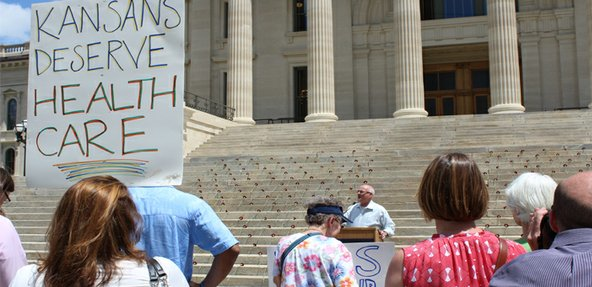
Advocates for Medicaid expansion are preparing to raise the issue again during the next legislative session. -Photo by Susie Fagan
By Jim McLean
KHI News Service
TOPEKA — It’s make-or-break time for advocates of Medicaid expansion in Kansas.
Fearing that political events may be conspiring to foreclose the opportunity to use mostly federal dollars to extend coverage to thousands of uninsured poor adults, the Kansas Hospital Association is preparing to shift its lobbying campaign into high gear.
The first step, said Tom Bell, the association’s chief executive, will be to craft an expansion proposal for lawmakers to consider in the 2015 session.
We plan to have something very specific for the Legislature to consider next year,” Bell said.
The organization spent the last two legislative sessions trying to stimulate a conversation about expansion. It bankrolled a study that projected the economic benefits of expansion and commissioned a poll that showed a majority of Kansans favored expansion. The results generated headlines but little serious discussion at the Statehouse. Republican legislative leaders refused to even schedule a hearing on a bill to authorize expansion.
“The influence of Obamacare, from a political standpoint, has made this a very difficult issue,” said Jerry Slaughter, executive director of the Kansas Medical Society.
With the Affordable Care Act still unpopular with Kansas voters – Republicans in particular – Brownback and legislative leaders opposed to the law didn’t want to discuss Medicaid expansion, fearing it would send the wrong signal to core supporters heading into the November election. So, when asked about the issue, they stuck to talking points about the ACA’s messy rollout and concerns about the federal government’s ability to shoulder the lion’s share of expansion costs into the future.
Bell acknowledged that it’s been virtually impossible to engage Gov. Sam Brownback and GOP leaders on the expansion issue. But he said he believes that could change after the election.
“We’ve had a number of people tell us that maybe after the election this is something that will be a little easier to talk about,” he said.
A ‘unique’ Kansas proposal
The legislation being drafted by the hospital association will be tailored specifically to Kansas, though it will borrow elements from so-called private sector expansion proposals in other states. Pioneered in Arkansas by a Democratic governor attempting to overcome opposition from a Republican-led legislature, the private-sector approach has been adopted by an increasing number of Republican governors seeking an alternative to expanding public coverage.
Generally, the alternative plans, which require federal approval, expand Medicaid coverage to adults earning up to 100 percent of the federal poverty level – $11,670 of annual incomes for an individual. But the plans use mostly federal Medicaid dollars to help people earning between 100 percent of FPL and 138 percent of FPL – $16,104 annually for an individual – purchase private coverage. Some of the plans also require beneficiaries to work and contribute to the cost of their coverage and care.
“Our feeling is that the (Obama) administration wants to approve state plans,” Bell said. “And we ought to get something in front of them before it’s too late.”
Brownback said recently that he is watching what is being done in other states and is open to discussing options.
“We’re watching all of it,” Brownback said. “I’m more confident today than I’ve ever been there will be other options out there.”
Anthony Hensley, the Democratic leader in the Kansas Senate, called the hospital association’s decision to come forward with an expansion plan “a very positive move.”
“I’m open to looking at their proposal,” he said.
Kansas is one of 20 states to so far reject expansion. Of the 30 remaining states, 26 have implemented some version of expansion. The issue is still being debated in the other four.
Crafting a private-sector approach in Kansas makes sense, Bell said, given that three for-profit managed care companies have essentially run the Medicaid program since it was privatized in January 2012 and renamed KanCare.
Costs becoming bigger issue
KanCare costs about $3.2 billion a year. The state is responsible for about 40 percent of that cost, about $1.3 billion.
As an inducement to states, the ACA obligates the federal government to cover 100 percent of the costs of expansion through 2015 and not less than 90 percent after that. But even at that rate, states that expand Medicaid will see their costs go up.
Brownback administration officials have estimated that expansion would cost the state an additional $1.1 billion over 10 years. About $513 million of that would go to cover new beneficiaries who were previously eligible for Medicaid but not enrolled. Approximately $600 million would be needed to cover up to 150,000 low-income adults who would be made eligible by expansion.
Any increase in cost is likely to be a barrier to expansion given the state’s emerging budget problems.
Revenue shortfalls of more than $300 million in recent months have heightened concerns about the potential for spending reductions in the coming fiscal year to maintain a balanced budget.
Anticipating the cost concerns, the hospital association is considering a number of funding options for expansion, including the possibility of raising a state assessment on hospitals.
The state uses money generated by the assessment to bolster the rates it pays to hospitals to care for Medicaid beneficiaries. That, in turn, triggers an increase in federal matching funds to the state.
The arrangement currently generates about $50 million, according the nonpartisan Kansas Legislative Research Department. Expanding Medicaid eligibility would increase the amount generated by the assessment because of the higher match rate.
Cindy Samuelson, a spokesperson for the hospital association, said dedicating the increase in assessment revenue to help offset the costs of expansion is one of the funding options being considered. Raising the assessment also is a possibility, she said. Currently, hospitals pay assessments equal to 1.83 percent of their revenue. Federal law allows for an assessment of up to 6 percent.
“There are a lot of options to consider,” Samuelson said. “Everything is on the table.”
Some conservative Republican governors are attempting to use their state provider assessments to fund expansion, including Mike Pence of Indiana and Jan Brewer of Arizona.
Brewer succeeded in getting her proposal through the Arizona Legislature, but the conservative Goldwater Institute, acting on behalf of a group of legislators and private citizens, filed a lawsuit to block its implementation.
Urgent issue for hospitals
Medicaid expansion is a critical bottom-line issue for many Kansas hospitals. Their national association supported reductions in Medicare reimbursements and other government payments believing they would be offset by ACA-driven increases in the number of patients with private coverage and Medicaid.
“Whatever your politics, the reality on the ground in hospitals is that Medicaid expansion is critically important for us,” said Jodi Schmidt, chief executive of Labette Health, a 99-bed regional hospital in the southeast Kansas community of Parsons.
Reductions in Medicare reimbursements are expected to cost Kansas hospitals $1.3 billion over 10 years. Hospitals also are facing reductions in federal payments intended to offset their cost of providing care to uninsured patients who can’t pay their bills.
A ticker on the KHA website that keeps track of how much federal money the state has foregone by not expanding Medicaid reached $155 million on Monday.
A pair of tornadoes tore through northeastern Nebraska on Monday afternoon, killing at least two people including a five-year-old child.
Stanton County Sheriff Mike Unger says the Village of Pilger was evacuated overnight, but residents were expected to be allowed back in after daybreak Tuesday to recover whatever belongings they could locate. The village took a direct hit.
A tornado was observed crossing Highway 24 just west of the city of Stanton, Nebraska at approximately 3:45pm Monday.
After the tornado passed, Sheriff Unger says his team discovered a farm house that had been destroyed. The house was also used as a daycare center. Four victims were found in the wreckage.
Unger says reports of a second tornado came in shortly thereafter. Spotters confirmed in advance that it was moving directly toward Pilger, Ne. A large part of the village and its infrastructure were leveled, including major damage to the Fire Department Building.
The Sheriff says a total of 18 patients were taken to , where the five-year-old child died. A second victim died in a vehicle in Cuming County. Several other patients were taken to hospitals outside Pilger for treatment, according to the Sheriff’s Office.
“Houses are plumb gone,” Stanton County Commissioner Jerry Weatherholt told the Associated Press. “The co-op is gone, the grain bins are gone, and it looks like almost every house in town has some damage. It’s a complete mess.”
WASHINGTON (AP) — Food companies and restaurants could soon face government pressure to make their foods less salty. It’s a long-awaited federal effort to try to prevent thousands of deaths each year from heart disease and stroke.
The Food and Drug Administration is preparing to issue voluntary guidelines asking the food industry to lower sodium levels. FDA Commissioner Margaret Hamburg says sodium is “of huge interest and concern” and she hopes the guidelines will be issued relatively soon.
The food industry has already made some reductions, and has prepared for government action since a 2010 medical journal report said companies had not made enough progress on making foods less salty.
LAWRENCE, Kan. (AP) — A new report says Lawrence faces millions of dollars in potential costs for repairing existing sidewalks and building new ones in the city that’s home to the University of Kansas.
The Lawrence Journal-World reports that city officials have completed an inventory of the community’s sidewalks. It shows that fixing all of the city’s existing sidewalks would cost about $6.1 million.
Lawrence’s city codes require new housing developments to have sidewalks on both sides of the street, but for decades the codes allowed sidewalks on one side or no sidewalks.
The report says ensuring that all residential streets have a sidewalk on at least one side would cost $7.5 million. Ensuring that every street has sidewalks on both sides would cost $42 million.
HOLT- Four people were injured in a rollover crash in Clinton County on Monday night.
The Missouri State Highway Patrol reported a 1992 Honda Accord driven by Tammy L. McMurray, 37, Cameron was northbound on Interstate 35 three miles north of Holt. The driver fell asleep and the vehicle traveled off the left side of the road into the median. The driver overcorrected, crossed the northbound lanes, traveled off the right side of the road, struck an embankment and overturned twice.
McMurray and 4 children were transported to Liberty Hospital.
HARRISONVILLE (AP) – A Kansas City man has been sentenced to life in prison for the shooting death of a popular western Missouri bar owner.
Court records show a judge on Monday also sentenced 28-year-old Reginald Singletary Jr. to 30 years for armed criminal action.
Singletary was convicted earlier of first-degree murder for the death of Blaine Whitworth, a Warrensburg businessman who was gunned down in his driveway in September 2012. Singletary had been fired as a bouncer at one of Whitworth’s bars a week before the killing.
Singletary told police that his roommate – a college student from Saudi Arabia – had paid him to kill Whitworth. But he testified at his trial that he did not commit the crime.
The roommate was jailed for nearly a year before charges against him were dropped.

 NEW YORK (AP) — It’s about to get easier to compare prices at some big online stores.