WASHINGTON, D.C. – On Tuesday, U.S. Senator Jerry Moran (R-Kan.) responded to the release of two U.S. Department of Health and Human Services’ Inspector General (IG) reports on Obamacare verification systems. The first report reviews the effectiveness of the procedures and safeguards for preventing fraudulent or inaccurate information by applicants enrolling in health plans through the Obamacare insurance Exchanges. This report finds that the Obamacare system lacks internal controls to verify information provided by individuals enrolling through Obamacare. The second report details the inconsistencies that arose as part of the haphazard enrollment process. The IG finds that most exchanges were unable to resolve the majority of inconsistencies, most often relating to income and citizenship. In particular, the federal exchange was unable to resolve 2.6 million out of 2.9 million inconsistencies as of February 2014.
“The Administration has unilaterally changed Obamacare to bend every rule it can – delayed regulations, changed the enrollment period, and given select individual and employer exemptions – to try and make the law work,” Sen. Moran said. “Once again, we are provided further evidence that Obamacare is not working. In fact, the Administration is relying on nothing more than the honor system to run a billion dollar program. Without adequate safeguards or the ability to reconcile inconsistencies in income and citizenship, the Administration is wasting millions in American taxpayers’ dollars to provide subsidies to individuals who do not actually qualify.”
Without a process in place to verify an enrollee’s income or citizenship, the Centers for Medicare and Medicaid Services, the government agency responsible for implementing Obamacare, will continue to process applications based on nothing more than the honor system. As a result, the Administration will hand out inaccurate subsidies while relying on an unproven, incomplete back-end system to recoup incorrect subsidies during the tax filing process. This disorganization will result in massive uncertainty with the Administration having to dedicate more taxpayer dollars to reclaim the incorrect subsidies from enrollees who may not have the money to pay them back. In addition, many Americans who based their insurance choice off inaccurate subsidy information may now see their premiums increase as their subsidy is reduced by the Administration.
In May, Senator Moran demanded a response from the Department of Health and Human Services about a press report stating the federal government may be paying incorrect Obamacare subsidies to more than 1 million individuals. The Department has yet to respond to the Senator’s letter.
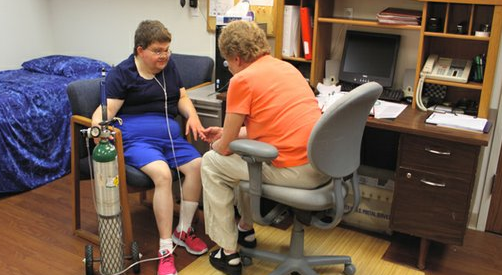
Shelley Schultz, left, a residential client of Cottonwood, Inc. in Lawrence, talks with registered nurse Pat Turmes, who works at Cottonwood’s clinic.-Photo by Mike Shields
By Mike Shields
KHI News Service
TOPEKA — Gov. Sam Brownback once called Obamacare “an abomination,” and with the federal health reform law now four years on the books bad-mouthing it has become a conservative Republican ritual.
But this week, after more than a year of planning and preparation by Kansas and federal officials, the Affordable Care Act and Brownback’s own KanCare initiative begin coming together in ways that will make the two programs indistinguishable to as many as 72,000 Kansas Medicaid beneficiaries.
Kansas officials will launch the Medicaid health homes program, which is a key but little-publicized Obamacare component, by sending letters to the thousands of potential participants informing them they will be included in it unless they opt out.
The actual services are then scheduled to begin Aug. 1.
“Lt. Gov. (Jeff) Colyer … has been very involved in this project and is very committed to it,” said Becky Ross, director of Medicaid initiatives at the Kansas Department of Health and Environment, the state’s lead Medicaid agency. “So, I think this administration is pretty supportive of it.
“It’s not a Medicaid expansion. We’re not adding more Medicaid members,” Ross said. “We’re simply trying to use this opportunity to bring some more resources to particular segments (of the Medicaid population) to make sure we get good health outcomes.”
Though federal approval of the state’s Medicaid plan amendment to enact the initiative has not yet been received, it is expected, Ross said.
More federal aid
In states that agree to adopt the system — which relies on closely managed, wraparound or integrated health services for specifically targeted, high-risk, high-cost Medicaid enrollees — the federal government will pay 90 percent of the costs for the first two years each individual is involved, versus the normal federal match to Kansas of about 57 percent.
Kansas is one of more than 25 states that have accepted the Obamacare requirements and funding, though in a way that officials say is somewhat unique because the health homes will be implemented through Medicaid managed care companies, rolled out statewide and include more target groups.
“Other states don’t have managed care programs as large as ours,” Ross said, “and so tend to operate (health homes) for populations not in managed care, or their MCOs (managed care organizations) have a minimal role.”
Ross said Iowa has a model most resembling Kansas’, but officials there only are targeting Medicaid enrollees who have serious mental illness and the services are being routed through a single health organization, Magellan.
The Kansas program will be run by the state’s three KanCare MCOs and will include not only beneficiaries with serious mental illness but eventually also those with the chronic conditions of asthma or diabetes and at risk of developing another potentially chronic malady.
“We estimate about 36,000 people are going to be eligible for the SMI (serious mental illness) health home and about 38,000 for the chronic conditions,” Ross said. “Of course, there will be some overlap.”
Ross said officials project that about 75 percent of those eligible from the two target groups would choose to stay in the program, for a total of about 55,000 Kansans. Those who opt out may remain in Medicaid.
Letters go out this week
The notification letters to those with mental illness are scheduled to go out Tuesday. Last week, KDHE officials said they also were planning to send notifications this week to those with chronic conditions. But Monday, they said they were delaying action on that until at least Jan. 1, 2015, because an adequate provider network wasn’t yet in place.
“We’re just not ready to pull the trigger yet on that part,” said Sara Belfry, an agency spokesperson. “We’ll keep working on that and re-evaluate Jan. 1.”
That is the second significant delay to the health homes program. The administration initially had planned to launch it Jan. 1 this year.
As of last week, 120 Medicaid service providers had submitted the information to KDHE indicating they wanted to take part in the program either as lead health home agencies or as subcontractors for the three managed care companies that run KanCare: Amerigroup, UnitedHealthcare and Sunflower Health Plan, a subsidiary of Centene.
Lead health homes agencies will be expected to provide each of six core services. Subcontractors might provide as few as one or two.
Still negotiating
Representatives of the KanCare MCOs and the various providers interested in participating in the program said they were still working through the contracting arrangements and negotiations, though that is being done with amendments to existing KanCare contracts as opposed to new legal agreements.
Among those expressing interest in participating so far are all the state’s community mental health centers and many of the Community Developmental Disability Organizations. Some centers for independent living and some doctor groups also want in the program.
Ross said about 19 local health departments and 13 safety net clinics also have indicated they plan to participate.
“We have enough providers to cover all 105 counties,” she said, and then some, because the state is requiring that there is a choice of at least two providers in each county for Medicaid enrollees.
Already investing
Some providers, such as the Center for Counseling and Consultation in Great Bend and The Guidance Center in Leavenworth, have made significant investments in anticipation of participating in the program. Both are community mental health centers that serve multiple counties.
“We are putting a lot of effort and investing quite a bit of resources,” said Dwight Young, executive director of the center in Great Bend. “We are establishing a service that will operate under the name of Center for Health and Wellness. A couple of months ago, I went to my board and said we need to make these investments. We don’t have any signed contracts for any of this.”
Young said the center was hiring additional staff and leasing additional building space.
“We’ve probably committed $400,000 or $500,000 in the total package that we’re going to need to recoup from the services,” he said.
Young said his organization and others across the state have concluded that many of the services they have offered fit easily within the health home model, so they might as well get reimbursed for it. But exactly how this new initiative will affect their bottom lines remains to be seen.
“Most behavioral health oriented agencies tend to think, ‘Oh, we do all that anyway; we might as well get paid for it.’ But then when the rubber hits the road … we’ll have to see how all that sorts out. We’re investing in this, and we’ll see if it generates the revenues to cover those costs and we may have to make adjustments. I guess that makes us entrepreneurs now.”
‘Treatment teams’
Keith Rickard is executive director of The Guidance Center, the community mental health center that services Leavenworth, Atchison and Jefferson counties.
“We’re putting together treatment teams as we speak,” Rickard said. “We’re ready to go soon as we have contracts.”
Rickard said the initiative is potentially a big deal for the center and has already involved hiring new people. He estimated there might be as many as 2,000 Medicaid enrollees in the center’s service area that could qualify for health home services, which could lead to the center’s growth.
“This could add 10 to 25 additional staff and $1 million to $2 million in additional service activity,” he said.
Rickard said he already has a program director/medical director on board for the initiative and within the next 30 days expects to have six more people hired.
“Our goal is to reduce the inappropriate use of (hospital emergency rooms) and the higher-cost services through education and early intervention,” he said. “We’re really looking forward to this. We think it’s going to be an overall improvement for the participants and eventually will save money for the state as well.”
Cost-cutting
KDHE officials projected the program in its first two years would result in about $16.4 million in savings from reduced medical expenses, of which about $7 million would be the state’s share. And the additional federal aid would reduce state general fund expenditures by about $24 million. The state’s share of Medicaid costs is more than $1 billion a year.
Those projections, however, were built on the assumption that both target groups would be included in the program this year. KDHE officials said they hadn’t yet developed revised numbers after deciding to delay the start of the chronic conditions portion of the initiative for at least six more months.
Policy experts say there are numerous studies that show health homes can be effective in reducing costs and improving health outcomes.
Two of the state’s three KanCare contractors apparently are taking similar approaches to health homes. Representatives for UnitedHealthcare and Sunflower each said their companies are seeking lead health home partners that are willing and able to take responsibility for the six core service functions that are required by federal and state officials.
“We are in the process of doing amendments to our contracts with a little over 80 providers, all of which have the capacity to provide all six core services,” said Dr. Katherine Friedebach, chief medical director for Sunflower. “We sent them out a little over a week ago … and we hope to get executed amendments in the first week or two of July.”
Friedebach said she “was very impressed” that many of the providers were choosing to work with both targeted populations, even though many of them had more experience with one group or the other.
“We are delighted to see health care providers expanding beyond that comfort zone in a very holistic, patient-centered way,” she said.
Tim Spilker, chief executive of United’s KanCare plan, said the company was “very close” to completing health home agreements with about 25 providers “with about 10 or 15 more that will probably fall right behind that and a number of others assessing their readiness.
“We really hope that providers will take on all six services,” he said, “because we really believe that this type of care coordination is so intensive and face-to-face,” that it is best to have the primary health home providers in the same community as the patient.
Leslie Porras of Amerigroup said her company has 13 health home provider contracts already in place and has contacted each of the 120 that told the state they were interested in participating.
Different approach
Amerigroup is taking a different approach with some of the providers, particularly those that work with the developmentally disabled, and in some instances will not farm out all of the six core service functions, Porras said.
“We know that some providers may not be ready or able at this time to perform all six services,” she said in an email to KHI News Service.
That different approach has been confusing or confounding to some providers that want to provide all six.
“My hope is that they (Amerigroup) might change their mind on that,” said Sharon Spratt, chief executive of Cottonwood, Inc., a Lawrence-based nonprofit that serves the developmentally disabled. “But we don’t know yet. We do want to be a health home partner, because we do these functions already and have a lot of the systems in place.”
“We’re still in negotiations with Amerigroup,” said Rickard of The Guidance Center. “We don’t understand the offer. Until I talk with them, I can’t be critical.”
TOPEKA, Kan. (AP) — The largest teachers union in Kansas plans to file a lawsuit after the July Fourth holiday challenging new education polices enacted this spring, including the elimination of guaranteed tenure in public schools.
Marcus Baltzell says Tuesday that attorneys for the Kansas National Education Association intended to file the lawsuit in Shawnee County District Court.
The union plans to contest the tenure issue and other provisions that were attached to a $129 million school funding bill by conservative Republicans and signed by Gov. Sam Brownback. The KNEA supported the funding increases in the bill, which were aimed at complying with a Kansas Supreme Court decision.
Other policies included loosening teacher licensing requirements and creating of a scholarship program for at-risk students funded by corporate donations in exchange for tax credits.
JEFFERSON CITY (AP) – Will Missouri’s budget be in the black? Or red?
The answer could come Wednesday as state officials are expected to release the final revenue figures for the 2014 fiscal year that ended on Monday.
Heading into the last couple of weeks of the budget year, Missouri’s revenues were lagging slightly behind the previous year. But they were well short of the growth projections upon which the budget was based.
The shortfall was due primarily to a decline in individual income tax collections.
Gov. Jay Nixon already has vetoed and frozen spending for 2015 budget year that started Tuesday. Those budget actions were due largely to the worse-than-expected state tax revenues.
WICHITA, Kan. (AP) — Wildlife experts say bald eagles are thriving in Kansas this year, and they expect the trend to continue.
District wildlife biologist Charlie Cope says there are between 84 and 90 actives eagle nests in the Kansas this year.
The Wichita Eagle reports one closely watched pair lives at Harbor Isle, an upscale housing area in Wichita.
For the fifth year in a row the eagles failed to produce offspring this year. Observers said they saw one of the eagles in an “incubating position” once but no egg hatched. A storm on June 12 blew their nest out of the tree.
The pair was first spotted in the Wichita area in 2009. Naturalist Bob Gress says it’s unclear why the birds have been unsuccessful in mating.
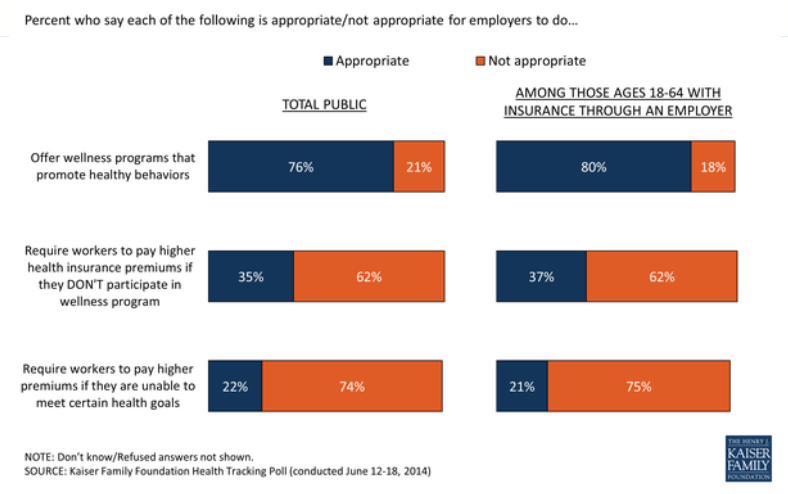
Most think it’s ok for employers to offer wellness programs…but not to tie premiums to participation or outcomes (Click to Enlarge)
By Jordan Rau
Kaiser Health News
WASHINGTON, D.C. — Workers believe employer wellness programs should be all gain but no pain, according to a poll released Tuesday.
The poll from the Kaiser Family Foundation found employees approve of corporate wellness programs when they offer perks, but recoil if the plans have punitive incentives such as higher premiums for those who do not take part. (KHN is an editorially independent program of the foundation.)
Wellness programs, which are encouraged under the federal health law, are structured in various ways. In some plans, the worker has to join a particular program, such as an exercise class, while others focus on outcomes, such as the employees’ blood sugar or cholesterol. Evidence is mixed about whether any substantially improve workers’ health or lower costs to employers and insurers.
The poll found 76 percent of workers thought it was appropriate for employers to offer wellness programs that promote healthy behavior. But a majority opposed wellness plans that had financial repercussions for workers: 62 percent did not think employers should charge higher health insurance premiums to workers who did not participate, and 74 percent said management should not charge more to those who did not reach health goals.
The Obama administration is allowing employers to link up to 30 percent of health premiums to wellness programs. Penalties and rewards for participating in a tobacco cessation program can be as high as 50 percent of the insurance plan cost.
The poll found that among workers who get health insurance from their employer, 48 percent said there was a wellness program in their workplace. Six out of 10 people said they participate; women were more likely to take part than men.
On another topic, the pollsters found that six of 10 people are following the problems at Veterans Affairs hospitals, some of which are accused of covering up the long waits some patients had before getting care. The VA scandal is the most closely followed health story of the year so far, the poll found, though more people have paid attention to the missing Malaysia Airlines flight, the kidnapped Nigerian schoolgirls and the Russia-Ukraine conflict.
Sixty three percent think the problems are widespread throughout the VA, while 22 percent believe they are isolated to a few facilities. Those who live in a household with someone who served in the military are even more likely to believe the problems are systemic. However, the poll indicated there are gaps in knowledge: Of those who said they are following the VA scandal “very” or “fairly” closely, two out of three were able to correctly answer that General Eric Shinseki resigned as Obama’s secretary of veterans affairs.
The poll found little change from last month in how the public views the health law. For the first time, however, more people said they were basing their impressions on their own experiences and those of friends or family, instead of on information gleaned from television, radio and newspapers.
“As implementation proceeds, more people may be having direct experience with the law themselves or through their loved ones,” the pollsters theorized. “It’s also possible that as coverage of the law has been out of the media spotlight for the last few months, fewer people are hearing about it in the news, resulting in a declining share who report taking cues from the media.”
The poll was conducted June 12-18 among 1,202 adults. The margin of error was +/- 3 percentage points for the general population and larger for subgroups.
DETROIT (AP) — Graco Children’s Products is recalling 1.9 million infant car seats, agreeing to government demands in what is now the largest seat recall in American history.
The recall came after a five-month spat between Graco and the National Highway Traffic Safety Administration. Earlier this year the company recalled 4.2 million toddler seats for a harness buckle problem. But it resisted the agency’s demand to recall the infant seats.
Buckles can get gummed up by food and drinks, making it difficult to remove children. In some cases parents had to cut harnesses to get their kids out. The agency says that increases the risk of injuries in emergencies.
Graco argued that infant seats are used differently, and in an emergency, an adult can remove the whole seat rather than using the buckle.
ROLLA, Mo. (AP) — A central Missouri sheriff has pleaded guilty to harassing a former female co-worker.
By pleading guilty Tuesday to one charge, Osage County Sheriff Michael Dixon avoided a trial on several charges including tampering with a motor vehicle, sexual misconduct, third-degree assault, and stalking. KRCG reports Dixon will serve two years’ probation.
Osage County Sheriff Michael Dixon
Phelps County Prosecutor John Beger, who was appointed special prosecutor in the case, says the 28-year-old Dixon’s probation requires him to have no contact with the victim, to undergo drug and alcohol evaluations, and to have sexual harassment counseling.
Beger says the incidents occurred in October 2012 and June 2013. Authorities accused Dixon of stalking and harassing the woman and driving away with a four-wheeler belonging to her fiance after demanding to know where she was.
JEFFERSON CITY, Mo. (AP) — Missouri Gov. Jay Nixon has signed legislation that he says will improve breast cancer detection.
The bill Nixon signed Tuesday will require medical facilities that perform mammograms to provide patients with information about dense breast tissue.
The notices will state that dense breast tissue can hide abnormalities that might otherwise be detected by mammograms and that women with other risk factors for breast cancer could benefit from supplemental screening tests.
Mammography facilities will need to provide the notices starting next January.
WASHINGTON, D.C. – U.S. Senator Roy Blunt (Mo.) expressed concern today surrounding the U.S. Department of Health and Human Services (HHS) Office of the Inspector General’s (OIG)reports revealing the Obama Administration’s inability to put safeguards in place to protect taxpayers and prevent incorrect ObamaCare subsidy payments.
Today’s report found that HHS was unable to resolve 2.6 million of 2.9 million verification inconsistencies because the Centers for Medicare & Medicaid Services (CMS) eligibility system was not fully operational. Congress passed a law – which Blunt voted for – requiring the HHS OIG to issue a report by July 1, 2014, evaluating the effectiveness of safeguards to prevent improper payments.
“These reports are very troubling. Americans deserve to know how the federal government spends their hard-earned dollars – and whether their money is being misused on wasteful and fraudulent ObamaCare payments,” said Blunt.
In January 2014, then-HHS Secretary Kathleen Sebelius certified to Congress that the ObamaCare exchanges could verify that individuals receiving tax credits and cost-sharing assistance are actually eligible to receive taxpayer-provided subsidies. She also detailed a number of measures that were supposed to be in place to protect the taxpayer.
Read the HHS OIG reports here and here, and the letters to Congress here.

 WASHINGTON, D.C. – On Tuesday, U.S. Senator Jerry Moran (R-Kan.) responded to the release of two U.S. Department of Health and Human Services’ Inspector General (IG) reports on Obamacare verification systems. The first report reviews the effectiveness of the procedures and safeguards for preventing fraudulent or inaccurate information by applicants enrolling in health plans through the Obamacare insurance Exchanges. This report finds that the Obamacare system lacks internal controls to verify information provided by individuals enrolling through Obamacare. The second report details the inconsistencies that arose as part of the haphazard enrollment process. The IG finds that most exchanges were unable to resolve the majority of inconsistencies, most often relating to income and citizenship. In particular, the federal exchange was unable to resolve 2.6 million out of 2.9 million inconsistencies as of February 2014.