We have a brand new updated website! Click here to check it out!

As Nurse Practitioners Try To Shake Free Of Doctors, Kansas Physicians Resist

Stephanneth Adams plans to leave Kansas.

The nurse practitioner landed in the state’s rural southwest — where she saw patients in Garden City, Dodge City and Liberal — through a federal program aimed at stubborn health care shortages in urban and rural America.

Nursing school. Many nurses eventually work on master’s or doctorate degrees to become nurse practitioners.
BETHANY WOOD / FOR THE KANSAS NEWS SERVICE

But why stay? Adams has her eyes on Nevada, a state that lets its most educated nurses roll up their sleeves and work without permanently needing, as they do in Kansas, permission from a physician.

“I want to practice in a state that recognizes our qualities and our academic experience,” she said.

Kansas makes advanced practice nurses ink deals with doctors that physicians say protect patients by ensuring those nurses will collaborate with their more educated colleagues.

Nurses disagree. They insist the contracts do little more than limit patient options, allow doctors to fend off unwanted competition, and, in some cases, give them a cut of nurses’ earnings for little to no work.

Nationally, one state after another has come around to that way of thinking — dropping contract requirements like those in Kansas. Physicians trying to stop the trend fight back with less and less success.

That’s like the days back in the 1950s, when a physician would go to medical school and then do a rotating internship. – Dr. John Eplee, state lawmaker

“This has kind of been painted like it’s a turf war,” said Rep. John Eplee, an Atchison family physician and state lawmaker opposed to lifting Kansas’ restrictions on nurse practitioners. “What this boils down to is, we just want patients to have access to safe care.”

If Kansas scraps the contracts, he argues, why would physicians stick around in a state where nurse practitioners can take a shortcut through less schooling?

“That’s like the days back in the 1950s,” he said, “when a physician would go to medical school and then do a rotating internship and then go out and practice. No one does that anymore because society requires more training and higher standards.”

That’s not how the National Academy of Medicine, the Federal Trade Commission, and many public health and health workforce researchers see it. To them, physicians in holdout states don’t have the goods to back their alarmism.

“No studies suggest that (advanced practice nurses) are less able than physicians to deliver care that is safe, effective, and efficient,” the National Academy of Medicine says, “or that care is better in states with more restrictive scope of practice regulations. …

“In fact, evidence shows that nurses provide quality care to patients, including preventing medication errors, reducing or eliminating infections, and easing the transition patients make from hospital to home.”

Welcome to the NP ‘revolution’

Walk into your local medical clinic and you’re increasingly likely to be seen by a nurse practitioner instead of a physician. In the span of about a decade, the number graduating from nursing schools has more than tripled.

Ed Salsberg calls that “phenomenal.”

The founder of the National Center for Health Workforce Analysis at the U.S. Department of Health and Human Services and of the Center for Workforce Studies at the Association of American Medical Colleges suspects nurse practitioner graduates will rocket past the nation’s supply of new physicians within a few years.

“It really has been sort of a revolution,” says Salsberg, now a faculty researcher at the George Washington University School of Nursing.

He originally raised red flags, worried the nation was charging toward a surplus of NPs unable to put all that graduate education to use.

But so far, he says, the U.S. has “soaked them up.”

More than two-thirds work in primary care, something that nurses, physicians and policymakers alike see as a blessing. Studies show those NPs can offer much of the routine health care that doctors provide, then refer cases beyond their training to the physicians.

But many doctors want to retain oversight or other control of that burgeoning cadre, including by requiring NPs to enter contracts that Kansas calls “collaborative practice agreements.”

About half of states have dropped such contracts for all NPs or all those with more than a couple years of experience, a trend that began decades ago.

In states that haven’t, the same legislative wrestling match between advanced practice nurses and physicians plays out one year after the next. Emboldened by research validating their safety and by health care shortages affecting millions of Americans, nurses refuse to back down.

The U.S. doesn’t have enough doctors — or at least, parts of it don’t. Its population is growing and, since the 2010 Affordable Care Act, more of those people are insured.

Exacerbating that: The giant Baby Boomer generation is reaching an age that requires more health care. The generation’s doctors are retiring. One in threeKansas physicians is over 60 years old, at a time when 1 million Kansans already live in areas with primary care shortages.

Researchers say states that roll back restrictions on NPs have more of them, with notable benefits for underserved communities. Skeptics argue that government could plot a different course instead, with targeted dollars for medical residencies and other incentives to reinforce physician ranks in the right places.

“The reality is, it’s probably a little of all of it,” says Candice Chen, former director of the medical and dentistry division at the federal Bureau of Health Workforce and an expert on graduate medical education at GWU’s School of Public Health.
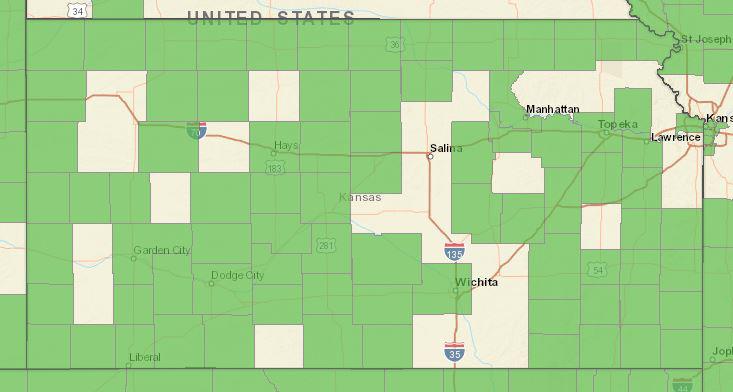
A map showing Kansas counties, in green, with shortages of primary care providers, generated by data.hrsa.gov.

The National Center for Health Workforce Analysis, she notes, predicts a shortage of more than 20,000 primary care doctors by 2025. NPs can help fill the gap.

Where doctors tend not to go

Sofia Navarro was a pediatric nurse at Children’s Mercy Hospital when she headed back to school to become a nurse practitioner.

She envisioned going into private practice, in a shiny new office with all the nicest gadgets and equipment that a health care pro could want.

That changed when a professor suggested Navarro wrap up her gynecological studies working public health in one of the state’s poorest places, Wyandotte County.

“I ended up falling in love with public health,” she said.

More than a decade later, she’s still there, screening women for cervical and breast cancer and explaining puberty to teens. About half her patients, she estimates, have no insurance or policies that don’t pay for much.

Peter Buerhaus is chairman of the National Healthcare Workforce Commission, a body created by the Affordable Care Act to puzzle out health care access.

He and others have plowed ahead with research for the commission on their own, mining Medicare and other data. Their findings?

NPs are more likely than doctors to serve people on Medicaid or without insurance, and people of color. The same goes for another of Kansas’ sore points — rural areas.

“There’s a strong body of evidence now,” said Buerhaus, a professor at Montana State’s School of Nursing. “Nurse practitioners are more likely to work in rural areas than physicians.”

Medicare data also suggests their care costs less, Buerhaus says, and not just because Medicare pays them less. NPs appear to order fewer tests and procedures and pick cheaper options when they do.

Goal No. 1: Protecting patients

LaDona Schmidt knows what it’s like to be a nurse practitioner. And a physician. The Lawrence doctor has been both.

What she learned from that transition opened her eyes. She went from knowing the basics of prescription drugs, she says, to understanding their workings at the cellular level.

Medical school, she testified to Kansas lawmakers, helped her save the life of a 4-year-old whom an NP had diagnosed with stomach flu.

“She recommended Tylenol, fluid, and ‘time,’” wrote Schmidt, the Kansas Medical Society’s president-elect. The mother sought care again the next day. Schmidt noticed the child’s enlarged liver, ordered tests and put him in the hospital.

“He continued to progress to liver failure,” she said, “and fortunately was able to receive a liver transplant two weeks later.”

Schmidt declined an interview. She and other Kansas physicians opposed to ditching collaborative practice agreements point to training. Family doctors slog through four years of medical school and three years of residency. Many specialty residencies last even longer.

NPs typically attend a two-year master’s program, though universities in Kansas and elsewhere are shifting to doctorates.

Stories like Schmidt’s frustrate Monica Scheibmeir, dean of Washburn University’s School of Nursing in Topeka.

“Whenever my well-respected physician colleagues make comments about errors, they should remember they live in a glass house,” she said. “And that never gets brought up.”

Other researchers with medical and nursing backgrounds agreed. Absent data, physicians’ anecdotes remain just that — anecdotes.

“There are horror stories about physician providers like that too, right?” said Chen at GWU, a trained pediatrician. “We have to figure out how to prevent those horror stories.”

That means training providers of all stripes to know their boundaries, she said, and when to involve doctors or nurses with expertise different from their own to address a patient’s care.

The FTC is unconvinced that restricting NPs is needed to achieve that. Collaboration is “‘the norm” even in states that don’t make NPs secure physician contracts, it says. NPs still refer their patients to physicians and hospitals.

The FTC warns of a one-way street that positions doctors as market gatekeepers. That can stifle competition and stick consumers with higher bills.

There are horror stories about physician providers like that too, right? We have to figure out how to prevent those horror stories. – Dr. Candice Chen, George Washington University

Though some states, such as Kansas, call their contracts “collaborative agreements” and dodge words like “supervision,” the power dynamic is clear:

Doctors don’t need the deals, nurse practitioners do.

A V.A. treasure trove

In 2014, a research team at the Department of Veterans Affairs that included physicians dug into past studies in search of the impact of NPs on patient health, quality of life and hospitalizations.

They found no negative impacts, but noted that recent, rigorous research was thin — and weaker than advertised by some proponents of unfettered NPs. Still, they said the lack of fresh studies wasn’t surprising.

“Well-publicized, well-conducted randomized trials conducted in the 1970s proved the concept” that independent advanced practice nurses “can deliver care comparable to that provided by a primary physician.”

The team suggested the VA could dig further by mining its own extensive quality and error data.

In 2016, the VA dropped collaborative contract requirements for NPs — including those working in states such as Kansas. A spokeswoman said the VA expects to complete a fresh study next year on the effects of independent practice.

Kansas NPs point to the VA’s 2016 decision to try to win over state lawmakers. They’ll try again next year after this year’s bill died in a legislative maneuver to expand Medicaid. Their new version offers to make new NPs work a few years before dropping their contracts with doctors.

Kansas physicians say they’re open to compromise of a different sort. They remain skeptical of granting NPs independent practice and distrust the Board of Nursing’s ability to oversee NPs if they get it.

So keep the contracts, they suggest. Just improve them. Make sure doctors don’t abuse them for financial gain and slack off on giving NPs meaningful help.

“We work side by side with these folks every day,” says Jeremy Presley, a private practice doctor in Dodge City and president of the Kansas Academy of Family Physicians. “We value the care they provide.”

Presley teaches nurse practitioners, works with them daily and sits on the advisory board for one of Kansas’ doctoral nurse practitioner programs.

Kansas lets doctors ink deals with as many NPs as they want, and charge as they see fit. Some may work in the same building as the NPs. Others, across town. Still others, 100 miles away.

NPs offer anecdotes of physicians overseeing and charging half a dozen NPs in scattered locations without consulting regularly or at all.

“I feel bad for those folks,” Presley said. “Frustrated for them, that those agreements aren’t in a better — you know, aren’t set up in a better way.”

But it’s unclear how common such situations might be because neither the nurses nor the doctors report contract details to the state.

Nor is it clear how much income Kansas physicians collect this way.

A new national study found advanced practice nurses face contract fees more often if they work in rural areas or at nurse-operated clinics. In those cases, contract prices charged to the nurses or their clinics often topped $6,000 and ranged up to $50,000 annually.

In a small and not necessarily representative survey conducted by the Kansas Advanced Practice Nurses Association, half of 180 respondents said their collaborating physician got monetary compensation.

The costs ranged from $1,200 to $16,000 per year.

Celia Llopis-Jepsen is a reporter for the Kansas News Service.  You can reach her on Twitter @Celia_LJ

Officials: Man critically injured in Springfield house fire

SPRINGFIELD, Mo. (AP) — Fire officials in southwestern Missouri say a man has been critically injured in a house fire in Springfield.

The Springfield Fire Department says in a news release that the fire was reported Saturday morning on the northeast end of the city. Officials say firefighters on the scene found a man who was taken to a regional burn unit with life-threatening injuries. The man’s name has been released.

The cause of the fire remains under investigation.

Officials say no firefighters were hurt.

Missouri man accused of killing cats he found on Craigslist

ST. PETERS, Mo. (AP) — A Missouri man is charged with felony animal abuse after authorities say he killed and dismembered cats he found in online want ads.

Louzader photo St. Charles Co.

20-year-old Kaine Louzader was charged Friday. Prosecutors say more charges are expected.

Court documents say dead cats have been turning up on or near Louzader’s street outside St. Peters since January. Police contacted Louzader after someone reported seeing him dump a dead cat near his house.

St. Charles County police Sgt. Jeff Ochs says Louzader told police he would scour Craigslist ads for free cats, then would take them home and stomp or strangle them. Police say he dismembered some cats before dumping their remains.

Louzader is being held on $50,000 bond and could not be reached Saturday for comment. No lawyer is listed for him in online court documents.

Company says it was told duck boats were OK before fatal sinking

BRANSON, Mo. (AP) — An entertainment company that owned a duck boat that sank on a Missouri lake last summer is disputing that an independent inspector told it that its vehicles did not comply with a government standard.

Duck boat involved in the fatal accident- Photo courtesy NTSB

Steve Paul says Ripley Entertainment hired him in 2017 before it bought the boats from Missouri company Ride the Ducks International to determine whether they met the Department of Transportation’s regulations. Ripley says Paul passed the boats in his report.

Paul has said he inspected 24 of the 40 boats that Ride the Ducks was selling and that all of them were deficient under the department’s standard because of the location of their tailpipes.

Florida-based Ripley ultimately purchased 22 of the boats in December 2017. One sank in Branson last July, killing 17 people.

Can We End The School Litigation Now? That And More From The Kan. Supreme Court

STEPHEN KORANDA & CELIA LLOPIS-JEPSEN

A fresh push by school districts to get Kansas to pony up more money for public education met with skepticism Thursday from the Kansas Supreme Court.

Justices had pointed questions for both sides in the lawsuit that began in 2010 and has already gone through multiple rounds of oral arguments and rulings.

Justice Eric Rosen called it frustrating that the funding goal that school districts argue for seems to be a moving target.

“Is there ever ‘crossing the finish line’ in these types of cases?” Rosen asked the districts’ attorney, Alan Rupe. “Or are you going to be back here three or four years down the road, making the same argument you just made?”

Rupe responded that all the court has to do is tell lawmakers to redo the inflation adjustment and districts would be satisfied.

“I think we’re getting real close,” Rupe said.

The question at hand in Gannon v. Kansas is whether the state has done enough to finally end a nearly  decade-long lawsuit over school spending.


Last June, the justices ordered the state to increase funding to account for inflation. Lawmakers did so this spring.

So the attorney representing the state, Toby Crouse, argued it should be “case dismissed.”

But the question is whether lawmakers added enough.

Rupe, who’s been fighting the state for more education funding for three decades, questioned the state’s inflation calculations and asked the justices to make lawmakers recalculate when they return for the 2020 legislative session.

How much is enough?

Lawmakers took a major step last year, by promising to phase in a half billion dollars for schools.

That got close to ending the lawsuit, except for the inflation problem that justices identified.

Crouse said the plan to add $90 million per year for four years should end the litigation.

He argued that approval this year from a bipartisan group of lawmakers and Democratic Gov. Laura Kelly give credence to the state’s solution.

“Everyone agrees that this is what satisfies not only the constitution,” Crouse said, “but also the best interests of the children.”

Rupe said the state continues to fall short because its new solution only calculated inflation for part of the funding increase to schools, not overall spending.

“You don’t figure the inflation on a loaf of bread by taking one slice and figuring the inflation on that slice,” Rupe said. “It’s on the whole loaf of bread.”

School districts contend spending ultimately has to reach levels consistent with a court ruling from the mid-2000s that dramatically increased school funding and ended a previous lawsuit, Montoy v. Kansas.

Hitting that target based on the Montoy agreement would take $3.7 billion in total annual funding by 2023, the districts argue. And it would shield the Legislature from litigation. But hitting that target would take another $270 million in annual funding by 2023 over what the state has promised.

Rupe says that’s an important difference, because $270 million could pay for 5,400 teachers.

Justice Dan Biles was skeptical the state needs to spend that much to meet constitutional requirements.

“That safe harbor number,” Biles said, “doesn’t necessarily mean that’s the minimum level necessary to comply with the constitution.”

Should the court trust the Legislature to keep its promises?

Even if they sign off on lawmakers’ latest fix, justices questioned the state’s request to dismiss the lawsuit.

Biles said the state would not be in full compliance with the court until it had paid out all the money in the school spending deal, which will take several years.

“I’ve got to tell you, I don’t have a lot of sympathy for the idea of dismissing this lawsuit,” Biles said.

There’s fear the governor and the Legislature might go back on their promises for more robust funding. They’ve done it before.

School districts filed the current suit, Gannon v. Kansas, in 2010, after governors Kathleen Sebelius and Mark Parkinson slashed school funding amid the global financial crisis and recession. The districts argued those cuts violated commitments the state made to end the Montoy lawsuit.

The district court and Kansas Supreme Court agreed. In ruling after ruling, they’ve pushed the state to restore hundreds of millions of dollars to its school funding formula. That included restoring targeted money meant to put poorer areas of the state on more equal footing with wealthier ones in terms of resources for education.

What if, Biles wondered, the court drops the case and the Legislature goes back to block grants or other funding schemes that have been found unconstitutional? Plaintiffs would have to start over at district court.

“When what the Legislature did is something we’ve already said they can’t do,” he said. “So that’s my problem.”

Stephen Koranda and Celia Llopis-Jepsen are reporters for the Kansas News Service. Follow Stephen on Twitter @kprkorandaand Celia @Celia_LJ.

NE Kansas deputies arrest 2, seize drugs and $11K in cash

DOUGLAS COUNTY —Law enforcement authorities are investigating two suspects on drug and weapons charges.

Photo courtesy Douglas County Sheriff

Just after 2 a.m. Friday, deputies responded to reports of shots being fired into the air from a vehicle near the intersection of U.S. 24-59 and U.S. 24-40 intersection, according to Sgt. Kristen Channel. Deputies were unable to locate the suspects.

A short time later, Lawrence Police officers spotted a suspect vehicle in the 900 block of Pennsylvania Street and questioned the two occupants and discovered a large amount of methamphetamine, cocaine, and marijuana as well as a stolen handgun and more than $11,000 in cash.

They arrested 31-year-old Antonio Brown and 28-year-old Bounsouay Khanya on requested charges of possession with the intent to distribute narcotics/methamphetamine/marijuana and possession of drug paraphernalia. Brown also faces counts of felon in possession of a firearm and criminal discharge of a firearm.


Missouri substitute teacher charged with child sex crimes

MONROE COUNTY — Law enforcement authorities are investigating a substitute teacher in Missouri for child sex crimes.

Gramley photo Monroe Co.

Twenty-seven-year-old Ty Michael Gramley of Columbia was arrested just after 1p.m. Thursday in Randolph County, according to a media release from the sheriff’s department.

The investigation lasted several weeks in connection with a  complaint that Gramley was exchanging pornographic text messages, photographs, and videos with a minor student from an area school via social media.

Gramley was housed in the Monroe County Jail after being served with an arrest warrant for Possession of Child Pornography (felony) and two counts of furnishing pornographic material to a minor (misdemeanor).

He is scheduled to be arraigned next week.

A Monroe County deputy wrote in a probable cause statement that a student said she had been sending and receiving sexually explicit text messages, photos and videos with Gramley through Facebook Messenger. The student said she met Gramley while he was working as a substitute teacher in the Madison C-3 school district.

Superintendent Shane Stocks said Gramley wasn’t an employee and worked for a contractor that provides substitutes.

Supreme Court: Kan. Senate must vote to keep nominee off bench

By JOHN HANNA AP Political Writer

TOPEKA, Kan. (AP) — A Kansas Supreme Court decision will force the state Senate into voting to reject a judicial nominee over political tweets that lawmakers found offensive.

Kelly nominated Jeffrey Jack March 15-photo office of Kansas Governor

The Supreme Court ruled unanimously that Democratic Gov. Laura Kelly did not have the authority under a 2013 state law to withdraw her nomination of Labette County District Judge Jeffry Jack for the Kansas Court of Appeals, the state’s second-highest court. And, under the law, if the Senate fails take a vote by next week, Jack would be considered confirmed.

Kelly’s withdrawal of Jack’s nomination in March touched off an unprecedented and bizarre legal dispute with Senate President Susan Wagle over whether the governor could name a second nominee — as Kelly eventually did. The Supreme Court’s decision means that Kelly will get that chance if the Senate, as expected, rejects Jack’s nomination.

“I encourage the Senate to act swiftly to vote down the Jack appointment next week,” Kelly said in a statement after the Supreme Court’s ruling.

The nomination was doomed after political tweets from Jack in 2017 came to light. They included vulgar language and criticism of President Donald Trump and other Republicans, with one post calling the president “Fruit Loops.”

Wagle, a Wichita Republican, has called Jack “absolutely unacceptable.” Senate Minority Leader Anthony Hensley, a Topeka Democrat, predicted no senator would vote for him.

Wagle and other Senate leaders already anticipated the possibility of such a Supreme Court ruling, and the Senate is scheduled to convene Tuesday. Lawmakers wrapped up most of their business for the year early Sunday.

The Senate president contends Kelly failed to properly vet Jack and said Friday that the legal dispute resulted from a “display of her incompetence.”

“Sadly, this avoidable situation by the Kelly administration has turned into a waste of taxpayer dollars,” Wagle said in a statement.

The Supreme Court ruled only a day after hearing arguments from attorneys. It was also less than three weeks after Attorney General Derek Schmidt, a Republican, filed a lawsuit against Kelly, Kansas Supreme Court Chief Justice Lawton Nuss and the Senate to resolve the dispute.

The Supreme Court appointed a substitute for Nuss, who removed himself. His attorneys told his colleagues that he had no position on how the case should be resolved.

The vacancy on the Court of Appeals was created by the retirement of longtime Judge Patrick McAnany on the day that Kelly took office in January.

The 2013 law says that if governor fails to make an appeals-court nomination within 60 days of a vacancy, Nuss makes the appointment. The deadline was March 15, the day Jack was nominated, and Wagle argued that Jack’s withdrawal meant Kelly failed to make a proper nomination in time.

Under the law, the Senate has 60 days to act on a nominee if the Legislature is in session, as it was when Kelly named Jack, or the nomination is deemed confirmed. The law says that if the Senate rejects a nominee, the governor appoints another.

Kelly cited that section of the law in arguing that she could name a new nominee, and she chose Sarah Warner, a 39-year-old Kansas City-area attorney.

It’s time to move forward and fill this vacancy,” Kelly said in her statement.

The 2013 law applies only to Court of Appeals appointments and doesn’t specifically say what happens if a nomination is withdrawn. A broader law applying to other appointments allows nominations to be withdrawn.

Justice Dan Biles wrote in the Supreme Court’s opinion that the Court of Appeals is “the obvious outlier” and the justices would be “adding words” to the 2013 law if they concluded that it allows an appeals court nomination to be withdrawn.

“We conclude the Governor is powerless to withdraw a Court of Appeals nominee once it is made,” Biles wrote.

If a nominee withdraws, Biles wrote, the only “practical purpose” is “clearing the path” for a quick vote against his or her confirmation. The court also concluded that Kelly’s nomination of Warner must be treated “as if it never happened.”

Government forecasts bountiful Kansas wheat crop

WICHITA, Kan. (AP) — A government report forecasts a bountiful Kansas winter wheat harvest.

The National Agricultural Statistics Service reported Friday that this year’s wheat crop is expected to be up 17 percent from a year ago. It predicted Kansas growers would bring in 323 million bushels.

The agency forecast the state’s average yield at 49 bushels per acre, up 11 bushels from last year.

It also anticipated that grain would be harvested from 6.6 million acres in Kansas, down 700,000 acres from a year ago.

The government’s estimate is a bit more optimistic than the one put out by participants in last week’s winter wheat tour who estimated the size of the Kansas crop at 306.5 million bushels.

Report: Doors unlocked before tiger attack at Kansas zoo

TOPEKA, Kan. (AP) — A state report says that safety doors in a Sumatran tiger’s enclosure at a Kansas zoo were left unlocked before the animal attacked and injured a veteran zookeeper.

Kristyn Hayden-Ortega-photo courtesy Topeka zoo
Sanjiv photo Topeka Zoo

The report released Friday by the Kansas Department of Labor agreed with the Topeka Zoo’s assessment that no equipment failure or other problem with the enclosure led to the April 20 attack.

Zookeeper Kristyn Hayden-Ortega was hospitalized after suffering puncture wounds and lacerations to her head, neck and back.

Hayden-Ortega had gone into the outdoor area of the tiger’s enclosure to clean it. The animal was supposed to be in an indoor area, behind two doors. The report says the doors “had been locked in the open position.”

The report said the zoo is now requiring that two employees check the doors.

Copyright Eagle Radio | FCC Public Files | EEO Public File