ROGERSVILLE, Mo. (AP) – A southwest Missouri day care operator is charged with 34 felonies after a 4-month-old child in her care died.
Beason-photo Greene Co.
The Springfield News-Leader reports 52-year-old Cheri Beason was indicted for child neglect or endangering in the August 2017 death of Brynlee Jones. The indictment became public Wednesday.
Court documents say Beason was looking after more than 20 children at her unlicensed daycare near Rogersville when Brynlee died. Unlicensed day care providers aren’t allowed to watch more than four unrelated children.
The documents allege Beason left one adult supervising 20 children who were 5 or younger on the day Brynlee died.
Beason also was charged by the state in January with the infraction of operating a day care without a license.
Online court records don’t indicate Beason has an attorney.
TOPEKA, Kan. (AP) — The leading Democratic candidate for Kansas governor is under attack for her past backing of tough voter identification policies as her party prepares for the possibility that the champion of those measures, conservative Kris Kobach, will win the Republican nomination.
State Sen. Laura Kelly, former Wichita Mayor Carl Brewer, and former Kansas Ag Secretary Josh Svaty are all competing to be the Democratic gubernatorial candidate. photo Kansas News Service
Democrats have regularly criticized Kobach, the Kansas secretary of state, over policies they believe suppress voter turnout. No state had gone further in requiring prospective voters to provide papers documenting their U.S. citizenship when registering, until a federal judge struck down the law in June as a violation of voting rights.
But the Kansas law had strong bipartisan support when the Legislature approved it in 2011, and one of the yes votes came from state Sen. Laura Kelly, of Topeka. That vote has dogged Kelly in the final weeks before the Aug. 7 primary, with her two main rivals — who were not lawmakers at the time — hoping Democratic voters turn away from her because of it.
“How can we have as the standard-bearer for the party someone who voted with Kris Kobach, really, on his signature issue?” one of them, former Kansas Agriculture Secretary Joshua Svaty, said during an interview after raising the issue in forums.
The measure that Kelly and two-thirds of the Democrats then in the Legislature backed imposed the proof-of-citizenship requirement, starting in 2013. The state is appealing the ruling that struck it down.
Only a few other states have attempted to impose a proof-of-citizenship requirement. Alabama and Georgia have such laws but they are not currently being enforced and Arizona has a more lenient version, according to the American Civil Liberties Union, which opposes them and has fought Kobach in court.
Kelly was a sponsor in 2016 of a bill that would have allowed people born in Kansas to check a box on registration forms, with the state verifying their status, so that citizenship papers would not be necessary to register. It died in committee without a hearing.
“I’ve always been a supporter of voting rights and expanding access to it, but I also saw the need to make sure that our elections were secure,” she said in an interview. “Kobach just went way beyond the authority given to him.”
Kelly’s main Democratic rivals are Svaty and former Wichita Mayor Carl Brewer. Svaty was a House member from 2003 to 2009, leaving to become agriculture secretary. Brewer has never served in the Legislature,
Brewer, seeking to become Democrats’ first black nominee for governor, says he could better stand up to Kobach.
“I just don’t think they did their homework,” Brewer said of legislators who supported the voter ID policies.
Kobach is trying to unseat Gov. Jeff Colyer in a contentious Republican primary race. Many Democrats expect Kobach’s solid base on the right to allow him to win the GOP nomination in a seven-candidate field.
He regularly cites the voter ID policies as one of his biggest accomplishments.
“He spent eight years banging this drum,” said Micah Kubic, executive director of the ACLU of Kansas, a frequent Kobach antagonist. “It is what his entire public record is built on.”
President Donald Trump has cited Kobach as a source for his unsubstantiated claim that millions of immigrants voted illegally in 2016 and Kobach was a vice chairman of Trump’s since-disbanded voter fraud commission.
Kobach argues that tough voter ID policies prevent election fraud, even though he has cited only a few dozen registrations by non-citizens and even fewer attempts by them to vote. U.S. District Judge Julie Robinson ruled in June that the proof-of-citizenship policy disproportionately affects qualified voters.
In the first three years the Kansas proof-of-citizenship requirement was in effect, about one in seven registration applications was blocked — nearly half of them from people under 30, according to court documents. Between 2013 and 2016, more than 35,000 Kansas residents were unable to register. The state has about 1.8 million registered voters.
Kobach’s actions in lawsuits over his policies also have led to him being cited for contempt of court twice, and in an extraordinary rebuke, Robinson ordered him to undergo six extra hours of legal education.
Kelly and other prominent Democrats have argued that lawmakers who voted for his voter ID policies couldn’t guess that Kobach would enforce them as aggressively as he did. They also accuse him of abusing his authority.
But Kobach scoffed at such arguments during a recent interview. He said most Democrats voted for his policies because they were popular and changed their views later when the national Democratic Party — the “mother ship” — attacked them.
“There was absolutely nothing in the implementation of the law that was surprising,” Kobach said. “They’re just trying to scrape the bottom of the barrel for something that sounds like an excuse.”
And longstanding critics of the voter ID policies such as the ACLU and civil rights leaders argue that lawmakers were warned clearly about how they would create obstacles for prospective voters. But some of them aren’t holding the past vote against Kelly or other Democrats who now promise to work to reverse them.
“I’m just glad they’re remorseful now,” Kubic said.
ST. LOUIS (AP) – A certificate of inspection for the Missouri tourist boat that sank last month, killing 17 people, shows that it was on the lake at a time when the wind speed far exceeded allowable limits.
First responders on the scene of the lake accident near Branson -photo courtesy KYTV
The Coast Guard on Wednesday announced it has convened a formal Marine Board of Investigation into the accident involving a Ride the Ducks of Branson boat. The vessel sank July 19 at Table Rock Lake.
The lake was calm when the excursion began, but weather turned violent and the boat sank within minutes.
The Coast Guard’s certificate of inspection issued in 2017 prohibited the boat from being on water if winds exceed 35 mph or wave height exceeds 2 feet.
Investigators said the wind speed at the time of the accident was more than 70 mph.
BETHANY, Mo. – The northbound lanes of I-35 are closed in Harrison County as crews complete a project on the Route AA/H Bridge.
According to the Missouri Department of Transportation, the bridge over Interstate 35 in Harrison County has been closed since late May for a deck replacement project. The northbound lanes of I-35 are closed so the crew may tie in the new bridge deck to the existing roadway and complete guardrail work under the bridge. Traffic is being routed up and over the ramps at Exit 84 around the work. This traffic pattern will remain in place through Thursday afternoon.
To ensure that interstate traffic flows as smoothly as possible no access to or from Route AA and Route H will be permitted. Motorists will experience delays and may want to consider using an alternate route.
The Route AA/H Bridge is scheduled to reopen to all traffic Friday afternoon.
All work is weather permitting and schedules are subject to change. MoDOT encourages all motorists to slow down, buckle up, eliminate distractions and drive safely to ensure everyone is able to Arrive Alive.
For more information about this and other MoDOT projects, call 1-888-ASK-MODOT (888-275-6636) or visit modot.org/northwest.
SAN FRANCISCO (AP) — President Donald Trump’s executive order threatening to withhold funding from “sanctuary cities” that limit cooperation with immigration authorities is unconstitutional, but a judge went too far when he blocked its enforcement nationwide, a U.S. appeals court ruled Wednesday.
In a 2-1 ruling, the 9th U.S. Circuit Court of Appeals agreed that the order exceeded the president’s authority.
“Absent congressional authorization, the administration may not redistribute or withhold properly appropriated funds in order to effectuate its own policy goals,” Chief Judge Sidney Thomas wrote for the majority.
But he also said there wasn’t enough evidence to support a nationwide ban on the order and sent the case back to the lower court for more hearings on that question.
An email to a spokesman for the U.S. Justice Department was not immediately returned.
U.S. District Judge William Orrick said in November that the order threatened all federal funding and that the president did not have the authority to attach new conditions to spending that was approved by Congress.
The ruling came in lawsuits filed by two California counties — San Francisco and Santa Clara. The executive order potentially jeopardized hundreds of millions of dollars in funding to the two counties, Orrick said, citing comments by Trump and U.S. Attorney General Jeff Sessions as evidence of the order’s scope.
The Trump administration said the order applied to a relatively small pot of money that already required compliance with immigration law.
Government attorney Chad Readler had told Orrick that the order applied to only three Justice Department and Homeland Security grants that would affect less than $1 million for Santa Clara and possibly no money for San Francisco.
During arguments before the 9th Circuit in April, Thomas asked what the court was supposed to make of statements by Trump and his administration about wanting to withhold money from sanctuary cities.
Thomas also questioned whether the order would be constitutional if it applied to all types of funding, as the lower-court judge found.
Readler said the order was much narrower, and the judges should not focus on comments by the president or other administration officials.
The executive order is part of a push by the Trump administration to crack down on cities and states that generally don’t comply with U.S. immigration authorities.
The administration has sued California over three laws aimed at protecting immigrants in the country illegally. It also has moved to block a key public safety grant from going to sanctuary cities and states.
The Trump administration says sanctuary jurisdictions allow dangerous criminals back on the street. San Francisco and other sanctuary cities say turning local police into immigration officers erodes the trust needed to get people to report crime.
CLAIR COUNTY — One person died in an accident just before 6a.m. Wednesday in St. Clair County.
The Missouri State Highway Patrol reported a 2006 Ford F250 driven by George D. Heisten, 76, Eldorado Springs, was eastbound on U.S. 54 three miles west of Collins. The pickup traveled off the left side of the road down an embankment and hit trees and overturned.
Heisten was pronounced dead at the scene and transported to Shelden Funeral Home in Osceola.
He was not wearing a seat belt, according to the MSHP.
It helps, the latest Kansas campaign money tallies show, to be rich or have wealthy friends.
Next best thing, run as an incumbent.
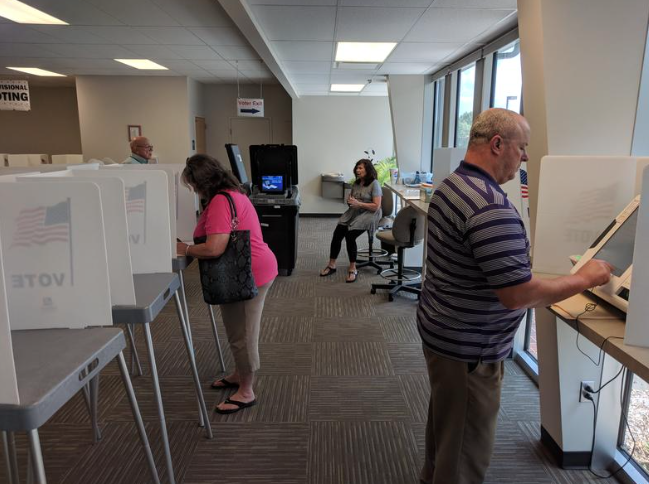
Even as candidates scramble to raise, and spend, campaign dollars, early voting is already underway in the Kansas primary. SCOTT CANON / KANSAS NEWS SERVICE
Campaign finance reports for the first half of this year show dollars spent nearly as quickly as candidates could corral them — filling airwaves, plastering billboards and stuffing mailboxes with flyers.
Several candidates for governor in the first election since Sam Brownback left the office earlier this year find themselves nearing next Tuesday’s primary on a path to burn through nearly all they’ve raised.
Fund thyself
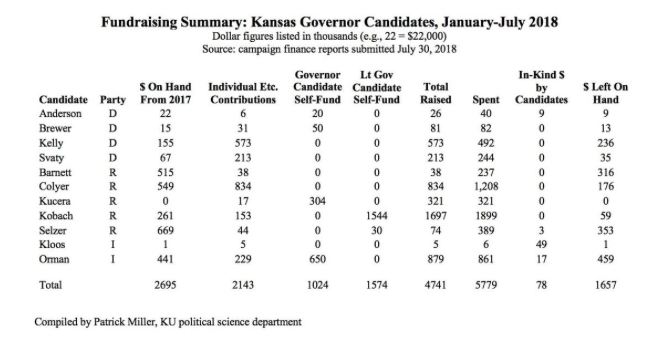
Republican Secretary of State Kris Kobach led the candidates for governor in money raised from Jan. 1 to July 26 with $1.7 million. Nearly all of it, $1.5 million, came from his running mate, Wichita businessman Wink Hartman. Most of that came as loans.
In fact, University of Kansas political scientist Patrick Miller said, about 55 percent of the cash raised by all the contenders in the governor’s race came from the candidates themselves.
“Which is extraordinary and bizarre for a governor’s race,” Miller said.
Although wealthier candidates historically often fund much of their own campaigns, Miller said it is far more rare for the No. 2 candidate on a ticket to pick up the tab.
“I’ve never seen a gubernatorial campaign like that anywhere, ever,” Miller said.
The influx of cash has given Kobach the ability to spend more during the period on campaign costs such as advertising. A single ad buy on July 13 rang in at $533,000.
“As a businessman,” Hartman told the Associated Press in a statement, “I know how important it is to invest in great leadership. And as a conservative, I know how critical investment is to the cause.”
Republican former state Sen. Jim Barnett, a physician, previously loaned his campaign more than $500,000. Self-described “entrepreneurial evangelist” Patrick Kucera’s fundraising was almost entirely made up of more than $300,000 from himself. Republican Insurance Commissioner Ken Selzer and former Democratic Wichita Mayor Carl Brewer have also put their own money into their campaigns for governor.
Independent candidate Greg Orman dropped more than $650,000 on his race.
Incumbent Republican Gov. Jeff Colyer raised the most from donors who aren’t also candidates. His report showed $834,000 during the latest filing period. Colyer made headlines for loans extended at critical points in the 2014 campaign, when he was lieutenant governor and then-Gov. Brownback was running for reelection.
There were no candidate loans in Colyer’s latest fundraising totals.
“I am humbled that our message of strong, optimistic, competent conservative leadership has resonated so well with Kansans,” Colyer said in a statement.
Colyer has also been pouring money into large advertising buys in advance of the primary.
On the Democratic side, state Sen. Laura Kelly led in fundraising with $573,000.
“I’m honored to have the support of such a broad and diverse group of Kansans,” Kelly said in a statement.
Former Kansas Agriculture Secretary Josh Svaty raised $213,000 and Brewer brought in $81,000.
“Nothing about the reports surprise us,” a Svaty campaign spokesman, Mike Swenson, said. “We have known all along that we would not raise as much money as the Kelly-Rogers campaign. They are both sitting state senators in the middle of their term.”
Easy come, easy go
The reports suggest several campaigns aren’t stockpiling for a general election.
Kobach on the GOP side, along with Brewer and Svaty on the Democratic side, all have used most of their money. Kobach had $59,000 left in his war chest. Svaty maintained $35,000 and Brewer had just $13,000.
That compares to Colyer with $175,000 and Kelly with $236,000.
“I am a little bit surprised by the number of candidates who have basically spent themselves into being broke,” Miller said.
PACs just getting started
Political action committees have started lining up behind some of the candidates for governor.
Colyer has garnered the support of more than two dozen organizations. He received donations of up to $2,000 from groups spanning a wide range of sectors.
The donors range from the Kansas Livestock Association, health care and pharmaceutical PACS to the Kansas Beer Wholesalers advocacy group.
Selzer got money from two insurance PACs and the Livestock Association.
On the Democratic side, Kelly had the support of a dozen PACs, including some that supported Colyer. Kelly also attracted PAC support from unions and transportation workers, as well as the Kansas Livestock Association.
The Kansas Livestock Association also donated to Svaty’s campaign.
Other groups are also starting to show up in the 2018 campaign, some of which are not constrained by the same spending limits as PACs. One is working on behalf of Orman by criticizing Kelly and Colyer, according to a story by the Wichita Eagle. That could reflect a calculation that the independent’s chances would be better in a three-way race with Kobach and Svaty.
Miller expects fundraising, and PAC activity, to pick up following the primary.
“Most of the money in this campaign,” he said, “is probably ahead of us, not behind.”
Out-of-state money
Money has poured into the Kansas races from across the country. Orman and a former Google executive running for secretary of state both have seen considerable out-of-state donations.
For Orman, some of that money came from Minnesota, where he was raised.
Democratic secretary of state candidate Brian McClendon pulled in contributions from Silicon Valley.
“Certainly, McClendon having lived in California and worked there, has a lot of connections,” Miller said.
McClendon raised $509,000, although $150,000 came from himself.
McClendon far outraised the best-funded Republican candidate for secretary of state, House Speaker Pro Tem Scott Schwab, who gathered $65,000, including $25,000 of his own money.
Democrats have not performed well in statewide races in recent years and have failed to win elections for offices such as attorney general, insurance commissioner or secretary of state.
“It’s one of the few times recently,” Miller said, “where we’ve seen a Democrat in a down-ballot race actually raise real money.”
Stephen Koranda is Statehouse reporter for KPR, a partner in the Kansas News Service. Follow him on Twitter @kprkoranda.
COLUMBIA, Mo. (AP) – A Columbia Public Schools middle school principal is suing the school district, claiming she was passed over for a different principal job because she is a black woman.
Walker -photo courtesy Columbia Public Schools
Melita Walker, principal of West Middle School, applied for the Hickman High School position in 2017. She says in her lawsuit that an all-white panel of interviewers gave the job to a white man, although she was the only candidate with a doctorate in education.
The Columbia Missourian reports the lawsuit claims Walker has unsuccessfully applied for many other jobs and has faced several instances of race and sex discrimination.
The district already faces two discrimination lawsuits filed last year by Rachel Henderson and Andrew McCarthy, assistant principals who are married.
The Missouri Department of Conservation (MDC) wants to know what Missourians think about its nearly 1,000 conservation areas around the state.
MDC is in the multi-year process of updating management plans for the Nodaway Valley Conservation Area northeast of St. Joseph. Plans for the area will be available for public comment through Aug. 31.
According to an MDC press release, the 3,881-acre Nodaway County Conservation Area in Holt and Andrew counties is a premier wetland destination for waterfowl hunters, birders, and hikers. Thanks to wetland development and native vegetation projects, the area has more than 2,000 acres of shallow wetland habitat and 400 acres of prairie and bottomland hardwood forest. The Nodaway River flows through the area and some bank fishing access is available. The area is a popular waterfowl hunting destination with blinds available to the public, including blinds designated for those with mobility challenges.
Conservation Area Management Plans focus on natural resource management and public use on conservation areas. The plans do not address regulations on hunting, fishing and other area uses, which are set by the Conservation Commission and enforced under the Wildlife Code of Missouri. MDC will consider all ideas received and will work to balance the issues and interests identified with the responsibility of managing areas for the present and future benefits to forest, fish, wildlife, and people. Decisions on which ideas to incorporate into area plans and on how to best incorporate them will be based on the property’s purpose, its physical and biological conditions and capabilities, the best roles of the property in its local, regional and state-wide context, and on the professional expertise of MDC staff.